His Father Left a Broken Violin in the Snow
A soldier follows his missing father’s shattered violin toward stolen flour and a snowbound camp’s reckoning.
- Western
 By Storyleo Editorial
- 7 min read


Listen to this story · narrated, 10 minutes
The Fiddle in the Snow
Daniel Rusk came home from the Army carrying half a violin and asking which of us had killed his father.
He stood in my boardinghouse doorway with snow packed white above his boot tops. One sleeve of his cavalry overcoat hung crooked where somebody had mended it with harness thread. He was twenty-two that winter of 1874, though his mouth had already learned an older man’s shape.
“Nobody’s killed him,” I said.
“Then where is he?”
Behind him, the wind drove grit and snow through Argent Camp. Our silver mill had stopped three days earlier. The wagon road over the summit had disappeared under a slide, and forty-seven people were counting what remained in their flour bins.
Daniel put the violin on my kitchen table. Its neck was gone. The belly had split along the grain, exposing pale wood beneath the varnish.
“Found it below the switchback. That’s his repair here.” He touched a little brass plate. “Where is he, Mrs. Pike?”
I took the kettle off the stove, although it had not boiled.
“He left Tuesday night.”
“For where?”
“Nobody knows.”
“He knew I was coming.”
There was no answer I cared to give. Daniel rubbed snowmelt from the violin with his thumb.
“Is he still playing for dances?”
“Until Tuesday.”
From the dining room came the scrape of a chair. Amos Dyer, who owned the company store, stepped through with his thumbs tucked into his waistcoat.
“Your father took six sacks of my flour,” he said. “If you mean to settle his account, we can speak civilly.”
Daniel looked at the broken instrument, then at Dyer.
“And if I mean to find him?”
“I’d follow the flour.”
I have remembered that answer for fifty years. Not because it was cruel, though it was. Because it was the first useful thing any of us said.
What We Had Counted
Daniel wanted a horse. There was none to spare: two were lame, and the others had been put on half feed. He wanted men. The men in my dining room examined their coffee.
“Your father came asking credit,” Dyer said. “I told him the camp needed every ounce. That night somebody forced my rear shutter.”
“Did you see him do it?”
“I saw him afterward with a loaded hand sled.”
“Going which way?”
“Down toward the old charcoal ovens.”
Daniel drew a breath through his nose. The road out lay uphill.
“Perhaps he intended to circle round,” Dyer added.
I set bread before Daniel. He broke it in two and put half inside his coat before eating the rest.
“Army habit?” I asked.
“Tomorrow’s habit.”
I told him what I had withheld. His father, Patrick, had played at the Christmas supper. Afterward he had asked whether anybody had heard from the teamsters hauling cordwood out of Juniper Draw.
“We thought they’d gone down before the storm.”
“Did anybody know?”
The stove ticked. Dyer brushed a crumb from his sleeve.
Daniel turned the violin over. Under its tailpiece, caught around a wooden peg, lay a strand of blue wool.
“He had a blue scarf,” I said.
“No. His was gray.”
I fetched my spectacles. The yarn was coarse, with white fibers twisted through it. I had seen that knitting across a supper table: a long scarf wound twice around the neck of a cordwood contractor named Lund.
Daniel stood.
“Your father might have met him,” I said.
“Or gone looking for him.”
“That proves nothing,” Dyer said.
“It gives me a direction.”
I put on my husband’s old boots. At sixty, I knew the draw better than Daniel did, and considerably better than I knew what to do with the shame gathering in my kitchen.
The Downhill Road
We left with a shovel, blankets, a coffee tin of coals, and three biscuits. Dyer followed us as far as the last cabin.
“Bring back whatever flour you find,” he called.
Daniel kept walking.
The snow above the ovens had hardened enough to bear us if we spread our weight. Below them it lay soft among the sagebrush. We took turns breaking trail, our breath rasping through scarves, the shovel passing from hand to hand.
At the switchback Daniel showed me where he had found the violin.
“Why carry it out here?” I asked.
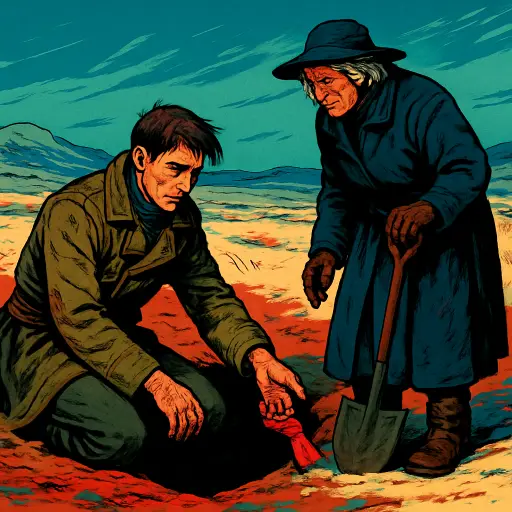
He crouched beside a post nearly buried in snow. Three strands of blue yarn clung to a splinter.
“He didn’t leave it by accident.”
From that post, a traveler could look down toward the ovens or continue toward Juniper Draw. The violin had lain on the draw side, tied where the wind could work it against the wood.
“A marker,” I said.
“For somebody coming after.”
His father had sacrificed the one possession Daniel could recognize at a glance. The thought made him press his lips together.
Farther down we found sled tracks beneath a shelf of wind-packed snow. They led toward a timber shelter used by the woodcutters, then vanished beneath a fresh slide.
A stovepipe stuck through the white slope.
Daniel shouted. No answer came.
He climbed onto the buried roof and lay flat with his ear beside the pipe. I watched his hand tighten.
“Someone’s coughing.”
We dug where the uphill wall should have been. My shovel struck a roof board, then another. Snow sifted into every hole we opened.
“Not the roof,” Daniel said. “We’ll bury them getting in.”
He crawled downhill, probing with the shovel handle until he found the lower edge of the eaves. Then he began digging sideways, on his knees.
“Here. Help me here.”
Six Sacks Between Them
The first thing through our opening was a child’s hand, red-knuckled and swollen.
Daniel caught it gently. “How many?”
“Seven,” a girl whispered. “Please don’t pull. My mother’s holding me.”
We widened the hole until Daniel could squeeze inside. I passed him the blankets and crawled after.
The shelter smelled of wet wool, cold ashes, and sickness. Three teamsters huddled along the lower wall. Lund lay under a door taken from its hinges, one leg splinted with kindling. His wife held their daughter against her.
Patrick Rusk sat beside a blackened stove. His boots were wrapped in sacking. When Daniel touched his shoulder, he raised both hands as though apologizing.
“I meant to get back.”
Daniel knelt so sharply the floorboards shook.
“You old fool.”
“Road fell in behind me.”
“You old, miserable fool.”
Patrick reached for his son’s sleeve and held it.
We gave them hot water before food. Daniel melted snow over our coals while Lund’s wife told us how a loaded sled had overturned against her husband. Then the storm shut them in. Patrick had come first with biscuits, seen what was needed, and returned to camp.
“He said he’d fetch flour,” she whispered. “I told him nobody would lend it.”
“They didn’t,” Patrick said.
I looked at the six sacks beneath the bunk. Two had been emptied. The rest were still tied.
“Why didn’t you tell us?”
“I told Dyer.” His cracked lips moved against the cup. “He said bring Lund up and he could buy his own.”
Outside, snow pattered into our tunnel.
Daniel looked up. “We need help. Today.”
I had hoped he would ask something else of me.
“I’ll go,” I said.
He gave me his discharge paper. On its blank reverse he wrote with Lund’s pencil.
Seven alive. Bring doors for sleds, shovels, rope, and food. The flour is here. So is my father. Daniel Rusk.
What Came Home
I reached camp near dark with one boot unlaced and blood dried beneath my nose. Dyer met me outside the boardinghouse.
“Did you find it?”
I handed him the paper.
He read the first line twice. Then he folded it small.
“The weather’s turning,” he said.
I took his store key from the ring hanging at his belt. He was too surprised to stop me.
“Then we had better hurry.”
By lantern light we took rope, bacon, candles, and every blanket he stocked. I wrote each item down. That mattered afterward. It mattered then, too; I wanted no man to find an excuse to turn back.
Dyer came with us. I cannot say whether shame brought him or the sight of his customers carrying off his goods. He pulled a door sled the whole way and did not complain.
We brought everyone out by noon the next day. Lund lost three toes. Patrick lost two. Daniel carried the little girl on his back while her mother walked with one hand hooked through his belt.
When Patrick came through the camp, somebody began cheering. He turned his face into his blanket.
There was an accounting afterward. Dyer admitted Patrick had told him about the stranded party. He forgave the flour, though Patrick insisted on paying for the forced shutter.
“I broke it,” he said. “No misunderstanding there.”
Daniel stayed. He worked at the mill when it opened, and that spring he married Lund’s widowed sister, who could make him laugh without asking about the Army.
For years I thought the violin had been ruined beyond saving. But a cabinetmaker in Virginia City fitted it with a new neck and patched its split belly.
Patrick tried it in my kitchen.
“Ugly voice now,” he said.
Daniel leaned back, his chair tipped against the wall.
“Play it anyway.”
And he did.