
One Broken Violin String Against the Rio Grande


Listen to this story · narrated, 10 minutes
The Mare at the Window
Tomás made me promise while his mare was eating the stuffing out of his mattress.
She had pushed her head through the open window, past the vinegar cloths and the flies, and found a seam worth worrying. Tomás watched her with the one eye he could still open.
“Bring her back to Teresa,” he said.
“Bring her back from where?”
“Wherever you take her.”
Outside, three hundred sheep crowded his corrals above the Rio Grande. It was June of 1887, and the river was running brown with mountain snow. A wool buyer waited near Socorro, thirty miles south. Tomás had contracted to deliver the flock there by Friday. His daughter would arrive Saturday to settle his affairs.
“Sell the sheep,” he whispered. “Pay Romero. What’s left belongs to her. But not the mare.”
I pulled a tuft of mattress wool from the animal’s lips. “I’m a fisherman, Tomás.”
“You used to ride.”
“I used to have teeth enough for jerky, too.”
His fingers tightened around my wrist. They were hot and astonishingly light.
“Promise me, Rafael.”
I had known him forty years. I promised.
He died before the mare finished chewing.
Under his cot lay a violin in a cracked leather case. Its neck was split, its bridge missing, and three strings curled loose like pig bristles. Years earlier, a wagon wheel had caught it when Tomás came home from a dance. After that, he had played only one thin string while Teresa sang.
I put it beside his boots for her.
Then I went outside to inspect my inheritance of trouble: one hired boy, three hundred thirsty sheep, a delivery contract, and a bay mare who laid back her ears when I approached.
“That’s Canela,” the boy said. “She doesn’t like strangers.”
“Neither do I,” I told her. “We’ll begin there.”
What the River Took
By morning I had learned that sheep could find a hole in any fence except the one you wanted them through.
The boy, Andrés, worked the corrals while I read Tomás’s papers at the kitchen table. Romero held a note against the flock, due Saturday. The buyer’s contract promised enough to clear it, pay Andrés, and leave Teresa something besides a burial bill.
Delivery was everything. After Friday, the buyer would leave for the railroad with somebody else’s sheep.
I saddled Canela. She swelled her belly against the cinch, stepped on my boot, then stood quiet when Andrés handed me Tomás’s coat.
“She knows the smell,” he said.
I tied the coat behind the saddle.
We started south before sunrise, Andrés walking the rear with two rangy dogs. The flock flowed between the greasewood in a dusty, complaining stream. My knees soon felt packed with broken crockery.
At noon we reached the usual ford.
There was no ford.
The river had swallowed the gravel bar and was dragging whole cottonwood branches through water the color of liver. On the opposite bank, a stranded fence post nodded with every surge.
Andrés took off his hat. “Bridge is twenty-two miles upstream.”
“We wouldn’t reach the buyer before Sunday.”
“Then we lose the sale.”
I dismounted slowly enough to disguise the pain.
For nineteen years I had fished this stretch, selling catfish and carp from a flat-bottomed boat. Half a mile downstream, an old channel curved behind a wooded island. In low water, it held stranded pools. Now it might offer shelter from the main current.
“We’ll look,” I said.
Andrés stared at my white whiskers. “You know sheep drown?”
“So do fishermen.”
I left him with the flock and rode downstream, listening past the water’s roar for the softer sound of a place we might cross.
The Price of a Crossing
The old channel was running knee-deep over firm sand. Beyond the island, the main channel had spread wide and shallow around a new gravel tongue. It was dangerous, but not foolish—provided we crossed before the river rose again.
I rode every yard of it twice. Canela picked her footing better than I could have asked.
Back at the flock, Andrés was holding my saddlebag.
“Why bring this?” He lifted the violin case.
“Teresa’s coming to Socorro. I didn’t want to leave it in an empty house.”
He opened it. “My uncle mends guitars.”
“Your uncle here?”
“No.”
“Then let’s mend our crossing.”
We cut willow poles and marked the firm route. I stripped to my drawers, tied my boots around my neck, and walked ahead of the first sheep. The water bit my shins with sand.
Canela followed on a lead rope. Andrés and the dogs pressed from behind.
The first dozen balked. Then one ewe splashed forward, and the others crowded after her so eagerly I had to beat them sideways with my hat to keep them from trampling a fallen lamb.
By midafternoon, two hundred were across.
Then a cottonwood struck the upstream end of the island.
I heard its roots grind against buried stones. Water surged through the brush, carrying sticks and yellow foam. The remaining sheep scattered along our bank.
One dog plunged after them. Andrés went waist-deep trying to catch a lamb.
“Back!” I shouted.
Canela jerked the lead rope from my wet hand.
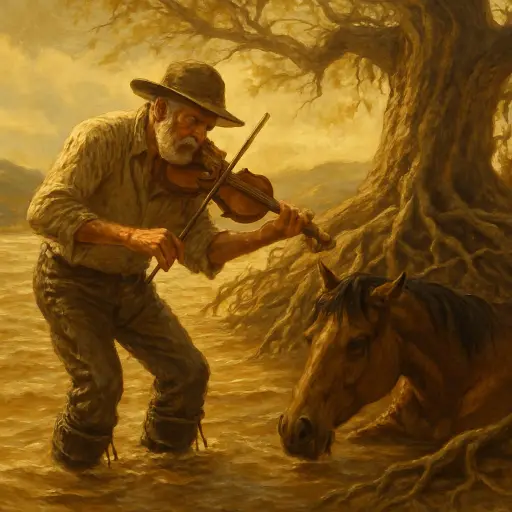
She lunged toward the boy, found the edge of a scoured hole, and vanished to her shoulders. Her saddle rolled sideways. For a moment I saw only her ears.
Then her head came up downstream, and the loose reins caught fast in the fallen tree.
One Thin String
I reached her by crawling along the cottonwood’s trunk. Each movement drove bark into my bare knees.
Canela’s nostrils flared above the current. The reins had drawn her bit hard against her mouth, and one foreleg thrashed among submerged branches.
I cut the reins. She surged backward, but the saddle skirt was wedged beneath a limb.
“Knife!” Andrés called.
“Stay out!”
I slashed the latigo until the saddle loosened. The river took it at once.
Canela twisted free and struck for the island. She gained a narrow shelf of sand beneath the roots, trembling, with water pouring from her belly.
There was firm ground ten feet above her. Between them lay a steep tangle of branches. She would not climb.
I pulled. She planted herself.
“Come on, you expensive old woman.”
She rolled an eye at me.
Across the channel, Andrés held up the coat. “Maybe this?”
“Bring it around the shallows. Carefully.”
He came with the coat and saddlebag held above his head. While I rubbed Tomás’s sleeve beneath her nose, the violin case fell open on the sand.
Canela turned toward it.
I remembered summer evenings outside Tomás’s kitchen: his scraped-out tunes, Teresa singing, that mare standing loose by the door to receive apple peelings.
“Give me the bow.”
“It’s broken.”
“Everything here is broken.”
I wedged a willow chip beneath the surviving string. The bow hair hung slack, so I caught it against the stick with my thumb and drew it across.
The noise was dreadful.
Canela lifted one foot.
I backed up the bank, sawing at that string. She followed the familiar irritation through the branches, scrambling once, then standing beside me on solid earth.
I laid my forehead against her wet neck.
Below us, six drowned sheep turned slowly in the eddy. Farther downstream, others struggled onto a bank we could no longer reach.
What Came Home
We delivered two hundred and sixty-three sheep on Friday evening.
The buyer counted them twice, examined their feet, and deducted for the missing animals exactly as the contract allowed. I stood beside Canela holding a bridle made from my belt and a length of rope.
After Romero’s note and Andrés’s wages, Teresa would receive eleven dollars and forty cents.
My ruined saddle had belonged to Tomás. I put that on the list, too.
Teresa arrived Saturday carrying a small carpetbag. She had her father’s square fingers and none of his patience for ceremony.
“Where is he buried?” she asked.
I told her. Then I gave her the money, the papers, and my account of the crossing. She listened without interrupting, though she pressed her lips together when I named the lost sheep.
“I’ll make up something,” I said. “My boat ought to fetch twenty dollars.”
“Did you cause the river to rise?”
“No.”
“Then keep your boat.”
I brought Canela from behind the livery stable. Teresa set down her bag.
The mare crossed the yard so quickly I nearly lost my belt. Teresa caught her face in both hands and put her cheek against the white star on her forehead.
For a while, neither moved.
“He made me promise,” I said.
“Of course he did.” Her voice caught. “He never could give a man a simple errand.”
I handed over the violin last, ashamed of the muddy case and my willow bridge.
“I’m afraid I made it worse.”
She drew the bow across the string. Canela nosed her shoulder.
Teresa looked from the mare to the battered instrument. Then she laughed, wiping her face with her sleeve.
“You got it working again.”
She had come intending to sell everything. Instead, she hired Andrés for another month and asked me to show her the ranch accounts.
I agreed, provided she did the riding.
That evening I went home with my empty saddlebag. Before dark, I pushed my boat into the river and caught enough supper for three.
More Western Short Stories

Fletcher Malone: The Savior of Dusty Ridge
- 4 min read

The Legend of Dusty McCoy: A Gunslinger in Coyote Creek
- 5 min read

Silent Creek: A Tale of Legends and Destiny
- 4 min read

The Mysterious Stranger of Dusty Creek
- 4 min read

The Keeper of Tumbleweed Junction
- 4 min read
The Enigmatic Whisper of Dusty Hollow
- 4 min read

The Legend of Dusty Canyon
- 4 min read
Lonnie McGraw: A Cowboy's Redemption in Red Bluff
- 4 min read


