A Peach Stone Worth Carrying
A cattlewoman carries her mother’s promise toward Abilene, with a flood and an estranged brother ahead.
- Western
 By Storyleo Editorial
- 7 min read
Listen to this story · narrated, 10 minutes


The Peach Stone
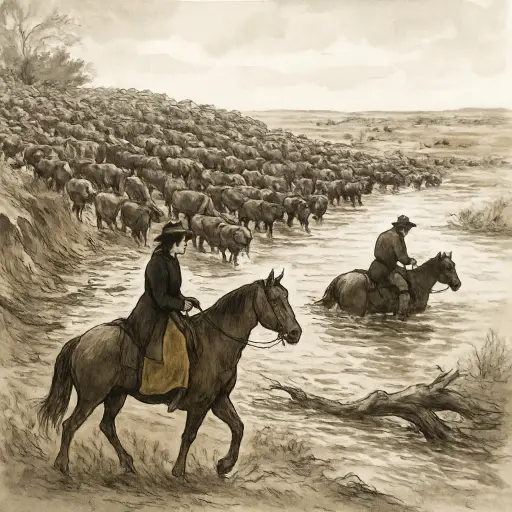
Clara Morrow had nine hundred cattle behind her, thirty hours to reach Abilene, and a brother who had just called her a fool in front of the hands.
“Say it quieter,” she told him, “or say why.”
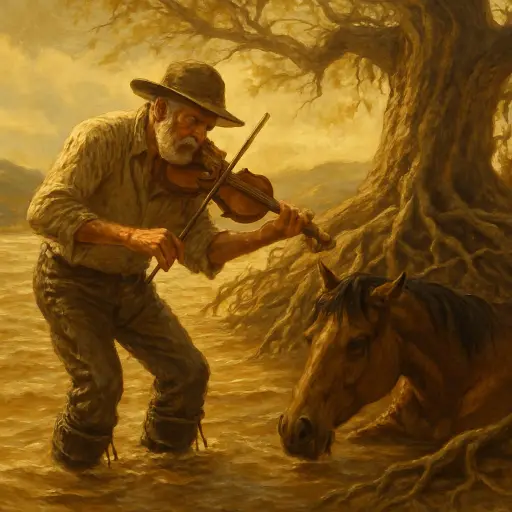
Wesley pointed across the Solomon River. A cottonwood trunk rolled through the brown water, its roots turning like a wheel.
“That’s why.”
The steers crowded the bank, bawling. Their hides smelled of warm dust and the sour mud churned up by the leaders. After two months on the Chisholm Trail, Clara could hear trouble beginning before a single horn swung.
“Hold them back,” she said.
Wesley waved the point riders away from the water. He had their father’s shoulders and none of their father’s patience. She had hired him in Texas because he knew cattle, not because seven years of silence had become comfortable.
The sale agreement lay inside her saddlebag. Eight hundred and fifty head delivered before noon tomorrow, at the buyer’s Abilene pens. After that, the guaranteed price expired.
The outfit had borrowed against that price.
Clara put her hand into her coat pocket and found the peach stone. Its ridges fitted her thumb as neatly as the worn grip of a tool.
Wesley noticed.
“You still carrying that?”
“Mother said there ought to be a tree wherever we settled.”
“She said plenty.”
Clara withdrew her hand. “There’s a crossing upstream.”
“Six miles. Might be worse.”
“Then ride and look.”
He stayed beside her long enough to make the order sting them both. Then he turned his horse.
The cook, Mr. Tatum, watched him go from the wagon seat.
“Your brother’s got a useful objection,” he said.
“He generally does.”
“Pity he delivers it like a shovel to the teeth.”
Clara almost smiled. Across the river, Kansas grass bent northward in a dry wind.
The Broken Bank
Wesley found the upper crossing choked with brush and came back with his horse sweating white beneath the cinch.
They could wait for the river to fall, or try the gravel shallows downstream. Neither choice would put the herd in Abilene by noon unless they drove part of the night.
Clara listened without interrupting.
That irritated him more than an argument. At sixteen she had thrown a skillet after him when he left. At twenty-three she kept accounts in a steady hand and paid his wages on Saturdays.
“We swim the leaders here,” she decided. “Let the others follow. Wagon downstream at the shallows.”
“You take the wagon.”
“I take the cattle.”
He looked toward the bank again. A shelf of earth had fallen away while he was gone.
“Stay above that cut.”
“I can see it, Wesley.”
The first steers balked. Then a red ox stepped forward, water climbing his brisket, and the herd began pouring after him.
Wesley rode below them, keeping the swimmers turned. Water slapped cold through his trousers. Above the bawling came Clara’s voice, low and regular, urging the next bunch in.
Then the bank broke.
Her horse plunged sideways. Clara kicked free, struck the water shoulder-first, and disappeared beneath a floating branch.
Wesley drove his horse toward her hat.
She surfaced coughing. He caught her coat and hauled until she could grip his stirrup leather. Together they reached gravel.
“Horse?” she gasped.
“Swimming.”
“Bag?”
Her saddlebag had torn loose. It bumped against the branch twenty yards out, one leather flap showing.
She stood too quickly and fell to one knee.
“The agreement’s in there.”
Wesley stripped off his spurs.
“Don’t,” she said.
He was already wading back.
The Wet Paper
Clara watched her brother swim with his head high and his boots dragging him down.
She wanted to shout instructions. Instead she caught the rope Mr. Tatum brought from the wagon and made a loop, though Wesley was much too far away to reach it.
He caught the saddlebag.
The branch rolled.
For several seconds she could see only his hand.
“Let it go!”
He surfaced beyond the branches, struggling toward the gravel. She ran along the bank until he found bottom, then went in waist-deep and took his arm.
On shore he vomited river water.
Clara knelt beside him with the useless rope still around her wrist.
“You left once,” she said. “You don’t get to do it that way.”
He coughed again. “Wasn’t my intention.”
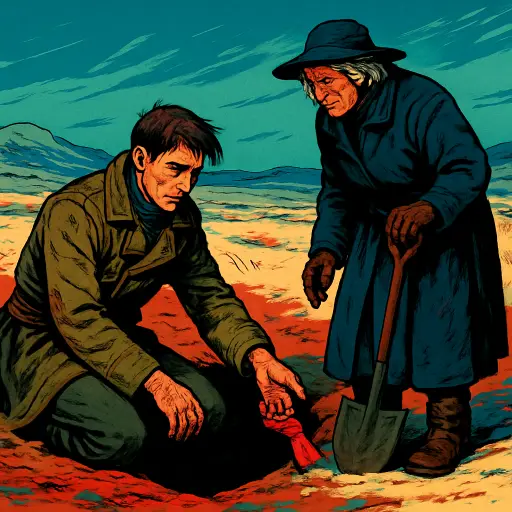
The agreement was wet but legible inside its oilcloth. Her pocket, however, had turned inside out. The peach stone was gone.
She searched the gravel while Wesley pulled off his boots.
“Leave it,” he said.
“It was hers.”
He rubbed water from his face. “It came out of the preserving kettle.”
Clara stopped moving stones.
“What?”
“That last summer. She saved it after making preserves. It was boiled, Clara. It wasn’t going to grow.”
“You knew?”
“I told her.”
“And she gave it to me anyway?”
He stared at his empty boot. “She wanted you thinking past the funeral.”
The cook called from above them. The cattle were across, scattered but held. They had lost nearly three hours.
Clara stood. Her wet skirt dragged at her knees.
“You could have written,” she said.
Wesley nodded.
“Seven years. You could have written something.”
“Yes.”
She waited, but he offered no excuse. At last she picked up the saddlebag.
“Get your boots on. We’ve still got cattle to sell.”
The Night Herd
By sunset, Wesley could feel every swallow scrape his throat.
The cattle moved slowly over the grass, their shadows stretching ahead of them. Nine hundred tired animals could not be hurried like a wagon team. Push them too hard and they would scatter; crowd them in darkness and one frightened steer could set the whole herd running.
Clara divided the riders into short watches. Men ate beans in the saddle and handed their cups back to the cook without stopping.
“We’ll lose weight off them,” Wesley said.
“Less than we’ll lose off the price.”
He rode beside her a while.
“I left because I could,” he said finally.
She kept watching the cattle.
“That’s about the size of it. Mother needed nursing. Father was dead. You knew where everything was kept, what everybody owed. I told myself you managed better without me.”
A steer rubbed against another, horns scraping with a dry clatter.
“I did manage,” she said. “That isn’t the same thing.”
“I know it now.”
“You knew it then.”
He looked down at his saddle horn. “Yes.”
For a mile they heard only hooves, leather, and a rider singing somewhere behind them.
Then Clara said, “Take the left flank. Those young cattle keep turning.”
It was work, not forgiveness. He was grateful to have it.
Near midnight a jackrabbit burst from beneath a steer’s feet. The animal wheeled, knocking horns against its neighbor.
Wesley moved at once, turning the first frightened cattle inward before the disturbance could spread. Across the herd, Clara began singing.
Her voice was thin with exhaustion. He joined it.
Other voices followed, ragged and sleepy. The cattle settled into their shuffling walk.
When the eastern sky paled, Clara came alongside him.
“You sing worse than you used to.”
“Had no call to practice.”
“You’ll have plenty. Take another verse.”
The Nursery Trees
At eleven that morning, Clara rode into the buyer’s pens with mud dried stiff on her skirt and no feeling in two fingers of her left hand.
The counting took forty minutes.
Eight hundred and eighty-three head passed through the gate. Behind them, Mr. Tatum brought the wagon and a lame steer tied to its tailboard.
The buyer examined the agreement.
“Looks like somebody washed this.”
“River did,” Clara said. “The figures are unchanged.”
He paid the agreed price.
Only when she had the draft in her hand did Clara sit down on a feed trough. Wesley stood nearby, holding both their horses. His eyelids were swollen from dust and lack of sleep.
She counted his wages, then added the rescue bonus she intended to pay every hand.
“I won’t take extra for fetching your bag,” he said.
“It’s for bringing the herd through. Don’t make me sorry I offered.”
He took it.
That afternoon Clara found him outside the livery with two small peach trees, their roots wrapped in damp sacking.
“Nurseryman had them on his wagon,” he said. “Says both are good varieties.”
She touched a leaf. It was dusty, soft as the inside of a wrist.
“You bought two?”
“One might die.”
“That’s a cheerful present.”
He shifted the bundle. “I thought I might help plant them. If you still mean to buy that place.”
Clara looked at his hands around the roots. They were scraped raw where he had caught the branch.
“There’s fencing needed before planting,” she said. “And a well to clean.”
“I can do that.”
“You’d be paid.”
“All right.”
She took one tree from him, dividing the weight.
“And Wesley?”
He waited.
“If you want to leave, tell me.”
“I will.”
They carried the trees to the wagon. Clara laid hers beneath the seat, where the roots would stay shaded, and went to fetch water.