A Land Thief Drinks From a Widow’s Horse Trough


Listen to this story · narrated, 9 minutes
The Man in the Trough
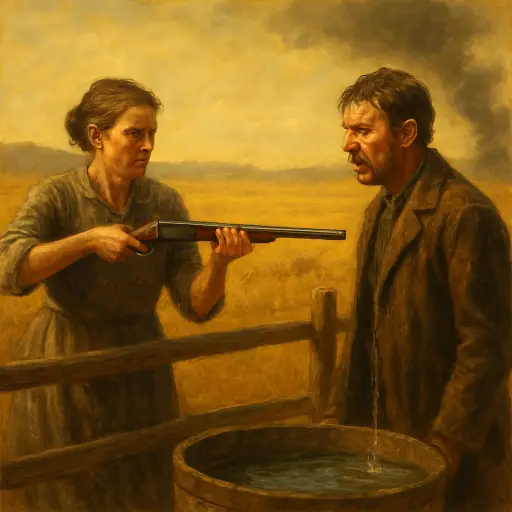
Ruth Voss found the man who had sold her husband three hundred acres of somebody else’s land drinking from her horse trough.
She laid a shotgun across the fence.
“Take your face out of there, Mercer.”
He straightened slowly. Water dripped from his mustache onto a collar polished shiny with wear. Beyond him, the Montana prairie lay yellow under the September sun; farther east, smoke rose where her lower pasture had been.
“I came to give something back,” he said.
“My husband’s been dead eighteen months. You’ll need a shovel.”
Daniel Mercer reached inside his coat.
“Two fingers,” she said.
He brought out an old photograph, its corners worn white. Ruth knew it: her husband beside a surveyor’s wagon, one boot on a limestone boulder, grinning as if the whole country had been made for him.
“You took that from our house.”
“From your husband’s satchel. After he paid me.”
Her thumb found the shotgun’s hammer.
“I’ve been keeping accounts for the Circle C,” Mercer said quickly. “Their foreman means to burn your hay tonight. Then he’ll have the only winter feed and the only water left along the creek.”
“He already claims the creek.”
“His map’s wrong. See the man beside your husband? Amos Pike. He surveyed this township. That rock marks a section corner. Your spring’s on your homestead, not Circle C land.”
“Then fetch Pike.”
“Fort Benton. Ninety miles, if we keep off the wagon road.”
A rifle cracked from the ridge.
The trough rang. Mercer dropped, splashing both knees into mud.
Ruth hauled him behind the stable by his collar. Across the yard, a second shot punched through her kitchen window.
“Can you ride?” she asked.
“Badly.”
“Then learn fast.”
What Could Be Carried
Mercer had imagined confession as a clean transaction: return the photograph, give warning, leave before anyone asked for money he no longer possessed.
Instead, he held two horses behind a stable while bullets clipped splinters from its far wall.
Ruth emerged carrying flour, salt, a frying pan, and her husband’s rifle. She wore a cartridge belt over her work dress.
“Where’s your stock?” he asked.
“My neighbor’s boys are driving them north. Unless somebody stops them.”
She looked toward the house once, then strapped the pan behind her saddle.
They escaped through a wash behind the corrals. By dusk the ranch was a black smudge against the sky.
Mercer turned in his saddle.
“Don’t,” Ruth said.
“Your house—”
“Watch the ground. That mare doesn’t need your help breaking a leg.”
They watered the horses in a shallow creek after dark. Cottonwood leaves clicked overhead like small bones.
Ruth passed him half a cold biscuit.
“Why’d you keep the picture?”
He could have said remorse. It would have been his first easy lie of the journey.
“Your husband wrote Pike’s name on the back. I thought it might be useful if I sold land again.”
She chewed without looking at him.
“And was it?”
“No.”
He took a folded sheet from his pocket: the Circle C’s copied township map. He had drawn the disputed boundary himself, shifting it a quarter mile west at the foreman’s direction.
“I know where to find Pike because I wrote asking him to certify this. He refused.”
Ruth stopped chewing.
“You helped them steal my spring.”
“Yes.”
She held out her hand. He gave her the map.
“You sleep on the other side of the horses,” she said.
Mercer lay awake smelling burned grass in his coat.
The Empty Canteen
By noon the next day, Ruth’s gelding had lost a shoe and Mercer’s mare was favoring one forefoot.
They walked.
The country folded into dry coulees, each promising shade and delivering another bank of loose shale. Ruth could hear the water sloshing in Mercer’s canteen. Hers had been empty since breakfast.
He offered it without speaking.
She took two mouthfuls. The tin rim tasted of rust.
“What did my husband say when he bought that land?”
Mercer watched his boots.
“That you wanted enough room to keep milk cows apart from the beef stock.”
Ruth screwed the cap on carefully.
“He wanted that. I wanted a stove that didn’t smoke.”
From the ridge behind them came the scrape of iron on stone.
Three riders.
She dragged Mercer down beneath a shelf of sandstone. His mare pulled backward, nostrils wide. Ruth caught the bridle and stroked its wet neck until it stood.
Above them, someone laughed.
“Mercer! Dodd says bring the map back and you can keep your wages.”
The Circle C foreman had sent men who expected an answer.
Mercer’s mouth opened. Ruth pressed two fingers against his sleeve.
He looked at her hand, then at the photograph protruding from her pocket.
“Dodd can come fetch it,” he shouted.
The first shot showered them with sandstone.
Ruth fired at the ridge, low, where a horse’s chest showed against the sky. The animal wheeled. A rider cursed.
“Down the wash,” she said.
They scrambled through brush, leading the horses until the bank hid them. At the first bend Mercer stopped, slipped off his coat, and flung it over a dead branch uphill.
Two shots tore through the cloth.
He followed Ruth into the next ravine in his shirtsleeves.
Behind them, his coat kept a man occupied for another precious minute.
The Surveyor’s Hands
Mercer reached Fort Benton with bleeding heels and six dollars stitched inside his waistband.
He had not mentioned the dollars. When Ruth sold her saddle to pay for a doctor to examine the mare, he stood beside her feeling the little hard roll against his belly.
He cut it loose before they left the livery.
“There’s this.”
She counted it.
“You might have remembered yesterday.”
“Yes.”
She bought bread, cheese, and two beds at a boardinghouse. Mercer waited while she took the better room.
They found Amos Pike repairing a warehouse scale near the river. His fingers were knotted, his thumbnail black from an old hammer blow.
He studied the photograph in the doorway.
“Voss,” he said. “Good fellow. Fed my whole crew when our wagon axle went.”
Ruth touched the edge of the picture.
“Can you prove where his spring lies?”
Pike fetched a leather field book from a locked chest. Mercer watched him turn pages dense with bearings and distances.
“Here. Spring branch, thirty-seven chains east of the corner. Well inside the homestead.”
“Will you swear to it?” Ruth asked.
“Certainly. Who moved it?”
Mercer put the copied map on the bench.
“I did.”
Pike’s finger stopped above the ink.
Outside, wagon wheels rattled over the hard street. Somewhere along the levee, men were unloading freight with a great deal of shouting.
“I’ll need your statement too,” Pike said.
Mercer looked toward the open door. Six dollars had bought him supper, but Fort Benton offered other possibilities: boats, freight outfits, strangers.
Ruth moved aside. She left the doorway clear.
He sat down.
“Have you got paper?”
Pike took a clean sheet from the chest.
“Start with your proper name.”
True Measure
Ruth returned to the ranch twelve days later with Pike, a deputy sheriff, and Mercer riding a borrowed mule.
The house still stood. The hay did not.
Its blackened foundations gave off a sour smell when her boot disturbed the ash. Someone had shot the pump handle apart. On the porch, her blue enamel coffee pot lay flattened beneath a wagon track.
The deputy examined it, then looked toward the ridge.
“Dodd’s in custody,” he said. “We’ll see what the men he sent have to say.”
Ruth nodded. Arrests would not feed cattle.
Pike’s sworn survey had secured an order against interference with the spring while the boundary dispute went before the court. Mercer’s confession had supplied names, payments, and the location of the Circle C account books.
It had also supplied enough evidence to charge Mercer.
He would return with the deputy that evening.
Before noon, Pike found the limestone corner beneath a fall of earth. Ruth knelt and brushed it clean with her sleeve.
There was her husband’s boot rest. There were the surveyor’s marks.
She set the photograph against the stone.
“Stand there,” she told Mercer.
He hesitated.
“I’m not putting you in his place. Hold the measuring chain.”
Pike handed him one end. Mercer walked east through the brittle grass while Ruth carried the other.
At the spring, water pushed clear sand into small, trembling heaps. She crouched and drank from her hands.
Mercer stood a little distance away, the chain slack between them.
“When they’re done with me,” he said, “I’ll try to pay you back.”
Ruth wiped her mouth.
“Pike says he needs a chainman next season. If you’re out.”
Mercer looked back across the measured ground.
“Would you trust that?”
“No,” she said. “I’d check.”
Then she picked up her end of the chain and pulled it straight.
More Western Short Stories
One Broken Violin String Against the Rio Grande
- 7 min read
- Audio

Fletcher Malone: The Savior of Dusty Ridge
- 4 min read

The Legend of Dusty McCoy: A Gunslinger in Coyote Creek
- 5 min read

Silent Creek: A Tale of Legends and Destiny
- 4 min read

The Mysterious Stranger of Dusty Creek
- 4 min read

The Keeper of Tumbleweed Junction
- 4 min read

The Enigmatic Whisper of Dusty Hollow
- 4 min read

The Legend of Dusty Canyon
- 4 min read