The Kite Would Not Fit the Truck
Forced to leave her schoolhouse, a retired teacher finds unexpected help with her husband's fragile kite.
- Sad
 By Storyleo Editorial
- 4 min read
Listen to this story · narrated, 7 minutes

The Bamboo Frame
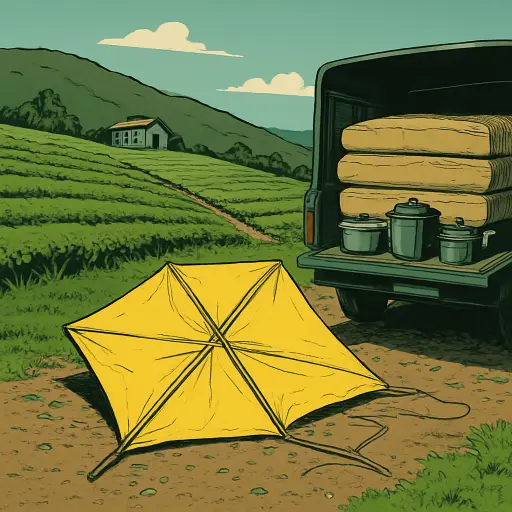
Mrs. Selvaratnam had got the kite halfway through the truck’s doorway when one of its bamboo ribs snapped.
“Stop pulling,” she said.
The woman on the other side let go. Yellow tissue shivered against the retired teacher’s face. Beyond it, the tea bushes lay in clipped green rows, and the factory siren sounded across the valley.
“I wasn’t pulling,” the woman said. “You were pushing.”
At seventy-four, Mrs. Selvaratnam disliked being corrected almost as much as she disliked needing help. She eased the kite back onto the gravel.
The estate truck would take their belongings to the new housing beyond Hatton. Her old schoolhouse, where she had been allowed to live after retirement, stood inside the boundary of an unstable slope. There was a red cross on its door now.
The other woman’s quarters had one too.
“We have until noon,” the driver called. He went down to the factory for his clearance papers, leaving them beside a load of mattresses and cooking pots.
“Leave it,” the woman said gently. “There’s nowhere to put something that size.”
Mrs. Selvaratnam knelt. Her knees struck gravel through her sari.
Her husband had built the kite thirty-two years earlier for a school demonstration. Since his death, it had hung above her bed, its long tail gathered over a nail.
“Then I’ll take it apart.”
The woman set down her bundle.
“You’ll need someone to hold the joints.”
“What is your name?”
“Parvathy.”
“I’m—”
“I know who you are, Teacher.”
The Red Thread
They carried the kite into the empty classroom. Without desks, it smelled of cold cement and the pale rectangles left beneath cupboards.
Parvathy held the frame while Mrs. Selvaratnam picked at its bindings. Her fingers, once quick enough to catch a boy exchanging examination papers, could barely lift the thread.
“Scissors?” Parvathy asked.
“The bamboo will split if we cut carelessly.”
“Then let me.”
From the knot of her bundle, Parvathy took a small blade. She slipped its edge beneath the binding and lifted. The thread parted without a scratch on the bamboo.
“How long did you pluck?” Mrs. Selvaratnam asked.
“Since I could reach.”
Outside, women were moving between the tea rows, their collecting sacks pale against their backs.
“Were you at this school?”
“No.”
“The upper division school?”
Parvathy shook her head.
Mrs. Selvaratnam looked at the grey roots along the woman’s parting. They could not be far apart in age.
“There were classes here for adults. I taught them myself.”
“At six.”
“Yes.”
“I still had water to fetch at six.”
The teacher pulled too sharply. A triangle of yellow paper tore free and settled between them.
“I’m sorry,” she said.
Parvathy smoothed the torn edge with a thumbnail.
“We can mend this.”
Mrs. Selvaratnam had meant something larger, but she fetched the flour paste left from packing. Together they laid the yellow tissue flat. Parvathy’s hands moved steadily over the fragile paper while the teacher held it still.
The Tea-Bush Wind
Under the paper lay a date in her husband’s small handwriting. Mrs. Selvaratnam touched it, then covered it again.
“Did it fly well?” Parvathy asked.
“I don’t know.”
Parvathy looked up.
“Sports day was cancelled. Then the inspector came. After that, my husband became ill.” She dipped a finger into the paste. “There was always something.”
They worked without speaking for a while.
When the kite was mended, Parvathy lifted it upright. Through the open windows came a dry rushing sound: wind passing over thousands of stiff tea leaves.
“We should try it,” she said.
“We’ve just repaired it.”
“Yes.”
Mrs. Selvaratnam glanced towards the factory road.
“Before he comes back,” Parvathy added.
They took the kite to the strip of grass above the school. The teacher held the spool while Parvathy carried the frame downhill.
“Now?”
“Wait.”
The wind lifted the loose end of Mrs. Selvaratnam’s sari.
“Now.”
The kite rose, turned violently, and struck a tea bush.
Mrs. Selvaratnam shut her eyes.
“Not broken!” Parvathy called.
She freed it and examined the string.
“This knot needs moving.”
“My husband measured it.”
“Perhaps the paper was heavier then.”
Mrs. Selvaratnam almost objected. Instead she watched Parvathy shift the bridle by the width of a finger.
On the next attempt, yellow paper climbed beyond the school roof.
The spool jerked. Parvathy hurried uphill and put both hands around the teacher’s.
“Give it a little,” she said. “Not everything.”
The Pencil Stub
The kite steadied above them. Sunlight passed through its patched skin, showing every bamboo rib.
Mrs. Selvaratnam waited for grief to spoil it. For several breaths there was only the pull against her palms, and Parvathy’s warm shoulder beside hers.
Then she turned towards the schoolhouse, where her husband ought to have been standing.
“He made a good thing,” Parvathy said.
The teacher nodded, unable to answer.
Below them, the truck sounded its horn.
They brought the kite down slowly. This time, Mrs. Selvaratnam helped loosen the bindings. The paper could be rolled around the bamboo; they knew now how to put it together.
At the truck, Parvathy searched among the bundles for her allocation slip.
“Can you tell me which house?” she asked.
Mrs. Selvaratnam read it aloud. Their new homes were in different rows, but only a short walk apart.
She found a pencil stub in her handbag.
“May I write your name on the kite? We both repaired it.”
Parvathy held out her hand for the pencil.
“Show me.”
On a scrap of packing paper, the teacher wrote the Tamil letters large and clear. Parvathy copied them onto the folded tail, stopping at each turn.
The driver started the engine. Neither woman looked up.
When it was finished, Parvathy touched the name with one rough fingertip.
“Is that right?”
“Yes.”
“I’ll need to do it again.”
Mrs. Selvaratnam put the pencil into her hand.
“Come tomorrow.”
Then they climbed into the truck, carrying the kite between them, and left the school standing empty in the sun.