The Mother He Promised a Living Son
Snowbound with a mother he deceived, a former swindler faces the hope his letters created.
- Sad
 By Storyleo Editorial
- 4 min read


Listen to this story · narrated, 6 minutes
The Face Across the Table
The woman whose son I had brought back from the dead offered me half a boiled egg.
“Take it,” she said. “We aren’t moving before morning.”
Beyond the carriage window, snow stood level with the bottom of the glass. Somewhere ahead, a clearing engine was digging toward our train. The wheels had been silent for six hours, but the spoon in her tea glass still trembled when she lifted it.
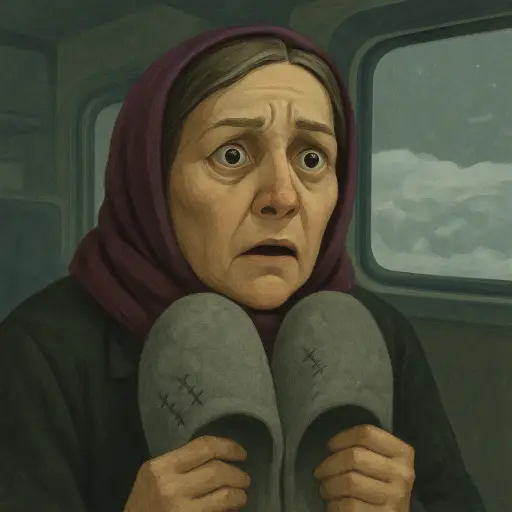
I recognized her from the photograph she set beside the salt: herself outside a wooden house, holding the arm of a broad-faced young man. He wore a miner’s jacket. She wore the same plum-colored scarf she wore now.
I had studied that photograph while writing letters in his name.
“Your family?” I asked.
“My Nikolai.” She pushed the egg closer. “You have children?”
“A daughter.”
“Going to see her?”
I touched the envelope inside my coat. Three months of wages from unloading fish in Omsk. Honest money, smelling faintly of herring despite the soap I had scrubbed into my hands.
“If she’ll open the door.”
The woman nodded without asking why she might not.
Her name was Galina Petrovna. I knew that already. I also knew what she had received for her house, and how much of it I had taken to arrange the rescue of a son buried beneath a collapsed mine.
“And you?” I asked.
She straightened the photograph.
“I’m going to bring my boy home.”
The Warmest Carriage
I had stopped cheating people in April. There had been no revelation. My daughter had returned a parcel unopened, and I had recognized the careful way she had covered my name with hers.
Since then I had rented a bed, carried crates, and practiced answering ordinary questions without improving the answers.
But before April, I had given Galina Petrovna another man’s address in Chita. He supplied my letters with official stamps. Apparently he was still using them.
“They’ve found him a place in a recovery hospital,” she said. “His memory comes and goes. That explains why he never telephoned.”
I had written that explanation.
She unwrapped two felt slippers, enormous and neatly darned.
“His feet always get cold.”
The carriage attendant came through with hot water. Cold air followed her from the vestibule, carrying the sharp smell of snow and coal smoke.
“Keep your blankets,” she told us. “We’re moving everyone forward if the heating drops further.”
Galina Petrovna tucked the slippers away.
“He won’t know I’m coming. They advised against it, but I couldn’t wait.”
I could get off at the next station. I could give her my wages anonymously. Neither would cost me the visit to my daughter that I had rehearsed through a hundred nights.
She held out the photograph.
“You’re a younger man. Does he look much changed, do you think? It’s twelve years old.”
“I haven’t seen him.”
My voice made her withdraw her hand.
Not another mile, I thought.
What I Had Written
“There is no hospital,” I said.
She put the photograph flat on the table.
I told her about the newspaper reports we searched for families, the copies of records we bought, the letters I wrote. I gave her my name: Mikhail Zorin. My real one.
She listened with her hands around her glass until I could no longer bear the small clicking of her ring against it.
“The man in Chita,” she said. “He knows where Nikolai is?”
“No.”
“But you said there was a witness. Another miner.”
“I invented him.”
Her mouth remained slightly open. She looked down the aisle, as though someone else might be available to answer.
“The identification report said everyone in that section died,” I said. “I had a copy. I don’t know anything beyond that.”
“You wrote that he asked after my knees.”
I nodded.
“That he remembered putting mustard in his father’s boots.”
“You told us that in your first reply.”
She took her hands away from the glass. There were pale grooves in her fingers.
I laid my envelope before her.
“It isn’t nearly enough. I’ll give a statement. At the next station, I’ll—”
“Stop arranging things.”
I stopped.
For a long while there was only the attendant shoveling coal at the carriage stove.
Then Galina Petrovna asked, “Did he write any of it?”
“No.”
She gathered the slippers into her lap and pressed them together, sole against sole. I sat opposite her until dawn, afraid that leaving would be one more thing I did without her permission.
His Own Words
At daylight, men outside struck ice from the couplings. Each blow traveled through the table into my elbows.
Galina Petrovna had not slept. She had put my envelope in her bag without counting the money.
“Fetch the attendant,” she said.
I did.
“This man needs the railway police at the next staffed station.”
The attendant looked at me.
“Yes,” I said.
She stayed beside us while I explained. Galina Petrovna corrected the sum I had stolen. I had forgotten two payments.
When the train finally moved, the woman turned the photograph over. Brown paper had been pasted across its back.
“The frame broke when I packed,” she said. “I found writing underneath. My eyes aren’t good enough for pencil anymore.”
She passed it across.
There were four short lines in a blunt, heavy hand. A word had been rubbed out so fiercely the surface was worn thin.
Mama, this is outside the canteen. The jacket is borrowed. I have bought my own now. Please spend the money on your teeth instead of sending it back.
Nikolai.
I read it without changing anything.
She took the picture and held it close to her mouth.
“I did get them done,” she said. “He was so pleased.”
Outside, the cleared snow rose in white walls. At the next station, police would meet me; farther east, my daughter would wait for a train I would not leave.
Galina Petrovna touched the faded pencil with her thumb.
“Again,” she said. “Only what’s there.”
I bent over the photograph, and gave her son back his words.