Nomin Bets Her Grandmother’s Quilt on Chess
A young chess prodigy sells a family quilt, then invents a thief to hide it.
- Sad
 By Storyleo Editorial
- 4 min read
Listen to this story · narrated, 6 minutes


The Red Wool Square
Nomin sold her grandmother’s quilt while Tsetseg was down at the well, and by supper she had invented a thief.
“Through the roof opening?” Tsetseg asked.
“I was fetching dung for the stove.”
“I asked how he got in.”
Nomin pushed a black pawn into the crease between two floorboards. At twelve, she could play three adults without looking at their boards. Now she could not look at her grandmother.
“The door, then.”
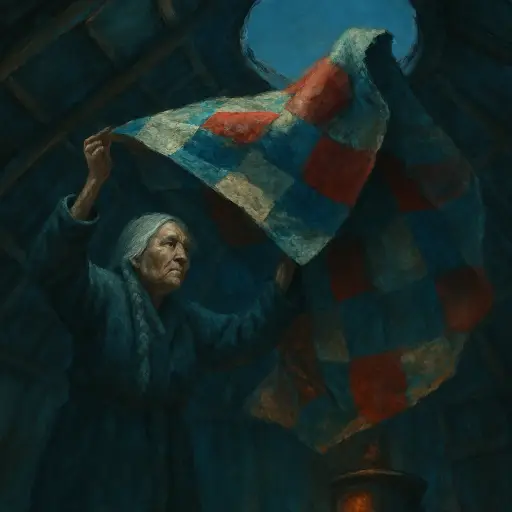
Outside, wind snapped a loose rope against the ger’s felt wall. Tsetseg stood beside the bedding chest, one hand resting on the pale rectangle where the quilt had lain.
“Perhaps you put it somewhere,” she said.
Nomin shook her head.
The buyer had come in a white van, selling batteries and plastic basins. He bought old textiles for a shop in the capital. He had counted enough money onto the table to pay for Nomin’s bus fare, tournament entry, and three nights in a hostel.
Her teacher had said there would be selectors at the tournament.
Her grandmother had said the camp could not afford it.
The quilt had seemed, beneath the buyer’s hands, merely heavy: faded silk, wool squares, cotton from clothes nobody wore anymore.
“Was your mother’s red sleeve still coming loose?” Tsetseg asked.
Nomin nodded.
Her mother had died when she was five. She remembered almost nothing of that red coat.
“I meant to mend it before winter.”
Under Nomin’s mattress, the money made a small, hard ridge.
The White Van
By morning, Tsetseg had visited all four neighboring gers.
She disliked the way people stopped their work when she mentioned the quilt. A missing cooking pot would have earned advice. This brought lowered voices and cups of tea she had no time to drink.
“Did Nomin see anyone?” asked Bat-Erdene, who drove supplies from the district center.
“Someone near the camp.”
That was what the girl had said after supper, adding a figure to her empty doorway.
“A man?”
“She thinks so.”
“There was a white van yesterday.”
Tsetseg set down her cup.
When she returned, Nomin was studying a chess problem scratched on cardboard.
“The trader,” Tsetseg said. “Did you see his van?”
A pause. Too small for most people to notice. Tsetseg had spent twelve years listening to this child breathe in her sleep.
“Yes.”
“Was he the man?”
Nomin rubbed out a square with her thumb.
“I think so.”
Tsetseg went outside before she could ask anything else. The steppe lay dry and bright; distant hills looked close enough to touch. She gripped the well’s wooden handle until a splinter entered her palm.
Ask her again.
Instead, she asked Bat-Erdene to make inquiries along his route.
That evening he brought two men who remembered the trader’s registration number. Someone suggested the police.
Nomin sat very still beside the stove.
“Wait,” Tsetseg said.
She watched her granddaughter’s shoulders drop, and wished they had not.
The Unspent Notes
On the third day, Bat-Erdene returned with dust powdered into the seams of his jacket.
“Found him. He says he bought it.”
Nomin’s hand closed around a knight.
“Says a girl sold it. I told him what I thought of that.” Bat-Erdene pulled out his phone. “He sent a picture.”
The quilt lay across a warehouse floor, beside rolled carpets and a radiator. Nomin could see the red square near one corner.
“He still has it?”
Both adults looked at her.
She set the knight down carefully. It fell anyway.
“I sold it.”
Bat-Erdene’s chair scraped the floor.
“I drove half a day.”
“I know.”
“I called that man a thief.”
She pulled the notes from beneath her mattress. They had absorbed the smell of wool and stove smoke.
“For the tournament,” she said. “I thought if I won, I could buy it back.”
Tsetseg did not reach for the money.
“And if he sold it?”
Nomin had calculated openings, bus departures, hostel prices. In every version, the quilt had waited for her.
“I didn’t think.”
“You did,” her grandmother said. “You thought about what you wanted.”
Bat-Erdene took out his phone again. Nomin heard him apologize. Then he held it toward her.
She had to apologize too.
The trader agreed to return the quilt, minus his transport costs. Bat-Erdene would collect it, if she paid his fuel.
Nomin counted out the money. What remained would not buy a bus ticket.
The Blue Cotton Hem
The quilt came back folded inside a feed sack.
Tsetseg shook it out alone. A warehouse label dangled from one corner. She cut the string, then sat with the scissors in her lap.
Outside, Nomin was carrying water, making unnecessary journeys with half-filled buckets. For two days she had done every chore before being asked. Tsetseg wanted to call her in. She also wanted another hour without having to speak gently.
At dusk, she spread the quilt over their knees.
“Find the loose stitching,” she said.
Nomin fetched the sewing tin.
They worked beside the stove. The needle made a faint tick against Tsetseg’s thimble.
“I thought you loved it because it was Mother’s,” Nomin said.
“Parts of it.”
Tsetseg turned back a blue cotton hem. Hidden underneath were tiny, uneven stitches forming a chess knight.
“You made that at eight. You said every knight needed ears.”
Nomin touched the thread.
There were other scraps: her first school shirt, a scorched cuff, the yellow cloth she had worn to win the district championship.
“I thought you were keeping her,” she whispered.
“I was keeping you, too.”
Nomin bent over the quilt. Tsetseg let her cry without finding work for her hands.
Later, she brought out a piece of plain cotton.
“For this year,” she said.
“I didn’t win anything.”
“I know.”
Nomin threaded the needle. Together they found a space, and she began stitching the blank square into the quilt.