What Would My Uncle Pay to Send Me Away?
A lighthouse keeper fights to educate his bereaved nephew under a controlling patriarch's roof.
- Sad
 By Storyleo Editorial
- 4 min read
Listen to this story · narrated, 6 minutes


The Price of Leaving
My uncle put his broken violin on the supper table, and my grandfather reached past it for the salt.
“That won’t buy you anything here,” Grandfather said.
Julián left his hand on the case. Tar had settled into the creases of his fingers. He had come straight from the lighthouse near Necochea, carrying his leave papers and a collar stiff with sea salt.
I was fourteen. My mother had been buried that morning beyond the ranch’s southern fence, where the grass grew too thin for grazing.
“She asked me to see him educated.”
“He can count wages. He can read a feed invoice.”
Outside, wind pushed dust beneath the kitchen door. I pressed my heel against the gap.
“There’s a school in Bahía Blanca,” Julián said. “Board included.”
Grandfather set down his knife.
“His mother owed me eleven years of living here. The boy can work some of it off.”
Julián stood so abruptly that his chair struck the wall. Then he looked at me and pulled it upright again.
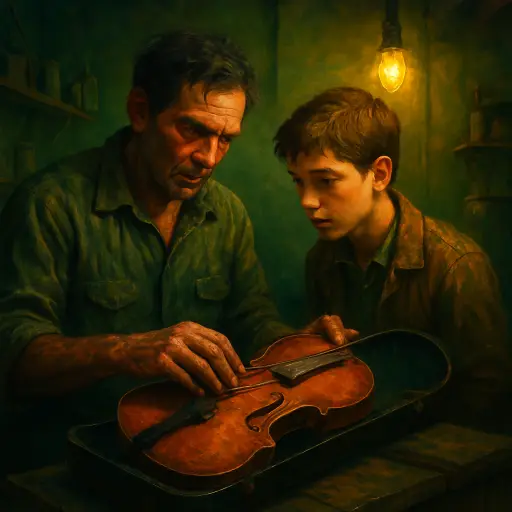
After supper, I followed him to the washhouse. Beneath the yellow bulb, he opened the violin case. The belly had split beside the bridge, and two strings hung loose.
“Did it fall?” I asked.
“Your grandfather stepped on it. Years ago, when I told him I was leaving.”
“Why bring it back?”
He touched the pale splintered edge.
“I was in a hurry when the telegram came. I brought the wrong case.”
What the Land Kept
Julián had eighteen days before another keeper would need relieving. I counted them on the washhouse wall with a nail.
He spent the mornings repairing the ranch’s wind pump. In the afternoons he rode into town to telephone schools. Each evening he returned with dust in his eyebrows and fewer cigarettes.
Grandfather watched him over his cup.
“They charge extra for orphans?”
“He isn’t an orphan. He has me.”
“Then take him.”
But Julián’s quarters were inside the lighthouse compound, and children could not live there. Boarding fees cost more than he earned in three months. My mother had left two dresses, a sewing basket, and a packet of my school reports tied with blue wool.
I had never asked to go away. I wanted to, so badly that I wouldn’t look at my uncle when he mentioned it.
On the twelfth evening, I found him outside with the violin across his knees.
“Can you play it broken?”
“Badly.”
“Could you play it before?”
“Also badly.”
I sat beside him. The iron bench still held the day’s heat.
“I could stay,” I said. “I know the work.”
He laid his palm over the strings to stop their faint rattle.
“Your mother used to say that.”
From the house came the scrape of Grandfather’s chair.
“What exactly did you promise her?” I asked.
Julián took a long time lighting his cigarette.
“That when you said you wanted something, someone would listen.”
The Keeper Without a Light
On the seventeenth day, Julián sent a telegram. The operator’s copy remained folded in his pocket until his trousers went through the wash.
REQUEST RELEASE FROM SERVICE FOR FAMILY REASONS. UNABLE TO RETURN.
I found the softened paper while hanging clothes.
“You resigned?”
He reached for a wet shirt.
“Your grandfather has agreed to pay the school directly. I’ll stay through harvest.”
“And after harvest?”
“There’s always something broken here.”
His lighthouse had running water, a wireless, and windows facing the sea. At the ranch he slept in a room beside the harness shed, where mice chewed the soap.
I went inside and told Grandfather I wasn’t going.
He continued sharpening his knife. The stone made a damp, regular hiss.
“Suit yourself.”
That was all. No argument, no relief. By supper I understood he would keep us both if I let him.
At the station, Julián handed me bread wrapped in a clean handkerchief. His left thumbnail was black from mending a gate.
“Study what you like,” he said.
“You’ll come back to the coast when I finish.”
He nodded too quickly.
“We’ll see.”
I gripped his sleeve. “Promise.”
The engine released a white blast that swallowed his answer. I asked again.
He shook his head.
“Get aboard, Benicio.”
For years, I resented him for refusing me that small comfort. I could forgive the lie I had wanted much more easily than his silence.
The Other Address
I became a doctor, though for a while I wanted to build bridges. Julián’s letters treated both possibilities with the same solemn interest.
He stayed at the ranch after Grandfather died. By then his knees troubled him, and the lighthouse position had long been filled. Whenever I offered him a room with me, he asked whether my patients would appreciate his snoring.
Then a neighbor telephoned. Julián had collapsed beside the wind pump.
I arrived after the burial. In his room, the violin lay beneath the bed, still broken. Inside its case were my letters, my school reports, and a railway timetable worn through at the folds.
A town was circled in pencil. Not Necochea. Mine.
In the bedside drawer I found a letter he had begun to me.
Benicio, about that room. If the offer still stands, I could come after the pump is finished. I wouldn’t bring much.
I sat on his narrow bed until the neighbor knocked to ask whether I needed a lamp.
“Not yet,” I said.
Years have passed. The violin is in my house now, on top of the wardrobe in the room that would have been his. My children have asked why I don’t have it repaired.
I tell them it belonged to their great-uncle, and they must be careful with it.
Then I take it down. I show them where the case opens, how to support the broken wood. I let them ask about him for as long as they like.