Don Ignacio’s Umbrella Above the River Regulator


The Umbrella That Did Not Belong to Us
The first time I saw Bautista Roldán cry, he was holding an umbrella open inside a cowshed while hail punched holes through the tin roof.
He stood among the calves with his boots in manure and water, one arm raised, the black umbrella trembling above a wooden box full of gears. His spectacles were white with steam. His hair, always combed back with machine oil, had fallen across his forehead.
“Not the regulator,” he said, as if the hail had ears. “Take the calves if you must, but not this.”
I was sixteen then, hired at Estancia La Martina to scrub pots, mend shirts, and carry mate to men who forgot my name. Bautista remembered it the first afternoon.
“Rosa,” he had said, testing the sound carefully. “Like the flower, yes, but with thorns, I hope.”
I laughed because I did not know yet that lonely men often make jokes the way cold men build fires: quickly, desperately, with whatever is near.
The umbrella was not his. Nothing fine ever was.
It belonged to Don Ignacio Pereira, the ranch owner’s nephew, who had arrived from Buenos Aires with polished boots, a silver cigarette case, and plans to modernize everything Bautista had already spent years modernizing with wire, scrap metal, and bone-deep patience.
“Borrowed,” Bautista told me, though Don Ignacio had only set it by the kitchen door for a moment before riding out to inspect the south paddock.
“That is not borrowing,” I said, wringing rainwater from my braid.
“It is borrowing before permission catches up.”
Outside, the pampas flattened itself under the storm, endless grass bent silver by wind. Inside, the calves cried. Bautista’s machine ticked inside its box like a frightened insect.
He had built it to open the sluice gates on the irrigation channels by measuring the river’s rise. Don Ignacio had built his own version with factory parts and pride.
For months they circled each other like two bulls at a fence.
“Yours will rust,” Don Ignacio said.
“Yours will require a priest and three lawyers to repair,” Bautista answered.
I pretended to dislike the arguments. In truth, I waited for Bautista’s eyes to spark. Most days they were the color of cooled ash.
That night, under the stolen shelter of a city umbrella, he looked at me and smiled with one corner of his mouth.
“Rosa,” he said, “if this works, no one on this ranch will lose a foal to flood again.”
I wanted to touch his wet sleeve. I did not.
“Then keep it dry,” I said.
So he did. With another man’s umbrella, and both hands shaking.
Gears Against Silver
Don Ignacio discovered the missing umbrella at dawn, when the storm had crawled east and left the world smelling of crushed grass, wet wool, and dung.
He entered the shed with mud on his immaculate cuffs. Bautista was asleep sitting up, chin on chest, one hand still resting on the regulator’s box. The umbrella leaned in a corner, dripping politely.
“My umbrella,” Don Ignacio said.
Bautista opened one eye. “Good morning to you also.”
“You stole it.”
“No. I enlarged its experience.”
I nearly dropped the pail I was carrying.
Don Ignacio’s jaw tightened. He was not cruel, exactly. Cruel men enjoy wounds. Don Ignacio enjoyed being correct, which can cut nearly as deep.
“A man who steals small things,” he said, “cannot be trusted with large ones.”
Bautista rose slowly. He was thirty-eight then, thin as fencing wire, with burns on his fingers and a limp from a horse accident before my time. He wiped his hands on his trousers.
“A man who sees only theft,” he said, “may miss the flood.”
The two machines were tested a week later.
Everyone came: peons smelling of leather and tobacco, cooks with flour on their arms, children running barefoot along the channel banks. Even Señora Pereira watched from the veranda with field glasses as if war had been declared.
Don Ignacio’s apparatus gleamed on its platform—brass float, imported gauge, enamel face marked in perfect black numbers. Bautista’s stood beside it, ugly and stubborn, made from a clock spring, wagon parts, and pieces of a broken windmill.
“When the water rises,” Don Ignacio announced, “my device will release the gate at precisely the required height.”
Bautista murmured to me, “His machine speaks better Spanish than most politicians.”
I covered my mouth.
They diverted water from the holding pond. It rushed into the test channel, brown and foaming. The floats lifted.
Don Ignacio’s gauge climbed smoothly.
Bautista’s contraption groaned, clicked, coughed, then held still.
Men began to snicker.
I saw Bautista’s throat move. His hand hovered near the release lever, but he did not touch it. He had made rules for the test and would not break them, not even to save himself shame.
Don Ignacio’s brass float rose to the mark.
Nothing happened.
His smile faltered.
Then Bautista’s machine gave a sound like a chicken laying an egg, snapped its gear, and flung the gate open. Water thundered through the channel.
The ranch hands cheered.
Don Ignacio strode to his device, face red, and found a grasshopper crushed in the release catch.
“Bad luck,” Bautista said quietly.
I expected triumph. He gave none.
Instead he bent beside Don Ignacio and pointed with a blackened fingernail. “If you shield this part with wire mesh, it will work. Beautifully, I think.”
Don Ignacio stared at him.
For the first time, he had no clever answer.
What the River Keeps
Respect did not arrive like a guest in a clean hat. It came limping, suspicious, with mud on its boots.
Don Ignacio began visiting Bautista’s workshop behind the shearing shed. At first he stood outside the doorway and corrected measurements. Later he rolled up his sleeves.
“Your soldering is a crime,” he said one afternoon.
“Your handwriting is a disease,” Bautista replied.
They worked until the sun slid flat and red across the pampas, turning the grass tips copper. I brought them mate, then supper, then excuses to stay.
Bautista forgot to eat when he was building. Don Ignacio forgot that he disliked dust. Together they made a warning bell for grass fires, an automatic trough valve, a wind-driven pump that squealed for three days until Bautista solved it with sheep fat and a curse.
I loved him through all of it.
Not loudly. Not in a way anyone could point to. I loved him by darning his cuffs with blue thread because he liked blue, by saving the crisp edge of bread, by learning the names of tools he misplaced.
“Rosa,” he would call, patting every pocket, “have you seen the small wrench?”
“In your left boot.”
He would look. It would be there.
“You are the only accurate machine on this ranch,” he said.
I would turn away before my face betrayed me.
That summer, the river grew strange.
The old men tasted the air and spat. Birds lifted from the reeds in black sheets. Heat pressed down so hard the cattle stood knee-deep in ponds and would not move.
Then, far away in the sierras, rain fell where we could not see it.
The river rose at night.
By morning, it had eaten half the lower pasture.
“Open the north gates,” Don Ignacio shouted from horseback. “Move the mares.”
Men scattered.
Bautista ran to the workshop, his limp worse in mud. I followed with my skirt hitched in both hands.
“The regulator can release the overflow,” he said. “But the signal line—”
“Was not finished,” I said.
He stopped and looked at me. Rain had begun, fat drops darkening the dust.
“I must go to the channel tower.”
“Then I am coming.”
“No.” He said it too quickly.
I grabbed the umbrella from beside the door—Don Ignacio’s black umbrella, still never returned after all these months of “borrowing.”
“You’ll ruin the coils if they get wet,” I said.
He stared at the umbrella and gave a small, helpless laugh.
“Rosa,” he said, “you are ferocious.”
That was the closest he ever came to saying he saw me.
The Borrowed Sky
The channel tower stood where the irrigation ditch met the river, a skeletal platform of wood and iron above brown water chewing at its posts.
Don Ignacio reached it before us. His horse was lathered white. He had tied the reins to a fence that was already leaning.
“Roldán!” he shouted over the water. “The manual gate is jammed.”
Bautista climbed the ladder with his tool satchel banging against his hip. I followed until he looked down and barked, “Stay!”
I stayed on the third rung, which was not the same as obeying.
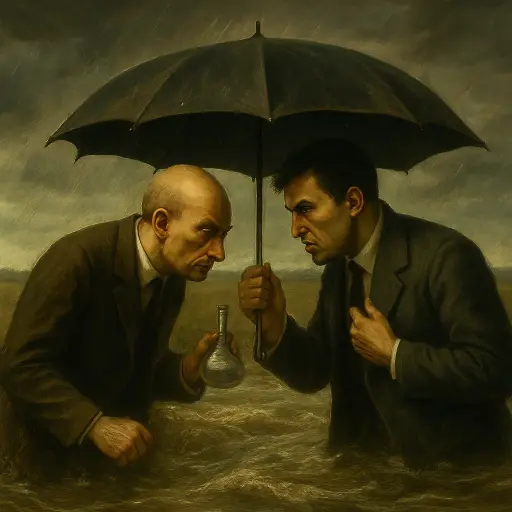
The rain thickened. It hammered the umbrella, drummed on the river, hissed in the grass. Beneath its black canopy, Bautista opened the control box and began connecting the copper coils.
Don Ignacio held the umbrella over him.
That image has lived in me longer than any prayer: the proud man from the city, soaked to the bone, one hand gripping a borrowed handle, shielding the rival he had once called a thief.
“Left terminal,” Bautista said.
“I know.”
“Not that left, the useful left.”
“I am going to push you into the river.”
Bautista laughed, then coughed. His fingers moved fast, twisting wire, tightening screws. The gate below shuddered but did not lift.
“Again,” Don Ignacio said.
“The current is weak.”
“Then take mine.”
He stripped off his leather belt, wrapped it around the bent release bar, and pulled until the veins stood in his neck. Bautista jammed a wrench into the gear teeth.
I saw the post shift.
“Bauti!” I screamed.
He turned at the sound of the name I never used aloud.
The platform dropped on one side.
Don Ignacio fell hard, shoulder striking the railing. The umbrella flew from his hand and spun upward for one absurd second, black against the white sky, then dropped into the boiling channel.
Bautista grabbed the control box. Not the railing. Not safety.
The gate groaned open.
Water burst through the overflow ditch, roaring toward the empty flats instead of the mare pasture.
The tower gave way.
Don Ignacio caught a crossbeam with one arm. I lunged up the ladder and seized his coat, screaming for help, for saints, for anyone.
Bautista hung below us, one hand locked around the strap of his satchel, the other gripping a broken plank. His spectacles were gone.
“Climb!” Don Ignacio shouted.
Bautista looked past him, toward the fields where horses were running to higher ground.
Then he looked at me.
His mouth shaped my name, but the river took the sound.
The plank snapped.
After the Water
They found the umbrella two days before they found Bautista.
It lay upside down in a stand of reeds, ribs broken, black cloth filled with river silt and little silver fish. Don Ignacio carried it back himself. He held it like something alive that had died in his hands.
No one spoke when he entered the yard.
The ranch had survived. The mares had survived. The new foals kicked their thin legs in the sun, ignorant of debts.
Bautista came back on the fourth day, caught in driftwood near the bend where children used to swim in summer. I knew him by his hands. Burned fingers. Blue thread at one cuff.
At the burial, the pampas stretched in every direction, wide and pitiless under a clean sky.
Don Ignacio stood beside me with mud still under his nails. When the priest finished, he did not cross himself at once. He stared at the fresh earth as if it were a machine he could not repair.
“He saved the ranch,” he said.
His voice broke on saved, and he turned away angrily, as if grief had insulted him.
I wanted to hate him. It would have given my hands something to hold. But I had seen him on the tower, keeping the rain from Bautista’s work with that ridiculous umbrella.
“He respected you,” I said.
Don Ignacio swallowed. “Too late.”
Weeks passed. The workshop remained locked until Señora Pereira gave me the key. Dust lay on the benches. A cup of dried mate sat by the window. On the wall, Bautista’s sketches curled at the corners.
In the center of the room stood his last machine: the improved river regulator, rebuilt from the ruined parts we had recovered.
Don Ignacio came every evening to finish it.
We worked mostly in silence. He polished. I sorted screws. Sometimes he asked where Bautista kept a tool, and I knew.
One night, he placed a small brass plate on the finished box.
For Bautista Roldán, inventor of La Martina, who trusted ugly things to work beautifully.
Below that, in smaller letters, he had added:
And for the borrowed umbrella that kept the rain off the future.
I ran my thumb over Bautista’s name until the metal warmed.
“There is something else,” Don Ignacio said.
He opened a drawer and handed me a folded paper, oil-stained and soft from handling.
It was a sketch of an umbrella stand made from old horseshoes, with a crank that opened and closed a canopy over delicate instruments. At the bottom, in Bautista’s uneven writing, was a note.
For Rosa, who notices what must be sheltered.
I sat down on his stool because my knees had forgotten their duty.
Don Ignacio stepped outside and closed the door, leaving me with the smell of iron, dust, dry grass, and him.
I did not sob. Not then.
I placed the broken umbrella in Bautista’s corner, handle down, ribs spread like a tired bird. Then I wound the regulator’s spring.
Its gears clicked once, twice, steady as a heart pretending not to be broken.
Outside, across the darkening pampas, the new warning bell rang clear.
Every animal lifted its head.
And for one breath, I imagined Bautista hearing it too, smiling crookedly, dry at last beneath a sky he had borrowed and never meant to keep.
This story was created with the help of AI writing tools and published by Storyleo Editorial.