Baba Yousuf’s Yellow Umbrella in the Spire


The Umbrella Above the Clouds
The first time my grandfather brought a fishing rod into the tallest hydroponic atrium in Dubai, security chased him past a wall of floating tomatoes.
“Baba Yousuf!” I hissed, hurrying after him in my smart heels, my staff badge bouncing against my chest. “This is the Al Masar Spire, not the creek.”
He glanced back at me, white beard split by a grin, one sun-browned hand gripping his old bamboo rod. “Fish do not read maps, Layla.”
Behind us, drones hummed between towers of lettuce. Mist puffed from silver pipes. Above, the glass ceiling curved so high that clouds brushed it like cotton dragged across a bowl.
“Sir!” shouted Hamdan Al Qasimi, the building’s operations director, striding toward us with the crisp fury of a man whose shoes had never touched mud. “You cannot bring contaminated wooden equipment into a food production zone.”
Grandfather stopped beside a shallow ornamental pool where pearl-colored koi circled beneath programmable lilies.
He bowed slightly. “Then I will catch only the clean fish.”
I pressed my fingers to my eyes. “Baba.”
Hamdan did not smile. He was young, sharp-jawed, and always smelled faintly of expensive oud and cooled metal. Everyone in the Spire feared him. He could spot a smudge on solar glass from three floors away.
“Madam Layla,” he said to me, “your guest has caused three access alerts, frightened a maintenance robot, and attempted to bait a hook with cafeteria bread.”
Grandfather lifted the bread cube. “It is za’atar manakish. Better than bait.”
Hamdan’s jaw tightened.
I loved my grandfather more than I loved my job, which was unfortunate because my job paid for his medicine, our apartment in Deira, and the cooling bill that kept his knees from swelling in summer.
“I’m sorry,” I said quickly. “He came to see the Sky Reservoir exhibit.”
“I came,” Grandfather corrected, “because your building drinks from the sea and forgets to thank it.”
Hamdan’s eyes flicked toward him. “This building produces thirty percent of its own water through atmospheric capture and desalination. We monitor every drop.”
“Monitoring is not thanking.”
The koi flashed orange beneath us. For a moment, the atrium fell quiet except for the soft breath of sprinklers.
Then Grandfather looked up at the glass roof and frowned. “Your tower is sweating wrong.”
Hamdan gave a short laugh. “Excuse me?”
Grandfather pointed with his fishing rod. “There. The condensation crawls inward, not down. Wind is trapped.”
Hamdan’s smile vanished.
I followed the rod tip. High above, near a seam in the glass, moisture trembled in a crooked silver line.
“Baba, please don’t diagnose a skyscraper.”
He patted my shoulder. “I have fixed nets older than this man’s grandfather.”
Hamdan stepped closer. “And I have seven engineering degrees’ worth of staff who will escort you out.”
Grandfather tucked the manakish into his pocket. “Then let them walk slowly. My knees are historical.”
A Man Who Read the Wind
My grandfather had once known every current between Dubai Creek and the old pearl beds. Before towers combed the sky, before driverless abras skimmed silent across the water, Yousuf Al Sayegh rose at three each morning and listened to the dark.
“The sea speaks before men do,” he told me when I was little, packing hammour into crushed ice. “Learn its voice, and you will never be alone.”
After my parents died in a highway accident, that voice raised me.
He braided my hair with fingers rough from rope. He sold extra catch so I could study environmental systems. When I graduated, he wore his best kandura and cried into a paper cup of karak, pretending the tea was too hot.
Now his boat sat unused under a tarp. The gulf had changed. The fish moved farther out. Heat rose earlier each year, and his lungs could not bargain with it.
So when Al Masar Spire hired me to help manage its water systems, he said, “Good. My Layla will teach towers to behave.”
I wanted that. I wanted to prove that new Dubai could honor the old one. But the Spire was Hamdan’s kingdom, and Hamdan believed tradition belonged in museums with dust filters.
After the atrium incident, he sent me a message:
Please ensure your grandfather does not return to restricted levels. The Spire is not a harbor.
Grandfather read it over my shoulder at dinner. He dipped bread into fish stew and snorted.
“Not a harbor,” he said. “Then why is it full of people afraid of drowning?”
“Baba, I could lose my position.”
His spoon paused. The kitchen light caught the deep folds around his eyes. “Ah.”
I hated that small sound. It meant he had heard more than my words.
“I am not a child,” he said softly.
“I know.”
“But you worry as if I am a cracked bowl.”
I reached across the table and squeezed his hand. His knuckles were swollen, his palm warm. “You are my only bowl.”
He laughed then, a rusty, surprised laugh that made the room bigger.
The next morning, Dubai baked under a white sun. I found Grandfather waiting outside the Spire’s entrance, wearing sandals, a neatly pressed kandura, and holding a bright yellow umbrella.
“Where did you get that?” I asked.
He twirled it once. “Borrowed.”
“From whom?”
He pointed to a delivery robot parked nearby. Its storage hatch was open, and a sticker on the umbrella handle read:
PROPERTY OF SKYBITE CAFÉ
PLEASE RETURN BEFORE NEXT SAND ALERT
“Baba!”
“I will return it. Borrowing is a promise wearing shoes.”
Before I could answer, Hamdan appeared through the revolving doors.
He looked at the umbrella. He looked at my grandfather. “No.”
Grandfather smiled. “Good morning to you also.”
Sand Against Glass
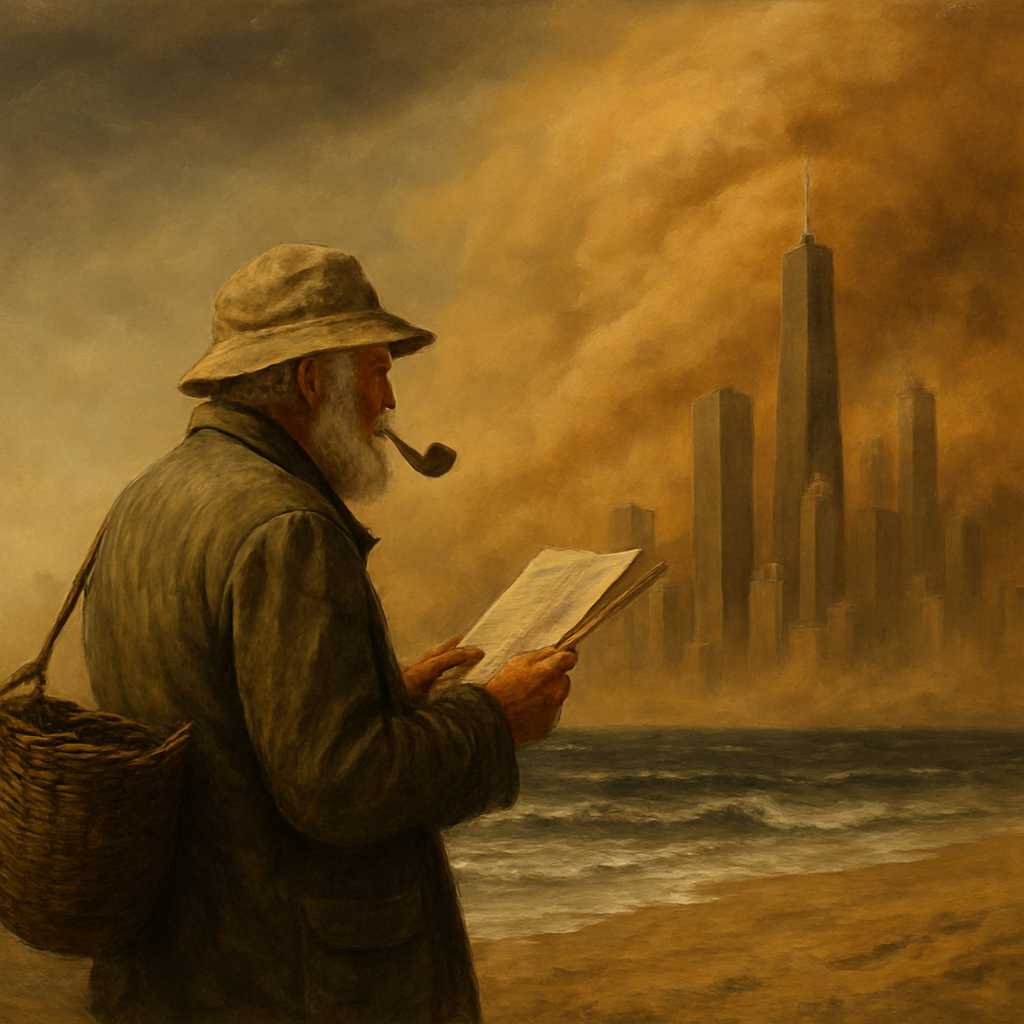
By noon, the sky turned the color of old brass.
Every screen in the Spire flashed warnings. A sandstorm had risen early from the Empty Quarter, fast and wide, carrying static that made my hair lift from my neck.
Al Masar Spire sealed itself like a shell. External lifts locked. Rooftop turbines folded in. The atrium vents adjusted with a sigh.
“All teams remain at stations,” Hamdan announced over the internal channel. “No one improvises.”
Grandfather, of course, was already improvising.
He stood beside me in the monitoring room on Level 118, leaning on his borrowed umbrella like a captain on deck. Through the glass, sand scratched the city into a pale blur. Even the Burj Khalifa vanished, swallowed from its feet upward.
“He shouldn’t be here,” Hamdan said.
“You let us in because the ground entrances closed,” I said.
“I let you in because you work here.”
Grandfather tapped the floor with the umbrella tip. “Argue later. Your tower is breathing too hard.”
On the main display, the atmospheric water collectors showed rising pressure. The storm’s charged dust was clogging the intake membranes faster than the cleaning pulses could clear them.
“We have protocols,” Hamdan snapped.
“Your protocols were written by people who thought sand moves like smoke.” Grandfather pointed to the western readings. “It is moving like a school of fish.”
Hamdan’s nostrils flared. “Sand is not fish.”
“No. Fish are smarter. But both follow pressure.”
An alarm shrieked. One of the upper reservoirs stopped responding.
I slid into my console chair, fingers flying. “Level 160 intake shutters are stuck half-open. Dust load is spiking.”
“Close them manually,” Hamdan ordered.
“External access is impossible,” I said. My mouth went dry. “Internal maintenance shaft is blocked by the old inspection cradle.”
“Then we wait for the automated reset.”
Grandfather’s umbrella snapped open with a pop.
Hamdan stared. “What are you doing?”
“Making a sail.”
“In a building?”
“Everything is a boat if it can sink.”
He turned to me. “Layla, show me the shaft.”
“Baba, no.”
His eyes softened, but his grip on the umbrella handle tightened. “If the shutters tear, how much water is lost?”
I looked at the display. The numbers climbed red. “Enough to shut down cooling for the residential levels.”
“Children live here?”
Hamdan answered before I could. “Eight hundred and twelve residents. Including a neonatal clinic on Level 73.”
Grandfather nodded once. “Then we go.”
Hamdan stepped in front of him. “You are not touching my systems.”
Grandfather looked up at him, small beneath all that engineered height. “Young man, your systems are touching my granddaughter’s future.”
No one spoke.
Then Hamdan grabbed a hard helmet from the wall and shoved it into Grandfather’s hands. “If you fall, she will kill me.”
Grandfather put it on backward. “Then walk carefully.”
The Borrowed Sail
The maintenance shaft smelled of hot dust, lubricant, and trapped electricity.
I crawled behind Hamdan, who crawled behind my grandfather, which would have been funny if the building hadn’t groaned around us. The borrowed umbrella was folded and strapped across Grandfather’s back with emergency tape.
“Your knees?” I called.
“Complaining in three languages.”
Hamdan glanced back. Sweat shone along his temple. “We can still return.”
Grandfather chuckled. “Now he becomes cautious.”
We reached the blocked cradle at a narrow junction. Beyond it, the manual shutter wheel sat behind a grated panel, just out of reach. Air roared through the half-open intake with the deep note of a giant flute.
Hamdan tugged at the cradle. It did not move.
“Hydraulic lock,” he said. “We need leverage.”
Grandfather unfolded the yellow umbrella.
Hamdan groaned. “That is nylon and aluminum.”
“And borrowed,” Grandfather said. “So do not break it.”
He pushed the open umbrella toward the roaring airflow. It snapped inside out instantly, ribs bending like fish bones. The shaft yanked it forward, pulling the handle against the cradle.
“Now!” Grandfather shouted.
Hamdan understood before I did. He wedged his shoulder under the cradle, using the wind’s pull on the umbrella as extra force. I jammed a wrench beneath the wheel assembly.
“Again!”
The umbrella shuddered. Grandfather’s sandals slid on the metal floor.
I grabbed his belt. “I have you!”
He laughed breathlessly. “Good. I am expensive.”
With a shriek, the cradle shifted three centimeters.
Enough.
Hamdan squeezed through the gap, scraping his arm bloody. He reached the wheel and strained. Nothing.
Grandfather squinted at the vibration of dust along the grate. “Turn with the gust, not against it.”
Hamdan bared his teeth. “It turns clockwise.”
“The wind does not care about labels.”
Another alarm wailed in my earpiece. “Pressure critical!”
Hamdan stopped fighting the wheel. He waited, chest heaving, eyes fixed on the fluttering dust. Grandfather raised one hand.
“Not yet,” he murmured.
The roar dipped.
“Now.”
Hamdan turned with the lull, then drove his weight as the next gust slammed through. The wheel spun. Above us, metal shutters clapped shut one after another, like giant hands applauding.
The alarm cut off.
For a heartbeat, we heard only our breathing.
Then the battered umbrella collapsed over Hamdan’s head.
Grandfather blinked at him through the twisted yellow fabric. “It suits you.”
I started laughing so hard my helmet knocked the wall.
Hamdan pulled the umbrella off, stared at its broken ribs, and then, to my astonishment, laughed too. Not politely. Not briefly. A real laugh, rough and young.
“Your borrowed promise,” he said, holding it out.
Grandfather accepted it with both hands. “Promises can be repaired.”
Hamdan looked at the closed shutters, then at my grandfather. The rivalry had drained from his face, leaving something quieter.
“How did you know?” he asked.
Grandfather wiped dust from his beard. “When I was fifteen, my father made me steer home in a shamal with a torn sail. He said, ‘Yousuf, the wind is never your enemy. Your pride is.’”
Hamdan lowered his eyes.
“My father built desalination plants,” he said. “He used to say old methods were anchors.”
Grandfather touched the bent umbrella ribs. “Anchors are useful when the storm comes.”
A Harbor in the Sky
Three days later, the Spire held a ceremony in the atrium, because Dubai can turn even a near-disaster into an event with dates, cameras, and tiny cups of saffron coffee.
The koi pond had been cleaned. The tomatoes floated peacefully. Outside, the city glittered as if the storm had polished every window by hand.
Grandfather wore his best white kandura and the wrong socks.
“Baba,” I whispered, “one is navy and one is black.”
“Both are loyal.”
Hamdan approached us, his arm bandaged. In his hands was the yellow umbrella, repaired with new silver ribs and a polished wooden handle carved in the shape of a little dhow.
Grandfather ran his thumb over the handle. His lips pressed together.
“You fixed it,” he said.
“I returned what was borrowed,” Hamdan replied. “With interest.”
Then he turned toward the gathered staff, residents, and reporters. His voice carried through the atrium speakers.
“Al Masar Spire was designed to be self-sufficient,” he said. “This week, we learned that no structure is self-sufficient if it refuses memory.”
Grandfather shifted beside me. “He speaks like a brochure, but better.”
I elbowed him gently.
Hamdan continued, “We will establish a Wind and Water Council, pairing engineers with sailors, fishermen, pearl divers, farmers, and others whose knowledge comes from years of attention. Yousuf Al Sayegh has agreed to be our first adviser.”
I turned to my grandfather. “You agreed?”
He looked innocent. “He offered good tea.”
Applause rose, soft at first, then swelling until the glass around us seemed to hum.
Grandfather stepped forward reluctantly. Hamdan offered him the microphone.
He tapped it. A squeal made a baby cry and three drones wobble.
“Sorry,” Grandfather said. “This fish has teeth.”
Laughter rippled through the atrium.
He cleared his throat. “When I was young, we looked at the sea and saw tomorrow’s meal. Then we looked at the sea and saw money. Then some looked and saw only a problem to solve.”
His hand found mine. His fingers trembled, so I held tighter.
“But water is not a problem. Wind is not a problem. The old are not problems. The young are not problems. Pride is heavy. Respect is light. Carry the light thing.”
No one moved for a second.
Then Hamdan bowed his head to my grandfather, deep and unhurried.
Grandfather bowed back.
Later, when the crowd thinned, I found him by the koi pond. His fishing rod rested across his knees. The repaired umbrella leaned against his chair, bright as a small sun.
“You know,” I said, “fishing is still not allowed here.”
He dropped a crumb of manakish into the water. A koi rose and kissed the surface.
“I am not fishing,” he said. “I am consulting.”
Above us, vents opened with a gentle sigh, guided by new software Hamdan’s team had named Yousuf Mode. The air moved through the atrium in careful streams, warm and cool, old and new, meeting without fighting.
Grandfather tilted his face toward it.
“Good wind,” he murmured.
I rested my head against his shoulder, breathing in salt, starch, and sandalwood soap.
For the first time in years, I did not feel as if I had to choose between the creek that raised me and the tower that employed me. Somewhere high above Dubai, in a harbor made of glass, my grandfather had cast no net and caught the future anyway.