The House of Clocks


The rain had been falling over Bellweather since sundown, not in honest sheets, but in a fine, needling drizzle that made every gaslamp wear a halo and every alley look like it had swallowed a secret. By midnight the streets were nearly empty, save for the occasional cab clattering over the cobblestones and the black umbrellas drifting like funeral birds past the shuttered shopfronts.
It was on such a night that Inspector Elias Crowe was called to the house of Mr. Alistair Vane, banker, widower, collector of rare clocks, and the sort of man who could make an enemy simply by entering a room. Vane lived in a tall brick mansion on Ashbury Square, where the doors were polished to a shine and the servants moved so quietly one might mistake them for ghosts.
Crowe arrived with his collar turned up and his hat brim dripping. He was a narrow man with sharp cheekbones, a tired mouth, and eyes that missed very little. He had once been described by a newspaper as “owl-like,” a comparison he disliked, not because it was untrue, but because owls were known to hoot unnecessarily.
At the front door stood Sergeant Finch, stout, damp, and eager in the way only a young policeman at a murder scene can be eager.
Inspector, Finch said, lowering his voice though there was no one nearby but the rain, it’s a queer one.
Murders generally are, Sergeant. The ordinary ones seldom ask for us by name.
Finch blinked, decided this was wisdom, and led him inside.
The house smelled of wax, old wood, and something metallic beneath it all. In the great hall, a grandfather clock stood solemnly against the wall, its pendulum still as a held breath. The silence of the place was unnatural. For a collector of clocks, Vane had allowed none of them to speak.
All stopped? Crowe asked.
Every one, sir. Servants say Mr. Vane wound them himself each morning. Never failed.
And tonight?
Stopped at nine seventeen. Every clock in the house.
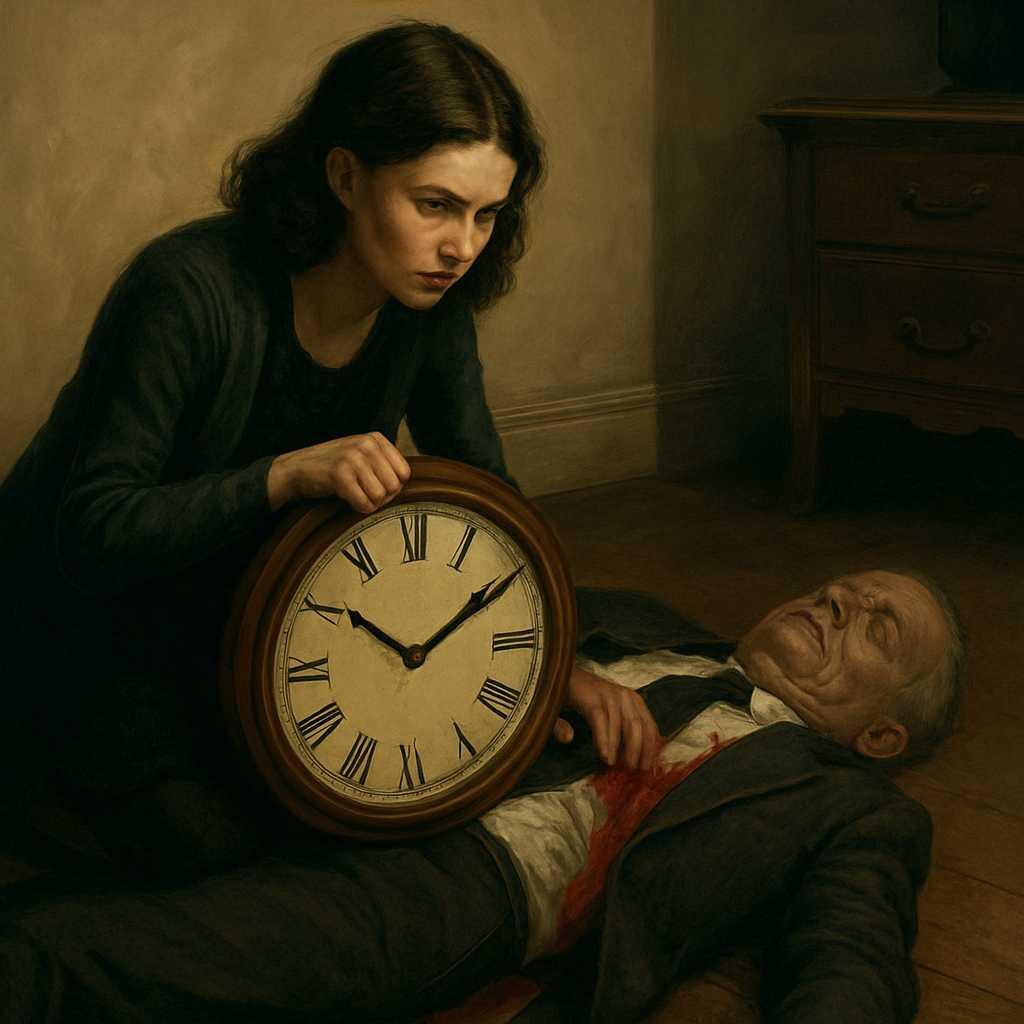
Crowe’s eyes flicked toward the grandfather clock. Its hands indeed pointed to seventeen minutes past nine.
Show me the body.
They found Alistair Vane in his private study, seated in a high-backed chair before a desk of carved walnut. He was dressed for dinner, his silver hair neatly brushed, one hand resting on the arm of the chair, the other curled beside a crystal glass. His expression was not one of terror but of deep annoyance, as if death had interrupted him in the middle of correcting a ledger.
A thin red wound marked the left side of his neck, just below the ear. On the carpet near his feet lay a long, narrow blade, delicate as a letter opener but stained dark at the tip. The window behind him was open a few inches, and rain had dotted the sill.
Weapon found there, Finch said. No sign of forced entry. Door was locked from the inside. Window opens onto a small garden, but the mud shows no footprints beneath it.
Crowe walked to the window and looked down. The garden was boxed in by high walls of soot-black brick. Beneath the window lay a bed of white gravel, clean but for rainwater. No footprint, no scuff, no dropped thread.
Who discovered him?
The butler, Hobb. At ten o’clock, when Mr. Vane failed to come to supper.
And who was in the house at nine seventeen?
Finch consulted his notebook. Four persons. Hobb, the butler. Mrs. Merrow, the housekeeper. Miss Celia Vane, the niece. And Mr. Julian Pike, Mr. Vane’s secretary.
Family, servants, and a secretary, Crowe murmured. The holy trinity of domestic murder.
He bent over the body. There was no blood on Vane’s shirtfront save a narrow trickle, now dry. The wound was precise. Crowe lifted the dead man’s left hand gently. A faint smear of black powder darkened the fingertips.
Interesting, he said.
Powder, sir?
Or soot. Or ink. The dead are poor conversationalists, but excellent note-takers.
On the desk lay an open account book, a brass lamp, a cigar case, several letters, and a small mantel clock. It too had stopped at nine seventeen. Crowe noticed that its glass face was cracked in a neat starburst around the center.
Did the killer strike the clock? Finch asked.
Perhaps. Or the clock struck him.
Finch laughed, then stopped when he realized Crowe had not.
The suspects were gathered in the drawing room, beneath portraits of stern Vanes who looked as though they had disapproved of joy for generations. Hobb the butler stood straight as a candlestick, a pale man of sixty with a dry voice. Mrs. Merrow sat with her hands folded in her lap, plump, red-eyed, and trembling. Julian Pike, the secretary, was young, handsome, and too composed by half. Celia Vane stood by the fireplace in a gown of dark blue, her face white, her chin lifted.
Crowe spoke to Hobb first.
At nine seventeen, where were you?
In the pantry, sir, polishing the dinner silver.
Alone?
Yes, sir.
You heard nothing?
Only the clocks stop.
Crowe tilted his head. You heard them stop?
The butler’s mouth tightened. One hears a house change, Inspector, after forty years in it.
That was true enough. Houses had habits, and servants knew them better than their masters did.
Mrs. Merrow claimed she had been in the kitchen preparing broth for her employer’s late supper. She had heard no cry, no struggle, no footsteps. Mr. Vane was a quiet gentleman, she said, then seemed ashamed of the lie and added, when he wished to be.
Julian Pike had been in the library cataloguing correspondence. He offered this statement as if dictating it for legal record. Mr. Vane dismissed me at eight forty-five. I did not see him again.
You were his secretary. Did he have enemies? Crowe asked.
Pike gave a little smile. Inspector, Mr. Vane lent money at interest to men who believed themselves too proud to borrow and too clever to repay. His enemies could have filled St. Bartholomew’s at Christmas.
And you? Were you fond of him?
I respected him.
That is not the same thing.
No, Inspector. It is safer.
Then came Celia Vane. She had inherited the family eyes: dark, direct, and difficult to read. Her uncle had been her guardian since she was twelve.
At nine seventeen, Miss Vane?
In my room.
Alone?
Yes.
Did you hear anything?
She hesitated. It was brief, but Crowe saw it.
Miss Vane?
I heard a clock chime incorrectly.
Incorrectly?
The little French clock in the upstairs corridor. It chimed once. But it was not the hour.
Crowe leaned forward. At nine seventeen?
I believe so.
Finch scribbled furiously.
Did your uncle have a reason to stop all the clocks? Crowe asked.
Celia looked toward the fire. He had a reason for everything. He just rarely shared it.
Inspector Crowe spent the next hour wandering the house. He inspected locked doors, silent corridors, servants’ passages, bell wires, and the garden wall. He examined the French clock Celia had mentioned, a gilded thing with cherubs on top and a painted porcelain face. It had stopped at nine seventeen, but unlike the others, its hands were slightly bent.
Sergeant, Crowe said, remove this clock carefully and bring it to the study.
Do you think it matters?
I think everything matters until it proves itself too dull to continue.
Back in the study, Crowe stood before the mantel clock and the dead man’s desk. Something in the room troubled him. Not the locked door. Locked rooms were often no more than locked minds. Not the open window. Murderers loved open windows; they gave policemen something to stare at while the truth sat indoors.
He looked again at Vane’s hand, at the blackened fingers. Then at the cracked clock face. Then at the long, narrow blade.
Sergeant, ask Hobb whether Mr. Vane smoked cigars.
Finch hurried away and returned. Yes, sir. One every evening after dinner, though tonight dinner was delayed.
And the cigar case?
His own.
Crowe opened it. Three cigars remained. The fourth was missing. He sniffed the case, then frowned. Not tobacco alone. There was another scent: bitter, sharp, and chemical.
Bring me a candle, a saucer, and a pair of tongs, he said.
Finch fetched them from the pantry. Crowe clipped a sliver from one cigar, held it over the candle flame, and dropped it into the saucer. It flared with a fierce blue spark and a puff of acrid smoke.
Finch jumped. Good Lord!
Not the Lord, Sergeant. Chemistry.
Crowe’s face had become very still. Someone packed flash powder into at least one of these cigars. Enough to burn the fingers and startle a man badly, but not enough to kill him.
Then the wound killed him.
Yes. But not by a hand standing before him.
Finch stared.
Crowe pointed at the mantel clock. Observe the crack at the center. Observe the blade on the floor. Now observe this.
He lifted the clock and turned it around. Behind it, cleverly fixed to the wooden casing, was a spring mechanism, small and powerful. A length of fine black thread trailed from it, broken near the end. The same black residue dusted the wheels inside.
A trap, Finch whispered.
A timed trap. The blade was mounted here, drawn back by this spring. When released, it shot forward through the clock face. Mr. Vane sat in his customary chair, leaned close to adjust or inspect the clock after the cigar startled him, and the blade struck him in the neck. Then it fell to the carpet.
But who set it?
Someone who knew his habits. Someone who knew he alone wound and corrected his clocks. Someone who could enter this study without suspicion.
Finch swallowed. That does not narrow it as much as I hoped, sir.
No. But the house does.
Crowe summoned the four suspects to the study. The body had been covered, but its presence remained like a fifth witness. Rain tapped softly at the window.
Mr. Vane was murdered by a device attached to this clock, Crowe said. The killer needed access to the study, knowledge of mechanics, and confidence that Mr. Vane would approach the clock at precisely the proper moment.
Hobb’s face remained rigid. Mrs. Merrow gasped. Pike’s eyes narrowed. Celia did not move.
The cigar was prepared with flash powder, Crowe continued. When Mr. Vane lit it, it burned his fingers. We know this because his fingertips are blackened. Angry, perhaps alarmed, he reached for the nearest clock, because all the clocks had suddenly stopped at nine seventeen. But one clock had not merely stopped. It had been made into a weapon.
This is monstrous, Mrs. Merrow whispered.
Yes, Crowe said. And clever. But cleverness has a vanity to it. The murderer could not resist staging the whole house, stopping every clock. That required movement through many rooms shortly before the crime. A servant might do it. A secretary might do it. A niece might do it. But only one person made one clock chime once at the wrong time.
He turned to Celia.
Her face tightened, but she did not speak.
You heard the French clock chime, Miss Vane. You told us so. Yet Sergeant Finch and I examined it. Its chime mechanism had been disconnected for repairs. Hobb confirmed it had not chimed in six months. You did not hear it. You said you did because you needed a reason to explain why you were near the upstairs corridor at nine seventeen, stopping clocks.
No, she said, but softly.
Crowe’s voice gentled. Your uncle was going to change his will.
Julian Pike looked sharply at her. That was answer enough.
He had discovered, Crowe went on, that you and Mr. Pike intended to marry. He disapproved. More importantly, he intended to leave his estate to a hospital rather than to you. But you knew clocks. You learned from him. And you knew his temper. Stop his clocks, burn his fingers, and he would rise in fury to investigate the mantel clock himself.
Celia’s hands clenched. He kept me in this house like a prisoner. He read my letters. He dismissed my friends. He told me Julian wanted my money, and when I said I would marry without permission, he laughed. He said I would have nothing. Nothing.
Pike stepped back from her as if from a flame.
She saw it and gave a broken smile. There. You see, Inspector? My uncle was cruel, but he was not always wrong.
For a moment, only the rain spoke.
Celia Vane, Crowe said quietly, I must ask you to come with us.
She lifted her chin, and in that gesture one could see the whole tragic pride of Ashbury Square: the portraits, the locked doors, the polished silver, the silent clocks. She did not cry when Finch took her arm. Mrs. Merrow did enough crying for everyone.
When it was over, and the body had been carried away, Sergeant Finch found Inspector Crowe in the hall before the grandfather clock. Crowe had opened its case and set the pendulum swinging. Tick. Tock. Tick. Tock. One by one, the house seemed to remember itself.
Strange, sir, Finch said, that she stopped them all.
Not strange, Sergeant. Symbolic.
Symbolic?
Crowe put on his hat. She thought if she stopped time, she could escape what time was bringing her. Poverty, marriage, freedom, disgrace, who can say? But time is a poor servant and a worse victim. It refuses to stay murdered.
Outside, the rain had thinned to mist. Dawn was still hours away, but somewhere beyond the rooftops, the city was preparing its gray face for morning. Inspector Crowe stepped into the street, leaving behind the house of clocks, where every pendulum now swung in solemn agreement, marking the seconds after a death, and the long hours before judgment.