The Hidden Studio

On the first Monday of October, when the rain came down as if the sky had misplaced its patience, Mara Bell discovered that her mother had been paying rent on an apartment no one lived in.
Now, Mara was not the kind of woman who went looking for mysteries. She was thirty-four, a project manager at a software company where people said things like circle back and optimize the user journey with perfectly straight faces. She owned two black blazers, seven houseplants in varying states of betrayal, and a phone that buzzed so often it felt less like technology and more like a nervous condition.
Her mother, Evelyn, had passed away three weeks earlier, quietly, in her sleep, with a library book open on her chest and the bedside lamp still glowing. That was exactly the sort of exit Evelyn would have chosen, Mara thought, if anyone had bothered to consult her: dignified, literary, and inconvenient only in the softest possible way.
Grief had made Mara efficient. That surprised her. She had imagined grief as weeping into sweaters, as eating toast over the sink, as staring at old photographs until dawn. There had been some of that, certainly. But mostly grief had arrived carrying a clipboard. There were forms to sign, accounts to close, donations to make, insurance papers to find. The dead left behind an astonishing amount of administration.
Which was how Mara found the envelope.
It was tucked inside a cracked blue folder labeled HOUSEHOLD in Evelyn’s looping handwriting. The folder contained electricity bills, a warranty for a microwave bought in 2009, and, hidden between them, a lease agreement for a studio apartment on Mercer Street.
Mara read it once. Then twice. Then she sat at her mother’s kitchen table, where the lemon-patterned tablecloth had faded from cheerful yellow to the color of old candlelight, and read it a third time.
The rent had been paid automatically every month for eleven years.
“What on earth were you doing, Mom?” Mara whispered.
The apartment was only twenty minutes away, downtown, in a neighborhood that had once been full of repair shops and diners and now had cafés where a cup of coffee cost enough to make Evelyn say, For that price, it should come with a sandwich and advice.
Mara called the number on the lease. A woman answered, brisk and bored.
“Mercer Street Management.”
“Hello,” Mara said. “My name is Mara Bell. My mother, Evelyn Bell, rented unit 4C in your building. She recently passed away, and I need to—well, I need to understand what’s in the apartment.”
There was a pause, then the typing of keys.
“Bell. Yes. 4C. Rent is current.”
“I’m aware.”
“You have keys?”
“No.”
“Super can let you in. Bring ID and death certificate.”
Mara closed her eyes. Death certificate. Such an official name for the paper that proved her mother had become a past-tense person.
“Thank you,” she said.
The building on Mercer Street was six stories high, made of brown brick darkened by rain and time. It stood between a boutique fitness studio and a shop that sold candles named after emotions. Mara arrived at six in the evening, just as the city was changing shifts: office workers hurrying home, delivery cyclists slicing through traffic, restaurant workers pulling down chairs and lighting candles for strangers in love or pretending to be.
The super was a narrow man named Mr. Alvarez, with silver hair combed straight back and a face arranged permanently into skepticism.
“You’re Evelyn’s daughter,” he said, not asking.
“Yes.”
He studied her with an expression that suggested Evelyn’s daughter ought to have visited sooner. Mara felt herself flush, though she had not known there was any place to visit.
“She was a good lady,” he said at last, turning toward the stairs. “Quiet. Always brought cookies at Christmas.”
Mara followed him up four flights. The hallway smelled of old wood, someone’s garlic-heavy dinner, and the faint mineral scent of radiator heat. At apartment 4C, Mr. Alvarez selected a key from a ring heavy enough to anchor a small boat.
“She came here every Thursday,” he said.
“Every Thursday?”
“Most Thursdays. Around noon. Stayed a few hours.”
Mara’s mouth went dry. Her mother had played bridge on Thursdays. At least, that was what she had said. Mara pictured Evelyn in her soft gray cardigan, leaving the house with lipstick on, waving from the porch.
Don’t work too hard, darling.
Mr. Alvarez opened the door and stepped back.
“Take your time,” he said, and left her there.
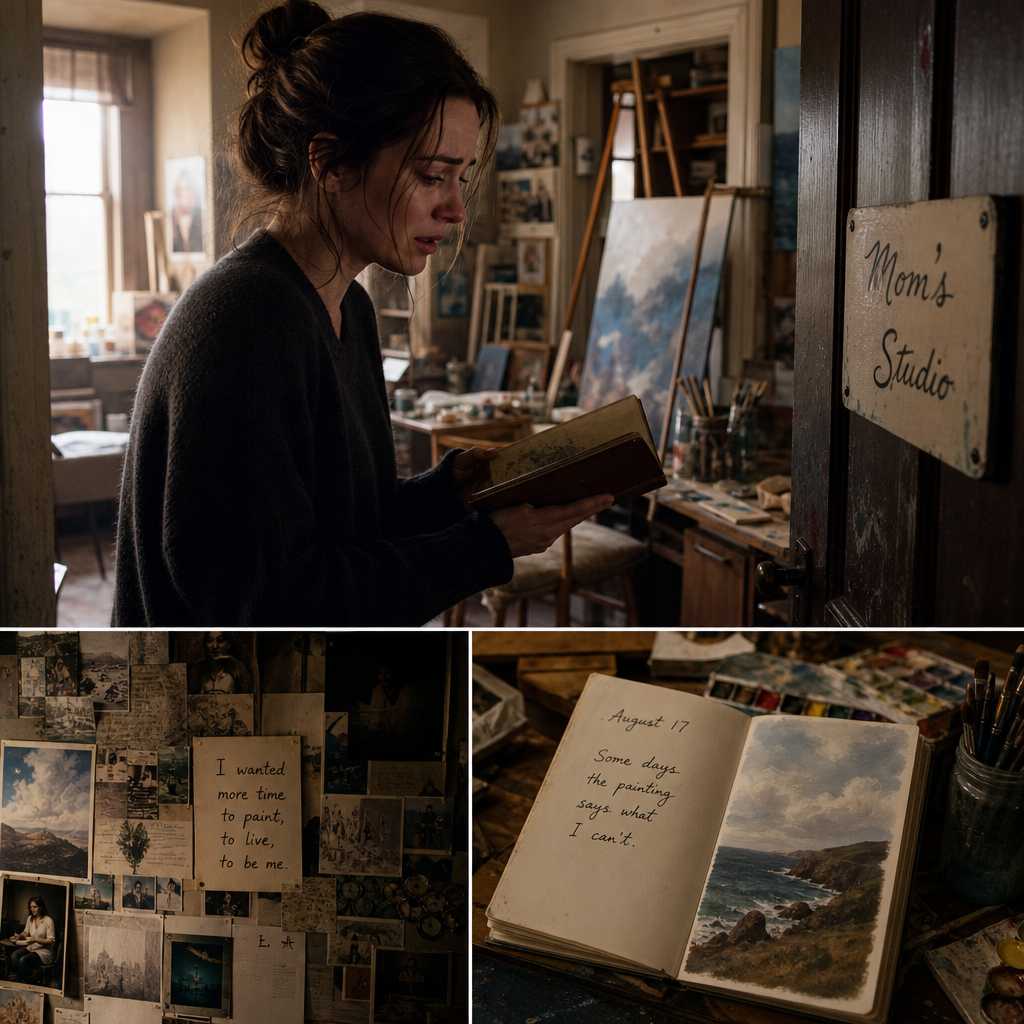
The apartment was small, one room with a kitchenette along the wall and two tall windows overlooking Mercer Street. For a moment, Mara could not move. Not because the place was shocking, but because it was beautiful.
The studio was filled with paintings.
Canvases leaned against the walls, crowded the floor, stood stacked in careful layers. Some were no bigger than a book. Others were tall enough to hide behind. There were jars of brushes on the table, tubes of paint squeezed from the middle, rags stiff with color, and an easel positioned near the windows to catch the northern light.
And everywhere, on every surface, was Mara’s mother.
Not literally, of course. Evelyn was not in the paintings. But her presence was in them so vividly that Mara felt as if she had walked into her mother’s hidden weather.
There were city streets after rain, taxi lights smeared gold across black asphalt. There was the corner grocery where Mara used to buy gum after school. There was a woman on a subway platform holding a red umbrella like a secret. There was Mara at sixteen, sitting on the back steps in combat boots, her face turned away, drawn in loose charcoal lines that somehow captured all her teenage fury and tenderness.
Mara pressed a hand to her mouth.
Her mother had painted.
Not as a hobby. Not as something done on Sundays between laundry and dinner. Evelyn Bell, retired school secretary, maker of excellent soup, woman who ironed pillowcases because she said the world was rough enough already, had been an artist in secret.
On the table lay a sketchbook. Mara opened it carefully, expecting perhaps studies of hands, lists of colors, notes about supplies. Instead, she found pages of writing.
The first entry was dated eleven years earlier.
Rented the studio today. I have not told Mara. She will worry about the money, or worse, she will be kind. I cannot bear kindness about this. I need a room where no one expects me to be useful.
Mara sat down on the stool. Rain tapped at the windows.
She read on.
I wanted to be a painter when I was young. That sounds dramatic, written plainly. Wanted. As though desire is a coat one takes off when the weather changes. I married at twenty-two, had Mara at twenty-six, took the job at the school at thirty. Life was not cruel. That is the part no one warns you about. A life can be good and still have a locked room inside it.
Mara felt a sound rise in her throat, not quite a laugh and not quite a sob.
She thought of her mother at school concerts, sitting in the front row. Her mother packing lunches. Her mother showing up with cough drops, birthday cakes, clean sheets, quiet advice. Evelyn had always seemed complete to Mara, as mothers often do to children, like buildings with all their windows lit. It had never occurred to Mara that some rooms might be dark.
She turned another page.
Painted badly today. Gloriously badly. No one died from it.
Another.
Saw Mara on the news feed from her company. She looked tired, but powerful. My daughter speaks in meetings as if she expects the room to make space. I hope she knows I was not raised to do that. I hope she never has to unlearn silence.
Mara wiped her eyes with the back of her hand.
Outside, a bus hissed at the curb. Someone laughed on the sidewalk below. The ordinary world continued, rude and miraculous.
At the back of the sketchbook, tucked between two blank pages, was an envelope with Mara’s name written on it.
For a while, she only looked at it.
Then she opened it.
My darling Mara,
If you are reading this, then I have either become brave enough to show you this place, or I have died, which is one way of becoming brave without having to endure the conversation.
Despite herself, Mara laughed. “Oh, Mom.”
I did not keep this studio secret because I did not love you. I kept it secret because I loved you so much that I forgot, for a long time, to love the parts of myself that did not belong to anyone else.
When your father left, I made a promise that you would never feel the floor vanish under you the way I did. I worked. I saved. I repaired things. I became dependable the way some people become religious. And dependability is a noble thing, but it can become a cage if you never open the door.
This room was my door.
I don’t know if the paintings are any good. Some days I think they are. Some days I think they look like weather reports made by a confused dog. But they are mine. That is the important thing. They are mine.
If you hate that I hid this, you may hate it for a while. You are entitled. But after that, I hope you will ask yourself what room you have locked inside your own life.
Find it, darling. Open it before you need a death certificate and a suspicious superintendent to let you in.
All my love, always,
Mom
Mara sat in the studio until the rain softened to mist and the streetlights came on. She walked from painting to painting, meeting her mother as if at a party where Evelyn had arrived wearing some dazzling dress Mara had never seen before.
There was pain in it, yes. The sting of being excluded. The ache of realizing that someone you loved had lived whole landscapes beyond your knowledge. But there was wonder too, and something like pride, bright and sharp.
Near the windows, half-covered by a drop cloth, Mara found an unfinished canvas. It showed a woman at a kitchen table, head bent over a laptop, face lit blue by the screen. Her shoulders were tense. Her coffee had gone cold. Around her, faintly sketched but not yet painted, were vines growing up from the floor, curling around the chair legs, reaching toward the window.
Mara knew herself immediately.
On the stool beside the easel sat a palette with dried paint in small hard islands. She touched one gently.
The next Thursday, Mara returned at noon.
She told herself she was only there to begin sorting things. There would be decisions to make. Keep, sell, donate, store. Practical verbs. Manageable verbs. She brought boxes, labels, a roll of packing tape, and the brisk energy of someone determined not to feel too much.
But when she opened the door, the studio received her with its quiet light, and all her efficiency slipped off like a wet coat.
She made tea in the tiny kitchenette, though the kettle was old and shrieked like a startled bird. She stood by the window and watched Mercer Street move beneath her. A woman in a green coat argued cheerfully into her phone. A boy on a skateboard leapt over a puddle and landed badly, then looked around to see if anyone had witnessed his defeat. A delivery driver balanced three paper bags in one hand with the grace of a circus performer.
Mara imagined Evelyn watching these same scenes, choosing colors, turning strangers into shapes and light.
Then, slowly, Mara took off her blazer and hung it on the back of a chair.
She found a blank canvas in the corner. She found brushes soaking in a jar, washed them, ruined two paper towels, and opened a tube of blue paint. She had not painted since childhood, unless one counted fixing scuff marks on apartment walls before moving out.
For ten minutes, she did nothing.
Then she painted a line.
It was not a good line. It wobbled uncertainly across the canvas, thin at one end and thick at the other. A line with no plan. A line that would not help anyone meet a deadline or increase quarterly growth. A useless line.
Mara looked at it.
Then she painted another.
By evening, the canvas was a mess of blue and gray and sudden yellow. It looked like traffic, or weather, or perhaps the inside of a woman trying to breathe after holding her breath for years. Mara could not tell whether it was beautiful.
But when she stepped back, she felt something unfamiliar loosen in her chest.
The following week, she told her boss she would no longer be available after six. He blinked at her through the video call, startled, as if she had announced she was moving to the moon.
“Is everything okay?” he asked.
Mara almost said yes automatically. Instead, she looked past him, toward the corner of her own apartment where she had propped the messy blue painting against the wall.
“Not entirely,” she said. “But it’s getting better.”
Over the next months, Mara kept the studio. At first she felt foolish paying rent on a secret she had inherited. But the room became less her mother’s and more theirs, and then, gradually, her own. She did not quit her job, did not become a famous painter, did not run away to live in a village where everyone wore linen and understood silence. Life, being life, remained complicated. Emails still arrived. Bills still needed paying. The dishwasher broke. Her dentist found a cavity.
But on Thursdays, Mara went to Mercer Street.
Sometimes she painted. Sometimes she read her mother’s journals. Sometimes she simply sat by the window and allowed herself to be a person without purpose.
In spring, she organized a small exhibition in the studio. She invited neighbors, old friends of Evelyn’s, Mr. Alvarez, and a few coworkers who looked uncomfortable at first and then surprisingly moved. The paintings covered the walls, and beneath each one Mara placed a handwritten card with a line from Evelyn’s notebooks.
Under the portrait of Mara at sixteen, she wrote:
Children are not ours, but for a while we are allowed to stand near the fire of them.
Under the rainy city street:
Even pavement has a way of remembering light.
And beside the unfinished painting of Mara at the kitchen table, now left exactly as Evelyn had abandoned it, she placed the final line from her mother’s letter:
Open it before you need a death certificate and a suspicious superintendent to let you in.
Mr. Alvarez read that one, snorted, and said, “Suspicious? I am cautious.”
Mara smiled. “She liked you.”
“She owed me cookies,” he said, but his eyes were wet.
Near the end of the evening, when the wine was nearly gone and the room hummed with soft conversation, a young woman Mara did not know stood before one of Evelyn’s paintings for a long time. It was the one with the red umbrella on the subway platform.
“Was she a professional artist?” the woman asked.
Mara considered the question.
Once, she might have said no. She might have explained that Evelyn had been a school secretary, a mother, a widow, a practical woman who clipped coupons and remembered everyone’s birthday. She might have measured professionalism by money, recognition, permission granted by the world.
Instead, Mara looked around the room, at the canvases bright with her mother’s hidden life.
“Yes,” she said. “Though almost no one knew it.”
The young woman nodded, satisfied.
Later, after everyone left, Mara remained in the studio. She washed glasses, folded napkins, turned off the lamps one by one. The city outside glittered with recent rain. On the table lay her own newest painting, still wet: a doorway, half-open, with yellow light spilling through.
Before leaving, Mara stood in the center of the room and spoke into the quiet.
“I found it, Mom.”
There was no answer, of course. Stories are honest about that. The dead do not step back through doors simply because we finally understand what they were trying to tell us.
But the radiator clanked. A taxi passed below, scattering light across the ceiling. Somewhere in the building, someone laughed. And in that ordinary chorus, Mara felt her mother not as a ghost, but as a hand at her back, gentle and firm, urging her forward.
So Mara locked the studio door, slipped the key into her pocket, and walked down to Mercer Street, where the night was still wet, the city was still awake, and every lit window seemed, for once, like a room waiting to be opened.