Someone Is Beneath the Lighthouse Road
A missing lighthouse volunteer’s cassette sends a ranger racing to stop a concrete delivery.
- Detective Fiction
 By Storyleo Editorial
- 6 min read


The Voice Under the Seat
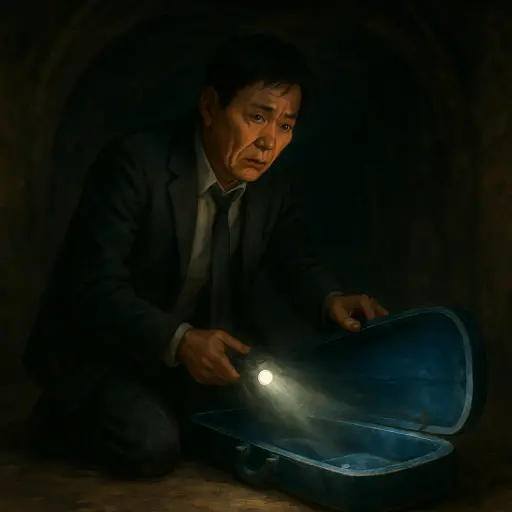
Ranger Audrey Sargent found the cassette beneath the brake pedal of an empty truck, while the man who owned it was supposedly drowning offshore.
“Coast Guard’s searching east of the point,” Deputy Curtis Hale told her. “His boat washed up without him.”
Audrey crouched beside the truck. Its door hung open over crushed beach peas. On the passenger seat sat a paper sack containing a ham sandwich and two yellow apples. Leonard Trask packed exactly that lunch every day he volunteered at Gull Point Light.
“He wouldn’t leave his truck here,” she said.
“People leave things when they drown.”
The keys were missing. The driver’s seat had been pushed back so far that Leonard, whose legs were shorter than Audrey’s, couldn’t have reached the pedals.
She photographed the cassette before lifting it by its edges.
Leonard had spent the summer recording memories of the lighthouse village for the park’s visitor center. Every fisherman over seventy had complained about his questions, then asked when their interview would be ready.
“Can you play that?” Curtis asked.
“Leonard keeps a machine in the exhibit room.”
Her radio crackled. The dispatcher wanted the service road cleared for a concrete mixer.
Audrey looked uphill. Beyond the lighthouse, a yellow excavator waited beside the old fog-signal station. At noon, contractors were filling its underground water cistern before demolishing the unsafe building above it.
Leonard had argued against that work at three public meetings.
“Tell them to hold,” she said.
“Contractor says the engineer’s cleared it. He’s got a road closure and two trucks coming from Rockland.”
Audrey checked her watch. Eleven twelve.
“Tell him a ranger asked.”
Curtis followed her toward the lighthouse. “You thinking Leonard ran off to stop the job?”
“I’m thinking somebody taller drove his truck.”
She climbed faster, the cassette clicking against her belt buckle inside its evidence bag.
A Room That Answered
The exhibit player smelled of warm dust. Audrey pressed Play with a capped pen.
Leonard’s voice emerged through a soft hiss.
“September eighteenth. Inspection with Douglas Phelps. Doug, would you explain why the plans say forty yards when your invoice says ninety?”
A second man answered, distant and sharp. “Put that damn thing away.”
Footsteps scraped. Metal rang against stone.
Then a crash made Curtis reach for the volume.
“Doug?” Leonard called.
His voice had changed. Each word returned behind itself, hollow and thin.
“The ladder’s gone. Doug, I can’t stand.”
A scraping sound followed. Then heavy breathing close to the microphone.
“Give me that.”
The tape rattled. A door slammed. An engine started.
Audrey stopped it.
Curtis was already speaking into his radio. Douglas Phelps, the site contractor, was to be located and detained. Deputies were to search the fog-signal building.
“Not just the building,” Audrey said. “Under it.”
“The cistern?”
She rewound a few inches and played Leonard’s call again.
“That echo. Stone walls. And he says the ladder’s gone.”
Curtis called the dispatcher again.
Outside, a diesel engine labored up the hill.
Audrey ran to the window. A mixer had arrived below the signal station. Phelps stood beside it in an orange vest, pointing toward the access lane.
“He’s right there.”
Curtis hurried out.
Audrey stayed long enough to turn the cassette over. Leonard reused old tapes; she had teased him about saving pennies while spending whole afternoons recording a single interview.
A woman’s voice began.
“We didn’t call it a cistern, dear. We called it the little reservoir.”
Audrey’s hand stopped above the button.
She knew that voice: Frances Bickford, ninety-three, whose father had tended the light.
“Which one?” Leonard asked on the recording.
“Well, there were two.”
Audrey sat down so abruptly the chair skidded.
Keep talking, Frances.
The Wrong Hole
“The big one fed the fog engines,” Frances said. “But the little one was for washing. Behind the retaining wall. Father went down through a square hatch.”
Audrey remembered the wall: granite blocks warm with afternoon sun, wild strawberries growing in the joints. There was no hatch now.
She fast-forwarded, stopped, listened.
“They roofed it over when they widened the lane,” Frances continued. “Left an inspection pipe. We children dropped pebbles down to hear the splash.”
Audrey took the cassette from the player and locked it in the exhibit office.
At the signal station, Curtis had Phelps against the mixer’s front tire. Another deputy knelt beside an open hatch, shining a light into darkness.
“Main tank’s empty,” the deputy called. “No sign of anybody.”
Phelps turned toward Audrey. Cement dust whitened the seams of his boots.
“I told you. Leonard’s been confused lately.”
“He remembered your invoice.”
“He misunderstood it.”
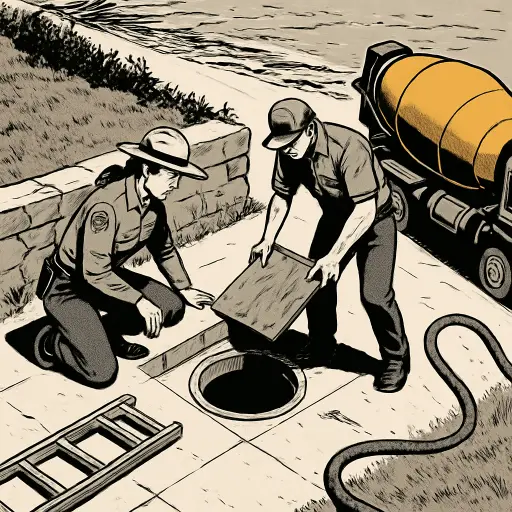
She looked at the mixer’s chute. It wasn’t aimed at the open cistern hatch. A rubber delivery hose ran toward the retaining wall.
“Where does that go?”
“Grout port,” Phelps said.
Audrey walked past him.
“That bank’s unstable,” he called.
The hose ended beside a broad iron pipe capped with plywood. Fresh scrape marks crossed the rust. Next to it lay a portable aluminum ladder, folded and secured for transport.
“Curtis.”
He joined her. Together they lifted the plywood.
A sour, mineral breath rose from below.
“Leonard!”
Nothing.
She knelt, lowering her face toward the opening.
Three taps came from underneath her knees.
Curtis called for the fire department.
Audrey put her mouth to the pipe. “It’s Audrey. Don’t move. We’ve found you.”
“About time,” came a faint reply.
She pressed both palms against the granite until they hurt.
Behind her, Phelps said, “He fell. I went for help.”
Curtis tightened a hand around his arm.
“With his boat?”
What the Tape Kept
The firefighters could not lift Leonard through the inspection pipe.
They cut asphalt instead, exposing the old square hatch beneath six inches of roadbed. Audrey stood close enough to smell the saw’s hot blade, answering every time Leonard called.
At twelve nineteen, they brought him up on a narrow rescue stretcher.
His left trouser leg had been cut open around a swollen ankle. Dried blood striped his temple. He caught Audrey’s sleeve as the paramedics carried him toward the ambulance.
“Recorder,” he whispered.
“We have the tape.”
His fingers loosened.
“Borrowed machine. Library’s.”
“We’ll sort it out.”
“Don’t let them charge me for it.”
Audrey walked beside him until the wheels reached pavement.
By late afternoon, investigators had photographed both tanks and seized Phelps’s records. He had billed the town for filling the smaller reservoir months earlier.
Leonard had brought him there to explain the empty space beneath the road.
At the hospital, with his ankle splinted and a bowl of untouched gelatin beside him, Leonard described Phelps pulling up the ladder. When Leonard threatened to report him, Phelps climbed down far enough to snatch the recorder, then left him in the dark.
“Must’ve thought he switched it off,” Leonard said.
“He did. Eventually. After it recorded him carrying it to your truck.”
“And he dropped the tape?”
“Looks that way. We found the machine in his equipment trailer.”
Leonard picked at the blanket. “I kept shouting. Wasted my voice.”
“You answered when it mattered.”
“You heard me through all that road?”
“Not until we opened the pipe.”
He looked toward the window. Beyond the hospital parking lot, sunlight flashed on a strip of harbor.
“Then how’d you know?”
Audrey pulled a chair beside his bed.
“Frances told me.”
“Frances Bickford?”
“On the other side of your tape.”
His mouth opened. Then he settled back against the pillows, carefully, as though trying not to disturb something.
“She said nobody wanted to hear her carrying on about wash water.”
“You’d better tell her she was wrong.”
Leonard reached for the bedside telephone.
“Get me my glasses,” he said. “She’ll want the whole story.”