A Cracked Teapot Makes a Postman an Impostor
A circus seamstress faces murder charges, and her postman risks everything on a borrowed authority.
- Detective Fiction
 By Storyleo Editorial
- 6 min read


The Woman Holding the Teapot
When Renato found me beside the dead circus owner, I was holding the murder weapon by its flowered handle.
“Put that down, Bianca,” he said.
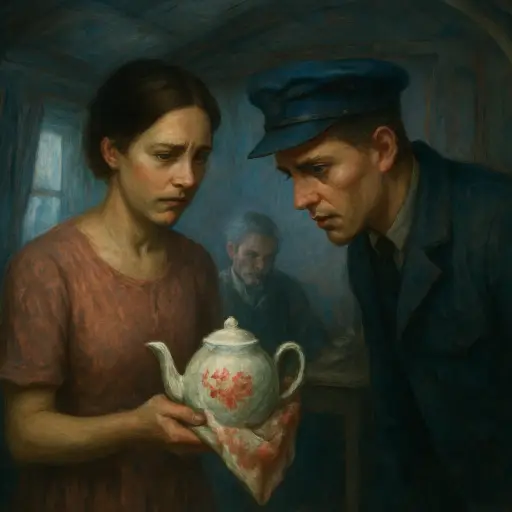
I obeyed so quickly the teapot knocked against the saucer. Blood had dried beneath its spout. Across its white belly ran the crack I had made the previous afternoon, reaching for a spool on Signor Conti’s shelf.
Outside the caravan, a trumpet practiced the same six notes. Someone shouted for the sawdust cart.
“I picked it up,” I said. “It was on the floor.”
Renato set his postal bicycle against the steps. His trouser clips were still fastened, his government cap crooked over one ear. I wanted absurdly to straighten it.
Conti sat behind his little desk, chin against his waistcoat. There was a dark wound above his temple.
“You must go,” I whispered. “You have your route.”
He looked at my red fingers, then closed the caravan door.
We had been meeting secretly since the circus reached Modena. He brought me bread with fennel seeds; I repaired the lining of his satchel. Last night, I had asked whether he might still visit a circus seamstress when the circus moved on.
He had not answered.
Now Vittorio, our ringmaster, pushed inside, followed by Signora Rizzi, who kept the accounts, and Arturo, whose shoulders barely fitted through the doorway.
“She threatened him yesterday,” Vittorio said. “Everyone heard.”
“I asked for six weeks’ wages.”
“Arturo, keep her here. I’ll telephone the carabinieri.”
Renato stepped between us.
“Nobody leaves. I’m conducting an investigation.”
Vittorio stared at his cap. “You deliver letters.”
“Postal investigation,” Renato said. “Conti reported interference with registered correspondence.”
I watched his thumb worry the split seam of his satchel.
Renato could not tell even a small lie without touching something broken.
A Larger Hat
“Your identification?” Signora Rizzi asked.
Renato showed his postal employment card, keeping his thumb over the lower half.
She reached for her spectacles. He put it away.
“Telephone the police, certainly,” he told Vittorio. “Tell them I require assistance. Meanwhile, I’ll take your accounts separately.”
“Accounts?”
“Of this morning.”
That was how it grew: one borrowed word supporting the next.
Vittorio said he had gone to buy lamp oil at seven. Arturo had been repairing the loading ramp. Signora Rizzi had brought Conti coffee at half past seven and found him working.
“Tea,” Renato said.
“What?”
“There’s a teapot.”
“He preferred coffee. That pot was ornamental.”
I glanced at it. Yesterday Conti had called me a clumsy cow when I cracked it. Then he had refused my wages again.
“He kept peppermints in it,” I said.
Renato lifted the lid with his handkerchief. Three white sweets rolled against the porcelain.
He examined the floor, then the wound, without touching either.
“A heavy blow,” he murmured.
Arturo folded his enormous hands. “I haven’t been inside since Tuesday.”
“Nobody asked you that,” Signora Rizzi said.
Renato looked at her.
On the desk lay an empty envelope, addressed in Conti’s steep handwriting. Renato turned it toward the window.
To the Public Prosecutor, Modena.
“Where is the enclosure?” he asked.
“Perhaps he hadn’t written it,” Rizzi said.
“He had.” Renato swallowed. “He told me yesterday it concerned stolen wages.”
I knew precisely what Conti had told him yesterday. I had been waiting by the steps.
Come back in the morning, postman. Registered item.
Nothing more.
Rizzi smoothed her skirt. “Then perhaps you know who was stealing them.”
Renato’s thumb found the torn seam again.
“Perhaps I do.”
The Crack That Was Clean
While Vittorio walked to the farmhouse telephone, Renato sent Arturo to guard the caravan steps. Rizzi remained outside, loudly counting the money in her cashbox for anyone willing to witness it.
“You’ll lose your position,” I whispered.
“Possibly.”
“For me?”
He bent over the teapot. “Please don’t make me answer that while I’m frightened.”
His hands were shaking now. I took the handkerchief and held the pot toward the window.
“I can’t see how it killed him,” I said.
“Neither can I.”
The blood lay in broad streaks around its belly. Yet the crack itself was white.
Renato leaned close.
“When did you break this?”
“Yesterday. Before supper.”
“If it struck his head hard enough to kill him, would that crack stay exactly as it was?”
“I wouldn’t trust it to survive a spoon.”
He pointed to a tiny red thread caught beneath the spout.
“Someone wiped blood onto it.”
I knew that thread. I had been hemming red cotton covers for the equipment wagon all week.
We went down the steps. Beyond the cook’s awning, the equipment wagon stood tilted on a screw jack. Its iron turning bar rested across the axle.
Arturo followed our eyes.
“I was using that until eight,” he said. “Then I went for breakfast.”
The bar had a broad, square end. One corner held a dark crust. Beneath it, where a wiping cloth had missed, was a strand of gray hair.
Conti’s hair had been gray.
“Who could take it?” Renato asked.
“Anyone.” Arturo’s voice shrank inside his chest.
From the awning, Rizzi called, “Have you finished persecuting us?”
Renato looked back at Conti’s caravan. Through the open door we could see the empty envelope.
“Not quite,” he said.
Then he leaned toward me.
“I need you to mend something.”
“What?”
“A lie. Before it splits.”
What the Postman Delivered
Renato gathered everyone outside the caravan. The lunchtime potatoes were boiling nearby, their earthy steam drifting through the crowd.
“Conti gave me a duplicate statement yesterday,” he announced.
My needle pricked my finger. I was sitting on the steps, apparently repairing his satchel.
“It names the thief. The original was taken from this envelope, but the duplicate is here.” He tapped the bag beside me. “Bianca, fetch it.”
“Which pocket?”
“The inner one. Behind the lining.”
Rizzi stopped counting her coins.
“You said you were investigating missing correspondence,” she said.
“Yes.”
“Not that you’d received his statement.”
“I didn’t think it necessary to tell you everything.”
I slipped my hand through the lining I had just opened. Paper rustled.
Rizzi lunged.
She caught my wrist and wrenched the sheet free so fiercely that my needle snapped. Then she backed away, holding it toward the cook’s fire.
Arturo caught her before she reached it.
Across the sheet, in Renato’s careful handwriting, was his delivery tally.
Rizzi stared at it.
“Where is it?” she demanded.
“Where is what?” Renato asked.
Her mouth closed.
Vittorio arrived with two carabinieri ten minutes later. Renato surrendered his employment card before anyone requested it.
“I’m a mail carrier,” he said. “I have impersonated an investigator. But please examine that iron bar before you arrest me.”
They found Conti’s statement beneath Rizzi’s cashbox, its torn pieces folded inside the false bottom. She had withheld our wages while entering full payments in the books; Conti had finally compared his ledger with ours.
The bar had killed him. The teapot had been meant to convict me.
Renato received a reprimand, a suspension, and considerably more attention from his supervisor than he enjoyed.
Three weeks later, he met our wagons outside Parma. I came down from the sewing cart carrying the cracked teapot. The police had returned it, and I had planted basil inside.
“You kept it?” he asked.
“It has excellent drainage.”
He laughed, then took off his cap.
“I have an answer. About visiting you.”
I straightened the bent badge with my thumb.
“No inventions this time.”
“Every Sunday,” he said. “Wherever I can reach you.”
It was a smaller promise than his investigation had been.
I trusted it completely.