The Napkin Map Beneath the Kimchi Fridge


The Napkin Under the Kimchi Fridge
The bloody handprint on the music room door belonged to a boy still taking his math exam downstairs. I knew because I was proctoring Class 2-4 when the alarm screamed through Haneul Foreign Language High School, making thirty students freeze.
“Mr. Han?” Min-ji whispered, clutching her sheet. “Is it a fire?”
“Stay seated,” I said, though my hand was already on my pocket. Three missed calls from Yu-na. That never meant anything good.
I taught Korean literature, packed lunches at dawn, and fell asleep with my youngest son’s dinosaur book on my chest. But before I was Appa, I’d been a patrol officer in Mapo. I still noticed things.
Principal Oh met me in the hallway, tie crooked, scalp shining with sweat. Inside the music room, iron stank under rosin and floor wax. A cello lay on its side. No body. Only the handprint—and a crumpled cafeteria napkin.
I lifted it with two pencils. A blue-ballpoint map marked the boiler room, old storage tunnel, and a stairwell sealed after the 2002 renovation. An X sat under the auditorium stage.
Find the blue case before Friday, or everyone hears the recording.
“Recording?” I asked.
Principal Oh snatched for it. I pulled it away.
“Call the police,” I said.
“We cannot have scandal during admissions week.”
Then Yu-na called again.
“Appa, Ji-ho isn’t at taekwondo. The master said he never arrived.”
The hallway tilted. Behind me, a burner phone buzzed inside the cello.
Your boy found the first clue. If you want him back, follow the napkin map. Alone.
I folded the napkin into my pocket and lied to the principal.
“I’m going to my classroom.”
Instead, I went hunting.
Under the Auditorium
The map took me through the cafeteria, past lunch ladies scrubbing radish stains from steel trays.
“Teacher Han,” Mrs. Park called, “why are you walking like a thief?”
“Because teachers aren’t paid enough to walk honestly,” I said.
She snorted, then pressed a warm fish cake skewer into my palm. “Eat. Your face looks like printer paper.”
I couldn’t swallow it.
Behind the recycling room, milk cartons hid an old stairwell. The lock looked new. Expensive. I used the key ring I had stolen from the principal’s office during last month’s fire drill, and one key clicked.
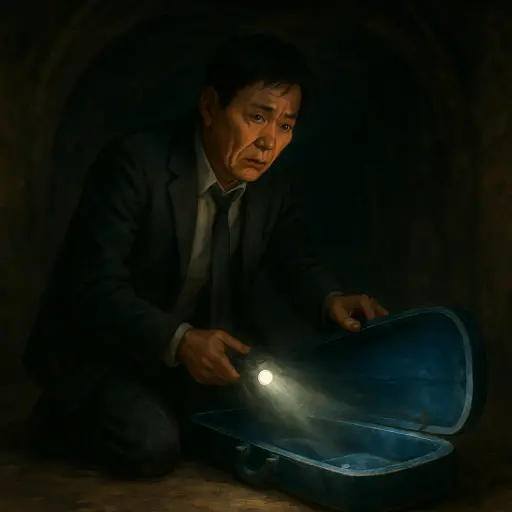
Cold air breathed up from below. I descended into dust and concrete until the tunnel under the auditorium opened around me, smelling of old wood and mouse droppings. At the X on the napkin map, I found a loose floor panel. Under it sat a blue violin case wrapped in a school cardigan.
Inside was no violin.
There was a voice recorder, a stack of exam papers, and a photograph of Principal Oh, Director Kang, and my late wife, Seo-yeon.
My knees gave way. Seo-yeon had taught art here before the hospital rooms and the white pills. She had died telling me to keep the children here because “at least the library is good.”
I pressed play.
“Director Kang, these scholarship scores are changed. Students with lower marks are admitted after donations. I made copies.”
“Think of your children,” Principal Oh hissed.
“I am,” Seo-yeon said.
The recording ended with a chair scraping and someone crying. My phone buzzed.
You found what she hid. Bring it to Seoul Station, locker B-117. Take the 3:20 train to Mokpo. Do not call police.
I called Yu-na.
“Did you find Ji-ho?”
“Take Su-bin to Aunt Hye-jin’s apartment. Do not go home.”
“Appa.” Her voice cracked. “You’re using your police voice.”
I closed the blue case. “Then obey it.”
At Seoul Station, locker B-117 held Ji-ho’s taekwondo belt and another napkin map. Mokpo Harbor. A ferry terminal. Gwanmae-do, written in clumsy English.
Appa.
I bought one ticket south.
As the KTX slid out of Seoul, the city loosened its grip, apartment towers giving way to fields, then rivers flashing silver under afternoon sun.
I held my wife’s recording in my coat and my son’s belt in my fist.
Across the aisle, a man in a baseball cap lowered his newspaper.
He was watching me.
The Island in the Yellow Sea
The man followed me all the way to Mokpo.
I watched him in train windows and elevator doors: broad shoulders, clean shoes, a scar near his left ear. At the ferry terminal I bought dried squid, held up two fingers, and turned.
“One for you.”
I drove my elbow into his stomach, swept his leg, and sent him hard onto the pavement.
“Where is my son?”
He coughed. “I’m on your side, you idiot.”
He flashed a badge. Detective Ma Dong-sik, Seoul Metropolitan Police. My wife had sent them files before she died. The evidence vanished.
“You waited four years?”
“The officer assigned to the case retired rich.”
Ma said the school was laundering donation money through island property. Ji-ho may have stumbled into a handoff. If he radioed it in, Kang would hear first.
The ferry horn bellowed. On the green-gray sea, my napkin map shook in the wind. On Gwanmae-do, we passed drying nets, a closed guesthouse, and a bare persimmon tree. Then I saw it: a boy’s sneaker print in the dirt above the fish warehouse.
Ji-ho wore cheap black sneakers because he said brand shoes made people slow.
I ran.
Inside, blue crates stacked to the ceiling. A freezer hummed. Somewhere a phone played a cartoon theme song—Su-bin’s favorite.
“Ji-ho!”
I found him in a storage closet, wrists taped, mouth covered, eyes blazing with fury.
“Ow! Appa!”
“Can’t breathe,” he said into my coat.
“Good. Breathing is required.”
Detective Ma cut the tape and pointed to the freezer. “The art teacher’s in there.”
Mr. Baek stumbled out wrapped in bubble wrap, lips blue, teeth clacking.
“I’m not dead,” he said, then fainted into Detective Ma’s arms.
Ji-ho grabbed my sleeve. “Appa, the bad person isn’t Mr. Baek. He tried to help me.”
Before I could ask who took him, loudspeakers crackled outside.
“Han Seung-woo. Bring the recorder out, and your children can finish school in peace.”
My phone rang. Yu-na’s name.
“Appa, Director Kang is here. She says Aunt Hye-jin invited her in.”
What Seo-yeon Drew
I stepped into the warehouse yard with both hands visible, the recorder hidden inside Ji-ho’s sock.
Principal Oh stood by a black van, sweat darkening his collar. Two men flanked him with fishing gaffs. On my phone, Yu-na kept the call open from her pocket; I heard clinking cups, Su-bin humming, Director Kang’s polished voice.
“Give it to me,” Principal Oh said.
“You kidnapped a child over admission fraud?” I said.
His mouth tightened. “Your wife ruined everything. She kept digging.”
Detective Ma was behind the crates, streaming the call to three numbers he trusted.
I needed Oh talking.
“Seo-yeon died of cancer,” I said. “You didn’t ruin her.”
His eyes flicked away.
“What did you do?”
“Nothing. She was sick.”
Then Yu-na shouted through the phone, “Su-bin, spill it now!”
A crash, Director Kang’s sharp cry, then Yu-na again:
“Her bag! Appa, I got her bag!”
My daughters. Brave, impossible girls.
Principal Oh lunged.
Ji-ho burst out and threw a crate of half-thawed mackerel at his knees. Oh went down in a slap of fish and dirt. Detective Ma rushed the two men while Mr. Baek, furious and newly defrosted, cracked one with a roll of bubble wrap.
Sirens wailed from the harbor road.
Later, officers cuffed Oh and found Director Kang trapped in Aunt Hye-jin’s bathroom, Su-bin’s strawberry slime sealing the doorknob.
Outside the island police office, Ji-ho turned over the napkin map.
On the back were tiny sketches: three children holding hands, a tired father, and a note in Seo-yeon’s hand.
Seung-woo, if this reaches you, forgive me for hiding trouble inside ordinary things. Follow the children. They notice exits adults forget.
We returned to Seoul at dawn. By noon, Haneul High was ringed with police, reporters, and angry parents. Scholarships were restored. Bribes were exposed. Seo-yeon’s name was cleared.
That evening, I pinned the napkin above our kitchen table.
“Isn’t that evidence?” Ji-ho asked.
“It’s a family portrait,” I said.
Su-bin pointed at the X. “Can we draw a treasure map to the ice cream shop?”
Yu-na grabbed a marker. “Only if Appa follows it alone and brings back four cones.”
I took a clean napkin, drew the corner store, and marked an X where the freezer stood.
Then I put on my shoes and began the smallest, happiest journey of my life.