She Trusted Her Quilt More Than Drawers
Blamed for a patient’s collapse, a nurse finds evidence stitched into the woman’s cherished quilt.
- Detective Fiction
 By Storyleo Editorial
- 6 min read


Blue Triangles
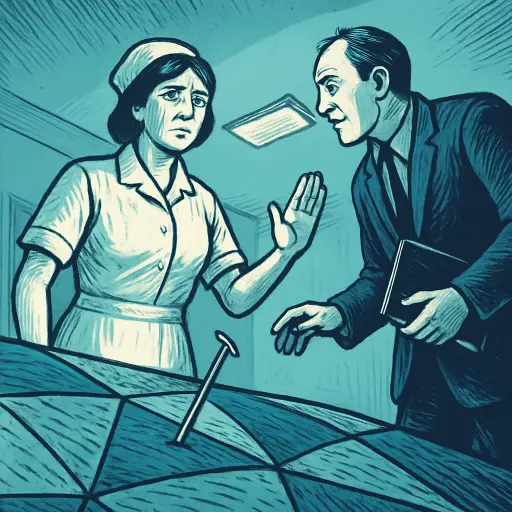
Denise Tran found the broken needle in the quilt while the policeman was explaining how she might have killed her patient.
It caught the fluorescent light: a sliver of silver protruding from a blue triangle beside Mrs Costello’s empty pillow. Denise stopped smoothing the patchwork.
“Don’t touch that,” she said.
Detective Patrick Keane lowered his notebook. “I was about to say the same to you.”
Beyond the bedroom window, a bread van rattled along Barkly Street. Footscray was waking. Denise had been awake since three the previous afternoon, and the starch beneath her collar had rubbed her neck raw.
At four-twenty, she had found Mrs Costello sweating through her nightdress, her pulse galloping and her jaw clenched. The ambulance officers had measured her blood glucose, given glucose themselves, and taken her to Western General.
Mrs Costello was not diabetic.
“You hold the drug keys,” Keane said.
“Yes.”
“You gave her the bedtime tablets.”
“Yes. Neither tablet was insulin. And insulin doesn’t come in a tablet.”
His pencil stopped.
Six months earlier, Keane had brought an injured prisoner into casualty during Denise’s shift. He had wanted answers while she was trying to stop the bleeding. She had ordered him out; he had complained to the charge sister.
Now he stood between her and the door.
Denise pointed at the quilt. “Someone injected her through that.”
“Or a needle was already caught in it.”
“Then preserve it and find out.”
Mrs Costello had made the quilt during the long afternoons when her swollen knees kept her indoors. Rust-red diamonds, yellow strips, blue triangles: no two sections quite matched. She would let nobody wash it with the home’s bedding.
Keane bent close without touching it.
“Did you move this before I arrived?”
“Only off her legs when the ambulance came.”
“And afterwards?”
“The manager wanted it sent straight to the laundry. I said the police might want the whole bed left alone.”
For once, he wrote down her exact words.
Keane Counts the Keys
Keane disliked being corrected in front of witnesses. He disliked unexplained needles considerably more.
He asked Denise to wait in the staff room, then examined the bedroom with the police photographer. A tiny brown spot marked the cotton around the metal. On the corresponding part of the sheet, there was nothing.
Perhaps it had happened elsewhere. Perhaps the nurse was right.
Perhaps was why he carried a notebook.
Graham Dempsey, the home’s manager, met him beneath a framed photograph of the 1981 staff Christmas party. His tie was fastened; his cardigan was missing a button.
“Dreadful business. Denise is usually very capable.”
“Usually?”
“Night duty takes its toll. Some people won’t admit it.”
“Who else has drug-cupboard keys?”
“The charge sister. There’s an emergency set in my safe.”
“Who opens the safe?”
Dempsey rubbed his thumb along his watch strap. “I do.”
He said he had come downstairs at three because the boiler was knocking. No, he had not entered Mrs Costello’s room. Yes, he had suggested laundering the quilt: there were standards to maintain.
Keane looked past him into the office. A portable television sat on a filing cabinet beside a tin of Danish biscuits. Nothing useful announced itself.
In the staff room, Denise had untouched instant coffee and both shoes off. She stood when he entered.
“Sit down,” he said.
“Am I being charged?”
“I’m asking you to sit down.”
She sat, but kept her feet beneath her chair.
“What do you know about her quilt?”
“She’s been unpicking the backing for weeks. Every time I come near, she puts it away.”
“Money?”
“I asked. She said money was no use if you couldn’t prove whose it was.”
Keane turned to a clean page.
“You didn’t mention that.”
“You hadn’t asked me anything about her.”
He let that stand.
“Would she speak to you at the hospital?”
Denise put her shoes back on.
“Mind My Yellow Squares”
Mrs Costello could swallow water by midmorning, but speaking left her breathless. Denise raised the bedhead while Keane pulled up a chair.
“Your quilt’s safe,” Denise said.
The old woman’s fingers picked at the hospital blanket.
“Not washed?”
“No.”
“Mind my yellow squares.”
Keane opened his notebook. “Did somebody hurt you last night?”
“Thought it was my knee needle.”
“Could you see who?”
She shook her head. “Dark. Said keep still.”
Denise rested the water cup within reach. “What’s behind the yellow squares?”
“What he gave me.”
“Who?” Keane asked.
“Dempsey. For my money.”
They waited while she gathered enough breath.
“Took it to bank. Wouldn’t bring the book.”
Denise felt the chair edge against the backs of her knees and sat down.
Mrs Costello had asked her twice to walk to the bank with her. Twice Denise had said they would arrange it on her next afternoon off.
Next week. Such an easy thing to give away.
“Why sew the papers inside?” Keane asked.
“He searches drawers.”
At the station, a scenes-of-crime officer opened the quilt along its existing loose stitches. Denise attended to identify the sections Mrs Costello had described.
Behind seven yellow squares lay seven folded receipts.
The first read:
Received from Mrs Kathleen Costello: $300 for deposit to her personal savings account. G. Dempsey. 12 March 1986.
The others brought the total to nineteen hundred dollars.
Keane used the telephone. Denise watched him make notes, ask for a supervisor, wait, and begin again. With Mrs Costello’s written authority, the bank eventually confirmed that no corresponding deposits had reached her account.
“Yesterday,” Denise said, “she asked me to get an envelope. A big one.”
Keane covered the receiver.
“For what?”
“A letter to the owner. She’d found his address in the office.”
“Did Dempsey hear?”
Denise remembered his hand settling on Mrs Costello’s chair, the way she had drawn her sewing into her lap.
“He brought her tea while we were talking.”
Keane uncovered the receiver. “I’ll need those details in a statement.”
A Cup with Two Sugars
By late afternoon, Keane had enough for a search warrant, though not enough to know which charge would hold.
The quilt proved that Dempsey had accepted the money. The bank established what he had not done with it. Neither put a syringe in his hand.
At the home, Dempsey watched two officers enter his office.
“She gets confused,” he said.
Keane handed him the warrant. “She keeps receipts.”
Inside the safe were the emergency drug keys, betting slips and a cashbook listing residents’ payments. Three entries beside Mrs Costello’s name had been altered from cash to cheque.
There was also a packet of insulin syringes.
“My brother’s diabetic,” Dempsey said.
“Does he live here?”
“He visits.”
Keane asked for his address.
Dempsey gave it, then sat heavily behind the desk.
The search continued. In the small incinerator behind the kitchen, officers found a partly burned insulin carton among blackened wage envelopes. The home’s refrigerator held its matching vial, short of most of its contents.
“You can’t prove I gave her anything,” Dempsey said.
Keane cautioned him. This time he did not interrupt.
Denise was finishing her statement when Keane returned to the station. Her uniform smelled of boiled cabbage from the home and disinfectant from the hospital.
“Charged?” she asked.
“Thefts tonight. Further charges when the laboratory reports come back.”
“And my drug count?”
“Correct. I’ve put that in writing for your charge sister.”
She read the page he offered, including the sentence acknowledging that her actions had preserved evidence.
“You might have asked before deciding,” she said.
“Yes.”
He brought her tea. She added two sugars, stirred, and drank before it cooled.
“She’ll want the quilt back,” Denise said.
“I’ll ask about releasing it after examination.”
“Ask her first. She might prefer another blanket for a while.”
Keane drew his notebook towards him. Earlier, he would have promised something brisk and reassuring. Instead, he wrote the question down.
Then he turned the notebook so Denise could check what he had understood.