Her Bent Wheel Reached the Queen
A soldier brings his mother’s broken bicycle to court, demanding more than permission to pass.
- Contemporary
 By Storyleo Editorial
- 4 min read


The Wheel Against the Throne
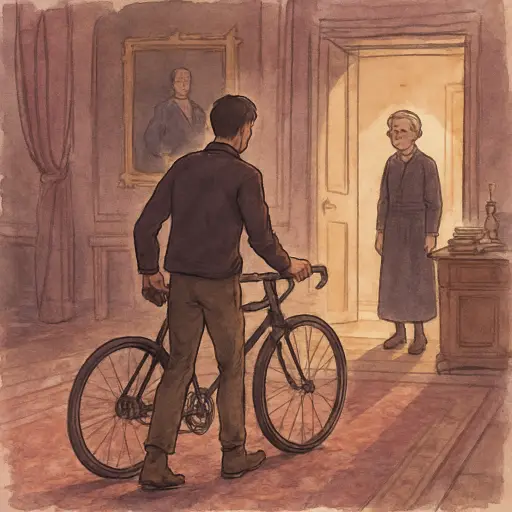
Marko carried the bicycle into the throne room because the guard would not let him roll it across the carpet.
Its front wheel resembled a dinner plate someone had tried to fold. Each step shook a dry little chime from the spokes.
I was the royal secretary then, responsible for appointments, unpaid electricity bills, and keeping Queen Vesna’s terrier off visiting officials. There were few officials left to worry about. By 2018, most people outside our valley mistook Rovina for a brand of bottled water.
“Bicycles go outside,” I said.
“So do soldiers. Usually.”
He wore desert boots beneath civilian trousers. A pale strip on his wrist marked where a watch had been; he kept rubbing it with his thumb.
“I got back yesterday. My mother’s in Greda.”
That was ninety kilometers away, beyond the reservoir, where the new hotel company had leased the mountain road.
“Residents have access,” I said.
He set the bicycle down carefully.
“Tell the gate.”
The wheel had bent when his mother struck the barrier coming downhill. She had broken her hip. Now she was back in her cottage, with a neighbor bringing food. Marko had walked six hours from the bus stop to reach her.
“I need to bring her down for treatment.”
“Submit a petition.”
“I’m due back with my unit Monday.”
Behind me, a door opened.
“Take the bicycle out of my secretary’s way,” said the queen. “And bring him a chair.”
The Blue Folder
Marko refused tea until someone told him how to open the gate.
Vesna sat beneath a portrait of her grandfather, wearing reading glasses repaired with white tape. Through the window came the shriek of a contractor cutting tiles in the courtyard.
“The lease guarantees access,” she said.
I fetched the blue folder. I knew the clause. I had typed it.
Access shall be maintained for registered permanent residents traveling in registered motor vehicles.
Marko read it twice.
“She rides a bicycle.”
“The company says pedestrians and bicycles create an insurance risk,” I explained.
“Then send a car.”
“They require residents’ vehicles to be registered with their office.”
“She doesn’t have a car.”
The queen took off her glasses.
“How many households?”
“Nine,” I said. “Seventeen people.”
“You know that very quickly.”
There had been eleven complaints. I had forwarded each to the company and filed each acknowledgment beneath it.
“We can seek an injunction,” I said.
“How long?” Marko asked.
I straightened the folder against the desk.
Vesna rang for her driver.
“We’ll visit your mother.”
“They’ll open it for you,” Marko said. “Then close it behind you.”
Outside, the tile cutter stopped. The quiet made the room seem smaller.
“Yes,” she said. “I expect they will.”
She told me to bring the lease and cancel the afternoon’s ribbon-cutting. Marko lifted the bicycle before I could offer to have it stored.
“It’s hers,” he said. “She’ll want it back.”
The Aluminum Barrier
We tied the bicycle to the roof of the royal estate car with luggage straps. All the way around the reservoir, its loose mudguard tapped above my head.
Marko sat beside the queen. He showed her a phone photograph of his mother beside an enormous cabbage.
“She sent that while I was overseas. No message. Just the cabbage.”
“A respectable specimen,” Vesna said.
“She wanted me to worry about something ordinary.”
At the barrier, a security guard came out carrying a paper cup. Beyond him stood three delivery vans, admitted through a second entrance.
He recognized the number plate immediately.
“Your Majesty. Of course.”
“And this man?” she asked.
“With you, certainly.”
“Tomorrow?”
He lowered his cup. “I’d have to telephone.”
“Please do.”
We waited in the dusty heat. Marko loosened the bicycle straps, lifted it down, and began turning the front wheel with his fingers. It stopped against the brake.
Click. Scrape.
The manager arrived in a white hotel shuttle. He explained liability, investment, and the jobs Rovina badly needed. Then he offered permanent vehicle passes for all seventeen residents.
“And their visitors?” Marko asked. “The nurse? Whoever fixes the boiler?”
“Arrangements can be made.”
Vesna asked me for the lease.
I handed it over, open at the access clause.
“Not that page,” she said. “The palace option.”
I looked at her.
“The whole court fits in two cars,” she said. “We’ve just demonstrated it.”
The Bus Ticket
The company had spent three years trying to buy the palace for its flagship hotel. Vesna had refused three years of offers while I moved buckets beneath leaking ceilings.
Now she placed the folder on the shuttle’s hood.
“An independent valuation. The collection remains public property. And this road becomes a public highway before completion.”
The manager reached for his phone.
“No promises today,” he said.
“No palace today,” said Vesna. “Open the gate.”
We reached Greda before dusk. Marko’s mother, Zora, was sitting outside with her injured leg on a kitchen chair.
“You brought the queen,” she said.
“I brought your bicycle.”
“That looks worse.”
He knelt to untie her shoe. She put a hand on his cropped hair and left it there while he worked.
That evening we brought her down to the hospital. Three months later, after lawyers had exhausted everyone, the palace sale paid for a community clinic and a bus. The road transfer was recorded first. I checked it myself.
People sometimes ask whether Vesna regretted giving up the throne room. I cannot speak for her. She conducted audiences in the municipal library afterward and complained chiefly about the chairs.
I retired six years ago. On Thursdays I take the bus to Greda for lunch with Zora and Marko, who repairs agricultural machinery now.
Her bicycle hangs outside his workshop, the front wheel still bent.
He offered to replace it.
“Repair the spare,” she told him. “That one got a road opened.”