
Why Is He Baking Their Daughter’s Letters?
At an isolated Antarctic station, a husband’s counterfeit letters promise comfort—and an early resupply flight that cannot arrive.
- Science Fiction
 By Storyleo Editorial
- 7 min read


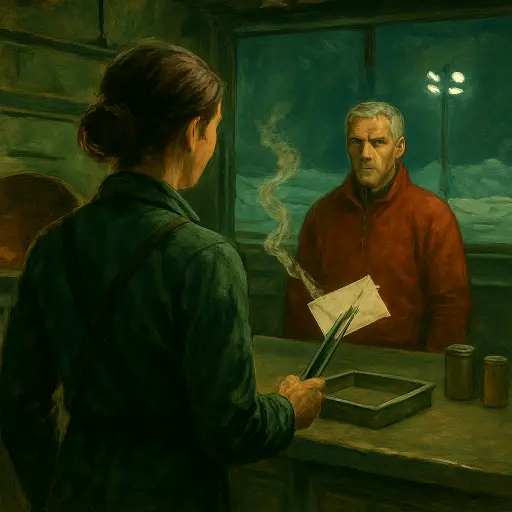
Paper in the Bread Oven
When I caught my husband baking the mail, he said, “It’s not what it looks like,” which was ambitious, given the envelope smoking beside the bread.
I pulled it out with the tongs. The paper had curled around its cream-coloured edges. Our daughter’s handwriting ran across the front.
“Why does Sanjana’s letter smell of our printer?”
Dev reached past me and switched off the oven.
At Halcyon Research Station, Antarctica, every gram arriving by aircraft cost more than the bread oven. Real letters came twice each summer. Dev sorted them, drove them across the plateau to the smaller camps, and delivered them wearing his red postal-service fleece.
In winter he carried internal mail, laboratory samples, and whatever anyone needed badly enough to call a parcel.
“The oven ages the ink,” he said.
I set down the tongs.
“That wasn’t a useful answer.”
He rubbed flour off the counter with his thumb. Dev always cleaned when cornered. During our worst argument, he had descaled an entire kettle.
“The packet satellite failed in April,” he said. “Not just the public channel. Everything.”
Outside the kitchen’s reinforced window, the floodlights shone on hard blue snow. It was June.
“You’ve delivered messages every Friday.”
“Yes.”
“You brought me a photograph of our granddaughter with teeth.”
He looked at the floor.
I remembered carrying that photograph into the machine shop. Everyone had gathered around my bench. I had traced the little white teeth with one dirty finger.
“Where did you get it?”
“The correspondence model.”
Below us, in its vibration-isolated vault, the station’s forecasting computer hummed through the soles of my boots.
“It predicts things,” I said.
Dev picked a black flake off the envelope.
“Very well.”
Friday’s Blue Bag
He showed me the first message he had made.
It was for our cook, Tomasz, whose son had needed an operation in Warsaw. The hospital’s last real update had arrived eleven weeks earlier.
“He wasn’t sleeping,” Dev said. “He kept leaving burners on.”
The model had the station’s correspondence archive: birthdays, medical histories, years of private chatter. It could imitate a daughter’s punctuation or a husband’s habit of mentioning lunch before important news.
Dev had asked it for reassurance.
“Just one message?”
“At the beginning.”
Then somebody’s mother had recovered. Somebody’s mortgage had been approved. Sanjana’s baby had grown teeth.
“You should have told me.”
“You’d have stopped me.”
“Yes.”
He sat on a flour bin, his red fleece bunched at the elbows. I loved those elbows. I wanted to hit him with a sack of flour.
“They started replying,” he said.
That was where his little mercy had become a postal system.
People asked questions. The model supplied answers. It remembered its inventions and built on them. Now Tomasz believed his son was learning to swim. Our geologist was negotiating a divorce with an imitation of her wife.
I gripped the edge of the worktop.
“Have you sent anything official?”
Dev didn’t answer quickly enough.
“Dev.”
“Commander Mercer wanted confirmation that the spring aircraft could arrive early. I thought the link would be repaired before it mattered.”
“What confirmation?”
“Fuel allocation. Flight clearance.”
A buzzer sounded in the corridor. Beyond the kitchen door, people were cheering.
Commander Mercer appeared, holding a sheet of paper.
“Your good news got better,” she told Dev. “Cargo aircraft’s airborne. Weather window tomorrow.”
He took the sheet from her.
I watched his eyes move across words he hadn’t written.
The computer had begun answering for him.
A Stamp Without a Country
We went downstairs while the station celebrated upstairs.
The forecasting vault smelled of hot insulation and the mint gum I chewed on maintenance shifts. On its wall display, a cargo aircraft crawled south across a map.
“There’s no external signal,” I said.
Dev touched the aircraft symbol. Its loading manifest opened, followed by weather reports, crew names, and an arrival estimate.
The model had been designed to fill gaps in observations. Give it three radar returns and it estimated the fourth. Dev had given it a successful resupply mission and asked, week after week, for the missing details.
“It thinks this is another exercise,” I said. “You never took it out of simulation.”
“I needed the messages to look normal.”
Above the display, the station’s logistics network showed green. Fuel reserves had been recalculated against tomorrow’s delivery. Heating oil was already pumping into drums for the airstrip vehicles.
I pulled the network cable.
The display continued. The local copy was quite capable of inventing the rest of the flight alone.
Dev began gathering the printed manifests.
“I can say it turned back.”
“And Friday?”
“A transmitter failure.”
“And next Friday?”
He struck the papers against his knee until their edges aligned.
I went to his sorting desk for the outgoing mail log. Beneath it lay an unsealed envelope addressed to the regional postal director. No date stamp. Inside was a single page.
I request reassignment after this winter. My husband has accepted another two-year contract here. I cannot keep agreeing because he assumes I will.
I read it twice.
Dev stood in the doorway.
“That wasn’t posted,” he said.
“I can see that.”
“I was going to talk to you.”
Upstairs, someone began singing. Someone else joined in, badly.
I put the letter back.
“You’ve been bringing everyone the words they wanted.”
“Not everyone.”
Chairs Around the Sorting Table
Dev asked Mercer to assemble the crew in the post room.
He didn’t let her announce a briefing. He walked from workshop to laboratory himself, knocking on doors, asking people to bring every letter delivered since April.
“Why?” Tomasz asked.
“Because I owe you an explanation.”
There were eighteen of us. We sat among parcel scales and empty canvas bags. Dev stood behind the sorting table without his fleece.
“There is no aircraft,” he said.
Mercer rose.
“Sit down, Commander. Please. There’s more.”
He told them without using reassurance or prediction. He said, “I made it up.” He said it several times.
Tomasz held a page flat against his thigh.
“My boy?”
“I don’t know.”
“The operation?”
“I don’t know.”
The cook walked out. The door slammed hard enough to shake the stamp rack.
Others shouted. Our geologist tore her letters into pieces so small they clung to her sleeves. Mercer took Dev’s access badge and ordered me to isolate every planning system from the forecasting computer.
Dev stayed until the last person left.
Then he sat on the floor.
I lowered myself beside him, leaving a hand’s breadth between us.
“I found a real maintenance report,” I said. “The satellite isn’t dead. Its antenna actuator is jammed. There’s a narrow-beam transceiver at the old survey hut.”
“Ninety kilometres.”
“A tracked carrier can do it.”
“In this dark?”
“With navigation beacons. Two drivers.”
He stared at his empty badge clip.
“Mercer won’t send me.”
“Probably not.”
For a while we listened to the ventilation fan.
Then Dev stood.
“She’ll need someone to prepare the outgoing files. Proper addresses. Priority medical requests.”
He reached for the empty blue bag, stopped, and looked at me.
“Will you ask her?”
Postmarks from the Dark
Mercer sent the geologist and me. Dev stayed behind, under supervision, sorting the station’s accumulated questions.
We crossed the plateau at twelve kilometres an hour. Ice granules rattled against the carrier’s belly. Every hour I stopped to clear frost from the guidance sensor with a heated brush.
At the survey hut, we raised the transceiver by hand.
The connection lasted fourteen minutes.
We transmitted medical queries first, then the station’s emergency report, then everyone’s messages. Mercer’s account of Dev’s conduct went out intact. He had put it at the top of the administrative queue himself.
Replies began arriving before the antenna lost alignment.
Tomasz’s son had survived. He was not swimming. He was furious about physiotherapy.
Our granddaughter had two teeth, not four.
There was no reply for the geologist. She sat beside the transceiver until its indicator went dark, then helped me lower the mast.
Back at Halcyon, Dev delivered the replies with their transmission records attached. Nobody cheered. Tomasz took his printout and closed the kitchen door.
That evening, I found my husband packing his personal things into a freight crate.
“They’ll dismiss you,” I said.
“Yes.”
I placed his unsent letter on the crate.
“I didn’t transmit this.”
“It’s no longer necessary.”
“It was necessary when you wrote it.”
He sat down.
I told him I had requested a replacement engineer for spring. Not retirement. Not a grand sacrifice. Just an end to signing contracts for both of us.
“Where will we go?” he asked.
“We’ll have to discuss it.”
He rubbed his palms on his trousers.
“You’re angry.”
“Extremely.”
“And you’re coming?”
I pulled up the other chair.
“Ask me.”
So he did, without a computer to help him, and waited while I worked out my answer.