
Something Beneath Meridian Is Stealing the Heat
As a heat-draining growth overtakes their station, a teenage intern discovers something strange about a cracked teapot.
- Science Fiction
 By Storyleo Editorial
- 7 min read

The Extra Cup
My daughter stole the station’s last twenty minutes of electricity to boil water in a cracked teapot.
“Anika,” I said, “put that down before I become the first mother arrested in Antarctica.”
She braced her boots against the galley cupboard. Behind her, frost crawled across the inside of the window in branching white fingers. The thermometer above the sink read minus six.
“It isn’t for tea.”
“Then you’re committing a very specific crime for nothing.”
The ceiling speaker clicked. Director Okafor’s voice came through thin and level.
“Thermal purge in thirty-eight minutes. All remaining personnel to the surface crawler.”
Yesterday, our drill had entered a chamber beneath fourteen hundred metres of Antarctic ice. Today, something from that chamber was climbing the borehole: transparent filaments that threaded steel, drank heat, and assembled more of themselves.
We had mistaken it for mineral contamination until the laboratory floor began growing walls.
The purge would divert our reactor’s stored energy down the shaft. Everything below Station Meridian would melt. Then we would leave before the foundations settled.
Anika had watched the evacuation briefing with both fists tucked beneath her thighs. At sixteen, she was our youngest winter intern, officially assigned to maintain sample inventories. Unofficially, she had spent six weeks finding mistakes in everyone else’s work.
“It stopped,” she said.
“What stopped?”
She pointed at the teapot.
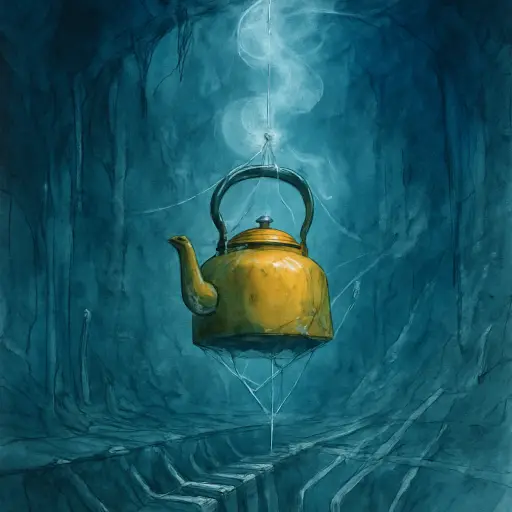
It was yellow, with a chipped green handle and a hairline crack beneath the spout. My mother had posted it south for my birthday, packed in enough wool to clothe a chair.
A transparent thread lay across its belly. Everywhere else, the filaments were branching.
Here, one had curled back on itself.
“I poured hot water in,” Anika said. “It made that clicking noise. And this bit stopped growing.”
I reached for her sleeve.
She caught my hand instead.
“Mum. Look before you drag.”
A Noise Between Notes
I gave her three minutes because I loved her, and another four because she was right.
We carried the pot into the materials laboratory inside a cooking tray. Ice crackled beneath my boots. Somewhere behind the wall, a pipe made the dull booming sound of metal giving up.
Anika attached two contact microphones to the ceramic.
“The kettle was on here when the filament reached it,” she said. “I thought heat repelled it. But it swallowed a hotplate.”
“It absorbs heat to build. We know that.”
“Then why not this?”
She poured. The pot gave its familiar little complaint: tik-tik… tik.
On the monitor, two sharp traces appeared, followed by a third.
“The crack opens as the inside heats,” I said. “Then the outside catches up.”
“Three pulses. Two close together. One late.”
She replayed footage from the borehole camera. Before every new branch formed, light flashed along the filaments.
Two flashes. A pause. A third.
I leaned so close that my breath clouded the screen.
“That’s not a colony.”
“No.” She rubbed her thumbs against her fingertips, a habit she had kept since learning to solder. “I think it’s a machine building something.”
The drill team had recovered a hollow, six-sided fragment from the chamber. Its faces bore channels finer than our best etching equipment could produce. We had called them crystal defects.
Perhaps we had drilled through a roof.
Okafor answered on the second call.
“You should be outside,” she said.
“We may have found a stop command.”
“May?”
Behind Anika, frost whitened the emergency shower.
“Give us until the ten-minute mark,” I said. “Keep the purge armed.”
Silence. Then: “If your daughter is still underground at ten minutes, I come down myself.”
Anika leaned toward the microphone.
“Bring hot water.”
The Wrong Kind of Perfect
We tried speakers first.
Anika copied the clicks into a signal generator and pressed a transducer against the nearest filament. It split into six branches.
“Off,” I said.
“Already off.”
The new branches pierced the laboratory bench. A drawer fell out and scattered drill bits across the floor.
Anika pulled up the recordings again. Her lips moved as she counted.
“The spacing changes.”
“Of course. The pot’s cooling.”
“We sent the same instruction over and over. Whatever that instruction was.”
I checked the wall clock. Nineteen minutes.
Our instruments had filtered out the small irregular noises between the three obvious clicks. Anika restored the raw recording. The screen filled with tiny jagged strokes.
She tapped one. “Those happen as it cools.”
“Ceramic contracting.”
“Maybe that’s the rest of the instruction.”
We set a fresh filament across the pot and filled it again. As the water cooled, the thread stopped, looped back, and joined itself. A closed ring.
Beside it, the bench continued to disappear beneath clear spines.
“A boundary,” I said.
Anika exhaled hard through her nose. “It’s building a room. We’re telling it the room is finished.”
The purge warning sounded: three low notes.
We needed the signal at the borehole, where the main trunk could carry it down. We needed a continuous supply of hot water and a way to reproduce the pot’s whole cooling cycle.
“I can build a heater jacket,” I said.
“No time.”
“Then we lower the pot.”
She looked at the yellow glaze, the green handle wrapped in repair wire.
“Gran sent you that.”
“Yes.”
“You said nobody was allowed to break it.”
I swept the drill bits aside with my boot.
“I’m revising the household regulations.”
What We Lowered
The borehole room smelled of hot insulation and the sharp, clean scent of freshly fractured ice.
Clear ribs climbed its walls. Between them, the steel panels had drawn inward like fabric pulled by stitches.
Okafor stood at the hatch in her evacuation suit, holding a vacuum flask.
“Eleven minutes,” she said.
“You’re early,” Anika told her.
“A privilege of command.”
We strapped the teapot into a sample cradle. I fed a thin water line through its lid and connected the other end to the borehole’s sterilizing boiler.
The main filament bundle rose from the shaft, thick as my wrist. Beneath its surface, pale points travelled downward.
Anika clipped a temperature probe against the crack.
“We fill, drain, let it cool,” she said. “Same as upstairs.”
“And if it grows?” Okafor asked.
“Pull it out.”
The cradle descended. One clear strand touched the pot’s belly.
I opened the valve.
Tik-tik… tik.
The bundle flashed. A new rib punched through the floor beside my foot.
Okafor grabbed the winch lever.
“Wait!” Anika caught her wrist. “It hasn’t cooled yet.”
The room shuddered. Over the speaker, the purge controller began its five-minute warning.
I shut the water off and opened the cradle’s drain. Steam rose from the shaft.
The pot clicked again, softly.
A line of white travelled down the bundle. The rib beside my boot stopped halfway through the steel.
“Again,” Anika whispered.
We filled and drained. The crack lengthened with a sound I felt in my teeth.
Three minutes.
The teapot’s bottom fell away.
Anika reached for the winch. I caught her harness before she could lean over the shaft.
Below us, the broken yellow pieces hung motionless, caught in a transparent web.
Then the web drew them together.
A small ceramic click travelled up through the floor.
A Place Set Aside
“Cancel the purge,” I said.
Okafor was watching her thermal display. “The temperature’s still falling.”
The web tightened around the pot. A bright point ran along the crack, paused, and returned.
Tik-tik… tik.
Across the room, every unfinished rib folded inward. Not violently. Each bent at the same precise angle until the floor lay clear.
Okafor pressed her microphone.
“Abort thermal purge. Hold reactor at standby.”
The controller requested confirmation.
She gave it with forty-one seconds remaining.
We stayed in the crawler for two days while instruments watched the station.
Anika slept against my shoulder, smelling of solder flux and orange peel. Whenever I shifted, her hand closed around my cuff.
On the third day, a survey robot descended the shaft.
The chamber below was no longer empty. Transparent partitions enclosed rows of small hexagonal cells, each maintaining a different temperature. Some held liquid water. Some held gases drawn from the borehole ventilation line.
One held the yellow teapot.
“A specimen room,” Okafor said.
Anika shook her head. “Look at the feed lines.”
The cells had water, heat, and tiny adjustable vents. Whatever the machine’s builders had intended, it had been assembling places where fragile things could survive.
We had entered with a drill and given it no reason to stop enlarging its accommodation.
The pot had supplied a limit.
A week later, the robot brought it back.
Transparent material bridged the missing base. The crack remained, supported along both sides by threads finer than hair.
Inside lay a second object: a yellow cup, small enough to fit Anika’s hand.
She turned it over carefully.
“They copied it.”
“Improved it,” I said.
“They left the crack.”
I poured hot water into the pot. It clicked; beneath our boots, something answered.
Anika set her new cup beside mine.
This time, we made tea.