
An Oud Cannot Buy Forgiveness
After decades away, a musician brings his sister a stolen recipe and a dangerous apology.
- Science Fiction
 By Storyleo Editorial
- 6 min read


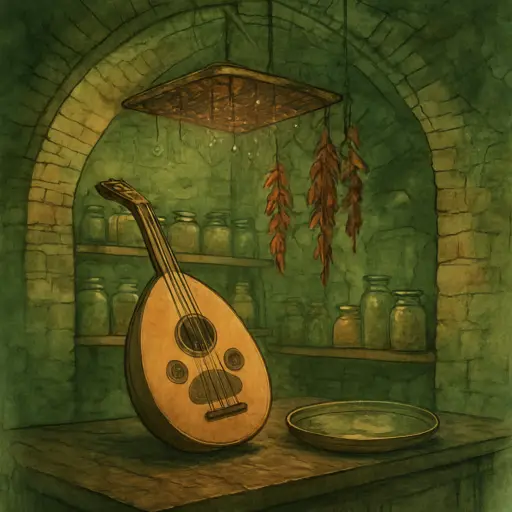
The Wrong Note
Cem’s first coin in Istanbul struck his oud while he was still playing, thrown by a woman who wanted him to stop.
“You’ve flattened the third note,” she said.
Above her, strings of dried peppers hung beneath the Spice Bazaar’s brick vaults. Thirty-one years had whitened her eyebrows and bent two fingers sideways, but Derya still held her chin as though someone had offered her a bad price.
Cem lifted his hand from the strings. “You used to sing it that way.”
“I used to have a brother.”
Behind her stood their mother’s spice counter. The walnut drawers remained, polished nearly black. The copper cooling lattice above them was new, and dead. Its little display showed forty-three degrees.
He had rehearsed this meeting on the transport from the lunar construction yards. In every version, he had managed more than opening his mouth.
Derya glanced at his instrument case. “If you need money, play outside.”
“I brought something.”
He slid a folded sheet from beneath the oud’s strings. It smelled faintly of the hot plastic sleeve in which he had carried it through customs.
Derya did not touch it.
“Another contract?”
“A recipe.”
She laughed once, without opening her lips.
The last recipe he had brought home had cost them their mother’s laboratory, their savings, and eventually their mother herself. He had sold it to pay a passage off Earth. The company had promised her royalties.
“This one,” he said, “I stole back.”
From somewhere beyond the stalls came the sharp double chime of an inspection trolley. Derya pulled a canvas flap across her shelves.
“Then you’ve chosen an excellent morning to return.”
The Price of Cool Air
The bazaar smelled wrong.
There was still cumin, coffee, the warm leather smell of sumac. Underneath lay spoiled sweetness. Without cooling, the living spice cultures were cooking in their jars.
Derya took him behind the counter, out of sight of the aisle.
“Three missed licensing payments,” she said. “They switched us off yesterday. Today they collect the equipment.”
Cem touched the copper lattice. Their mother had grown its first membranes in soup bowls: bacteria weaving sheets that pumped heat when fed electricity. Rooftop solar supplied the power. Kitchen scraps fed the cultures. She had intended every stallholder to make their own.
Now the company sold sealed cartridges and charged for every hour of cool air.
“I know.”
“You read that on the Moon?”
He nodded.
“And it took you thirty-one years to buy a ticket?”
His thumb worried a groove in the oud’s neck. There was no answer that did not sound smaller spoken aloud.
He unfolded the recipe. Ingredient weights crowded one side; activation sequences filled the other.
Open culture. No remote shutdown. Feed ratio: seven parts sugar waste to one part mineral stock. Activation through legacy acoustic port.
Derya read it twice.
“You stole a company culture?”
“Their latest. But I removed the dependency genes.”
“You’re a musician.”
“On the Moon I cleaned fermentation tanks between performances. For twenty years.” He showed her the pale chemical scars along his wrists. “I learned.”
She pressed one crooked finger against the paper.
“Did you test it?”
“In a lunch container. It kept my milk cold.”
“My entire stock against your milk.”
The trolley chimed again, closer.
Cem reached into his coat and produced a small flask.
Derya stared at its cloudy contents. Then she took it from him.
“Not my entire stock,” she said. “One drawer.”
A Kitchen Instrument
The old acoustic port was beneath the counter, beside a scorch mark Cem remembered making at twelve.
Their mother had designed her equipment for kitchens with neither reliable networks nor money for controllers. A cheap piezoelectric receiver accepted commands as tones. She had whistled at her first cooling bowl, then complained that neither of her children could keep time.
“She would have hated those cartridges,” Cem said.
“She did hate them.” Derya unscrewed the receiver cover. “She wrote letters until holding a pen hurt.”
He bent over his oud.
Don’t ask whether she mentioned you.
He asked anyway.
Derya kept working. “Not after the first ten years.”
The words settled between them with the weight of something carefully placed.
Cem plucked the activation sequence. Six bright notes, a pause, then a descending pair. The receiver blinked amber.
Derya poured the culture into a shallow nursery tray. “Again.”
He played it.
The tray’s heating element clicked on. Across the cloudy surface, tiny islands began joining into a skin.
“Nineteen minutes,” he said.
“Until what?”
“Until we can feed it into the lattice.”
A man in a pearl-grey cooling vest stopped outside their stall. Behind him, the inspection trolley extended two padded clamps.
“Good morning, Ms. Aksu,” he said. His cheeks were comfortably dry. “Please leave the licensed cartridge in place.”
Derya stepped in front of the nursery tray.
“It’s empty.”
“It remains company property.”
The inspector’s gaze dropped to the recipe.
Cem saw him recognize the laboratory formatting before he recognized anything else.
“Where did you get that?”
For three decades, Cem had been leaving rooms before anyone could ask him that sort of question.
He set his oud across his knees.
“Pull up a chair.”
Nineteen Minutes
The inspector did not sit.
He photographed the paper, then Cem’s face. “That formulation is restricted.”
“So was my mother’s,” Cem said. “After you bought it from someone who had no right to sell it.”
Derya looked at him sharply. He had always said we sold it in the messages he never finished sending.
The inspector tapped his wrist terminal.
“Security will decide that. Step away from the apparatus.”
Behind the counter, the nursery tray gave a soft click. Too soon.
Derya looked down. “Temperature’s falling.”
The inspector had disconnected the stall’s power.
Cem stopped playing.
At the neighboring counter, an elderly merchant lowered his coffee.
“My freezer still works,” he said.
The inspector turned. “Connecting an unlicensed biological device to a licensed circuit—”
“I was discussing my freezer.”
Derya was already crawling beneath the partition with an extension cable.
Cem resumed the holding sequence. His fingers had begun to sweat; one slipped. The receiver flashed red.
“Start that measure again,” Derya said from the floor.
He did.
People gathered, first to watch the argument, then to peer at the tray. Someone brought a battery pack. A coffee seller crouched beside Derya and held the cable clear of a puddle.
“What are you playing?” he asked.
Cem looked at the inspector’s recording terminal.
Then at the phones raised throughout the aisle.
“Instructions,” he said.
He read the ingredient list aloud between measures. Derya, emerging dusty from under the counter, caught on first.
“Slower,” she said. “People need the weights.”
The inspector reached for the paper.
Derya lifted it above her head.
“Photograph this side first,” she called to the crowd. “The other side tells you how to keep it alive.”
For the remaining eleven minutes, Cem played while his sister dictated.
A Place Behind the Counter
The first breath from the lattice smelled of warm copper and oranges.
Then cool air touched Cem’s knuckles.
Derya held a thermometer beneath the lowest membrane. Forty degrees. Thirty-six. Thirty-two.
No one cheered until she did: a startled, furious shout that made Cem miss a note.
“Keep playing, idiot!”
He laughed so hard he had to begin the measure twice.
The inspector watched the falling temperature. His terminal kept chiming as copies of the recipe crossed the bazaar’s local network.
“Distribution doesn’t make this legal,” he said.
“No,” Derya replied. “But now we can afford to argue.”
She gave him her business registration and demanded a receipt for the cartridge he removed. By the time he left, three neighboring merchants had requested notices in writing too.
At closing, the bazaar’s stone floor released the day’s heat through Cem’s thin soles. Derya divided the new culture into six clean jars, keeping the seventh beneath the lattice.
“They may come back tomorrow,” he said.
“Of course they will.”
“I can stay. Give evidence. There are laboratory records in my luggage.”
She screwed a lid tight. “Then fetch your luggage.”
He watched her for some sign that she meant more than tonight.
Derya reached into a low drawer and took out their mother’s brass measuring scoop. Its handle had been repaired with wire.
“She kept your little room,” she said. “I turned it into storage.”
“That’s all right.”
“You’ll have to move forty kilos of chickpeas.”
He put down his oud.
She caught his sleeve before he could lift the first sack.
“Cem. I haven’t forgiven you.”
“I know.”
Her fingers loosened.
“And tomorrow you can play outside. Customers don’t need nineteen minutes of the same tune.”
For the first time since arriving, he left his instrument behind the counter.