The Keeper of the Lantern
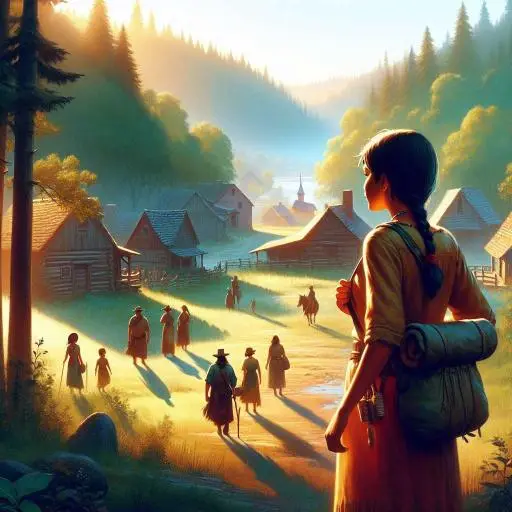
Before leaving his drought-stricken village, a boy follows a lantern bearer toward the cliffs.
- Inspirational
 By Storyleo Editorial
- 4 min read


The Last Spoonful
On the evening Fenris decided to follow Alara, he watched her pour her supper into the lantern.
Not the soup itself, but the spoonful of oil floating on top. She skimmed it carefully, tipped it into the brass reservoir, and ate what remained beside her open doorway.
Across Elarin, shutters closed against the smell of scorched fields. The river had shrunk to a thread between stones. Fenris stood behind the communal oven, holding a sack his mother had asked him to pack.
They were leaving at sunrise.
“Where do you go?” he called.
Alara looked up from trimming the wick. She was young, scarcely older than his eldest cousin, with a patched skirt and a blister across her palm.
“Around.”
“Nobody walks around anymore.”
“That makes it easier to hear anyone who needs me.”
She shut the lantern’s little glass door and set off.
Fenris hid his sack beneath the oven bench. He wanted to ask whether she knew something the others didn’t—whether there was water beyond the hills, or grain, or any reason his mother should unpack.
Instead, he followed.
Along the riverbank, Alara lifted her light for a woman gathering bitter greens. At the forest edge, she waited while an old charcoal burner found his walking stick.
Neither thanked her with words. The woman straightened her shoulders. The old man raised two fingers.
Then Alara climbed toward the cliff above the meadows, and Fenris hurried after the small gold square swinging beside her knee.
What the Flame Could Do
Loose shale slid beneath his heel.
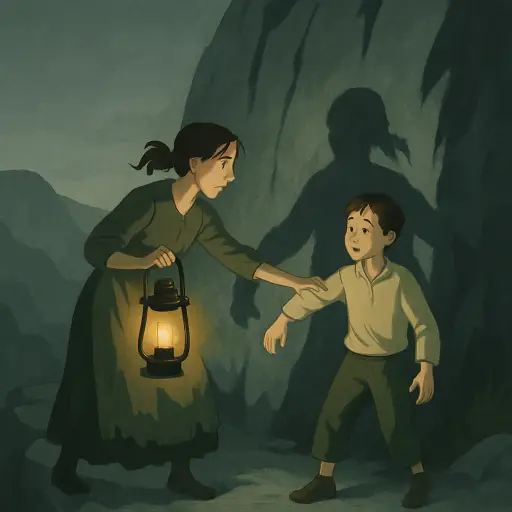
Alara caught his sleeve before he reached the steepest part of the slope. For a moment they stood breathing hard, the lantern throwing enormous versions of them across the rock.
“You could have asked to come.”
“You could have answered me properly.”
She laughed once and helped him onto the cliff path.
Below them, Elarin looked almost deserted. Only the communal oven showed red through its vent.
“We’re leaving tomorrow,” Fenris said.
Alara set the lantern between them. “Do you want to?”
He picked at a split thumbnail. “I want my mother to stop counting bread before she cuts it.”
For a while, Alara said nothing.
“My father used to come home over that ridge,” she said at last. “Whenever he was late, my grandmother put a light here. After he died, she kept putting it here.”
“Why?”
“Other people were still coming home.”
Fenris studied the flame. “Does yours make them come back?”
“No. It helps them find the turning.”
His mouth tightened. “Then it won’t fix anything.”
Alara opened her blistered hand beside the glass. “Not the fields. Not an empty cupboard.”
A faint call rose from below.
She stood immediately and lifted the lantern high. Far across the meadow, someone raised a bundle overhead: the missing charcoal burner, who had taken the wrong track.
“But that,” she said, “we can do.”
Fenris reached for the handle. “Let me hold it while you go down.”
The Weight of Brass
By morning, Fenris’s mother had unpacked the sack.
“One week,” she said. “The charcoal burner says there’s work clearing the old irrigation channel. They’re paying in barley.”
Fenris nodded so hard she caught his chin to inspect him.
“And next time you spend half the night on a cliff, tell me first.”
He carried stones from the channel that afternoon. That evening, with aching arms, he walked beside Alara.
Years put water back in the river and silver into Alara’s hair. Fenris grew broad enough to lift grain sacks alone. He learned which bank crumbled after frost, which cottage held a sleepless widow, and where a frightened child might hide.
Then, one autumn, Alara stopped halfway up the cliff path.
“A stone in my shoe,” she said.
Fenris knelt. There was no stone.
Neither of them spoke about it until they reached her doorway.
“Tomorrow,” she said, “you take it.”
“I already carry it half the way.”
“Tomorrow you decide where it goes.”
The village gathered at dusk. Someone had swept the square; someone else brought late chrysanthemums in a chipped jug.
Alara placed the polished lantern in his hands.
Fenris checked the reservoir. A little oil washed against the bottom.
“Enough?” he whispered.
“For tonight.”
He looked toward the cliff. With everyone watching, the familiar path suddenly seemed very long.
Alara touched his wrist. “Your hand is shaking.”
“I know.”
“Mine did too.”
He took the first step before he could find another objection.
The Light Behind Him
The wind caught him above the forest.
It struck hard enough to tear the lantern door from its worn catch. Fenris turned his body around the flame, but the wick gave a blue twitch and vanished.
Hot brass pressed into his fingers.
He crouched beneath the cliff, fumbling for his tinderbox. The first spark died. The second found the tinder, then guttered when he tried to transfer it. Oil had spilled down his sleeve.
Not tonight.
Below him, a pebble clicked.
“Alara?”
“No,” called a woman. “And if you ask my knees to climb any faster, I’m going home.”
His mother emerged around the bend carrying a kitchen lamp. Behind her came the miller with a candle shielded inside a jar, then children, then the charcoal burner’s grown granddaughter.
Warm pinpricks moved through the trees.
Fenris stared. “You followed me?”
“We thought you might need company,” his mother said.
“I let it go out.”
She examined the bent catch. “Then hold this while I find you a flame.”
By the time they reached the cliff, the lantern burned again. Fenris set it on the flat stone and turned toward Elarin.
Alara sat far below beside her doorway, a blanket over her knees. He raised the lantern. She raised her hand.
“Who carries it tomorrow?” asked a child beside him.
“I do,” Fenris said.
The child’s face fell.
He lowered the handle until her hand could fit beside his.
“But there’s room.”