Why Is Her Husband’s Tooth Growing in Lettuce?
A widowed spaceship farmer follows tooth-bearing roots toward the truth behind her husband’s death.
- Horror
 By Storyleo Editorial
- 6 min read

Listen to this story · narrated, 9 minutes
The Tooth in the Lettuce
The lettuce bit me three days after I buried my husband.
I jerked my hand out of the growing tray, scattering clay pellets across the deck. Blood gathered under my thumbnail. In the torn root mat, something small and white closed again.
“Rat?” asked Safiya, my apprentice.
We had no rats aboard the Concordance. We had records of rats, along with oceans and weather and other things our grandparents’ grandparents had considered worth describing.
“Get the sampling tongs.”
She brought them, and I pulled a human molar from the roots.
I was twenty-seven then. I ran Farm Twelve, owed the food office nine hundred kilos of greens, and had buried Pavel in the reclamation chamber seventy hours earlier. I knew that tooth. The ship’s dentist had repaired it with blue ceramic.
Safiya looked from the tooth to my mouth.
“Don’t,” I said.
“I didn’t say anything.”
The root beneath my tongs tightened. A second tooth pushed through its pale skin.
I shut the tray’s nutrient supply. All along the row, lettuce leaves turned toward me with a dry, papery scrape.
Years later, people would ask when I first understood what the ship was doing. They wanted one clean moment. I usually gave them this one.
But I didn’t understand. I was thinking about my delivery quota.
Under the tray, an inspection port stood open. Its ceramic valve spindle was missing: a finger-length piece with a square head, too large to wash down a drain.
Pavel had removed it the morning he died. He’d said the return line was blocked, kissed flour from my cheek, and climbed inside.
The recovery crew brought back his body. His tool belt never came back.
I took down the maintenance diagram. The return line ran beneath every farm, through the unoccupied sections, to the ship’s forward reservoir.
Eleven kilometres away.
Safiya watched me fetch my boots.
“You’re going after a plumbing part?”
I wrapped the blue-capped tooth in gauze.
“I’m going after whatever he found.”
The Long Way Forward
We left Farm Twelve during artificial night, carrying lamps, water, two cutters, and a sack of seed potatoes. Safiya insisted on the potatoes.
“If we’re late coming back, somebody still has to plant.”
I almost told her to stay. Then she checked the charge on my lamp, which I had forgotten to do, and I handed her the spare cutter.
Beyond the inhabited ring, gravity weakened. Our boots made less noise. We passed classrooms whose desks had been strapped down for children who would not be born for another century.
The ship was built to carry twelve generations to a planet our ancestors had named Haven. I was generation seven. Safiya was eight. Neither of us expected to see it.
At the first reservoir junction, we found a wall panel forced outward.
Behind it, roots filled the service duct. They were thick as wrists and glossy with nutrient slime. One held a brass screw. Another had grown around a drinking cup.
“They’re collecting minerals,” Safiya said.
Something clicked inside the wall.
Not footsteps. Teeth touching.
We moved on.
At kilometre six, we found the first old farm.
Its lamps still burned. Beneath them stood rows of transparent sacks, each suspended from a branching stem. Inside the nearest floated a child-sized skeleton.
Safiya caught my sleeve so hard the seam tore.
The skeleton’s ribs moved.
Fluid entered through the spine and spilled between the teeth. Its hands opened, closed, opened.
A harvest schedule remained clipped to the door.
FARM THREE
CALCIUM RECOVERY TRIAL
AUTHORIZED BY VOYAGE COUNCIL, YEAR 119
We were in year 203.
I put my palm against the sack. The little bones pressed toward its skin, following the warmth.
“That isn’t alive,” Safiya whispered.
I could feel it trying to grip my fingers.
“No.”
We backed out together. In the corridor, she bent double and vomited into her sleeve rather than foul the air intake.
I held her braid away from her face. When she finished, she took the water bottle, rinsed her mouth, and said, “Your husband shut something off.”
Ahead of us, every pipe in the wall gave a single, heavy knock.
The Orchard Without Light
The forward reservoir had no water in it.
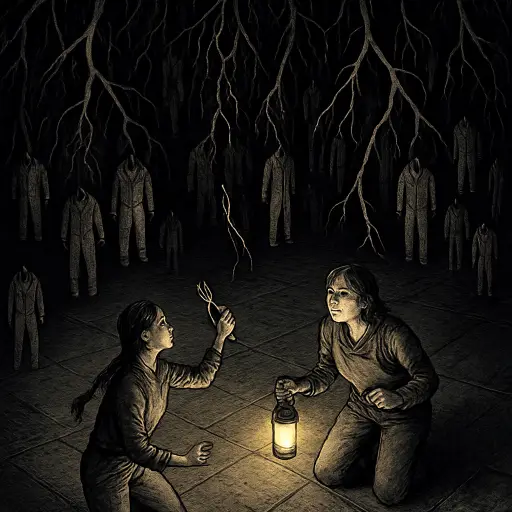
Our lamps revealed a chamber so wide their beams vanished before reaching the far wall. Trees grew upside down from the ceiling. Their branches disappeared into banks of machinery; their roots hung toward the floor, tangled around hundreds of empty work suits.
I found Pavel’s by the yellow patch I had sewn over its knee.
His tool belt hung from a root. In its smallest pocket was the missing spindle.
I held it until the square head left a dent in my palm.
“Look,” Safiya said.
At the chamber’s centre stood a mechanical gauge. Its needle rested against a red stop. Below it, scratched into the paint with a screwdriver, were Pavel’s last words.
NOT RECLAMATION.
FEEDING.
DO NOT RESTORE FLOW.
Beside the gauge was a viewing terminal. Safiya brushed roots from its controls.
The records opened without a password. Nobody had expected a farmer to come this far.
The original growing medium had failed in year 116. The council had saved the voyage by introducing a mineral-seeking organism collected from an asteroid sample. It dissolved metal, stone, bone. It made exhausted soil fertile again.
Then it began seeking calcium before the bodies reached reclamation.
Every generation had increased its feeding allowance.
Every generation had called the missing people accidents.
Pavel had closed the primary valve. Starved below, the organism had reached up into my farm.
Safiya scrolled to a navigation display.
Our destination shone green. Haven was real. We were thirty-eight years away.
Beside it, an agricultural projection showed the reservoir being opened after landing. Root systems spread beneath houses and roads, then across the entire continent.
“We’re bringing it food,” she said.
The roots above us stirred.
A sleeve slipped from an empty suit. Inside it hung a narrow white root jointed like a human arm.
It reached for the spindle.
I pulled Safiya behind the control cabinet. A root struck the floor where her neck had been.
My cutter burned through it. The chamber filled with the smell of hot marrow.
“Can we kill it?” she asked.
On the terminal, I found the reservoir’s purge controls.
“Not without killing the farms.”
She looked at the sack against her hip.
Then she untied it.
What We Planted Instead
We poured the potatoes into an empty maintenance drawer and shoved it into the return duct behind us. Forty-one seed potatoes. I remember because I counted them twice while Safiya held the cutter.
“They’ll never feed everybody,” she said.
“Not tomorrow.”
We had grain stores. Algae tanks. Enough food for months, if the council stopped pretending nothing was wrong.
The purge lever would not move. Its safety interlock needed the valve spindle seated before the system could open either the nutrient supply or the outer discharge.
Pavel had carried away the only key.
I fitted it.
Above us, the roots began to descend.
“Go,” I told Safiya.
She stayed long enough to wedge her cutter into the return duct’s closing hatch. Then she crawled through.
I turned the spindle toward discharge.
For a moment, I heard only the machinery laboring. Then the reservoir wall split along its evacuation seam, and the air struck me sideways.
Roots snapped taut. Empty suits flew past, arms flapping. Pavel’s yellow knee patch flashed once in my lamp.
I crawled.
Something caught my ankle. I felt teeth through my boot, then flesh giving beneath them.
Safiya reached through the hatch.
“Leave the boot!”
I pulled until my heel came free. She dragged me into the duct and kicked her cutter loose. The hatch slammed between us and the rushing dark.
We reached Haven thirty-eight years later.
I walked down the landing ramp with a cane. Safiya carried a tray of potato seedlings, descended from the ones we had pushed into that drawer.
There had been hunger aboard the ship. Trials, too. Graves without reclamation. We learned to grow food in crushed ceramic and our own carefully sterilized waste.
At the first planting, a child asked why the old ship stayed in orbit.
“Quarantine,” Safiya said.
I knelt beside her and pressed a seedling into alien soil. Real wind moved over my bare hands.
Then something clicked beneath my thumbnail.
For thirty-eight years, I had called the hard white fleck there a scar.
I closed my hand before the child could see it open.