The Napkin Map Beneath Nico’s Glass


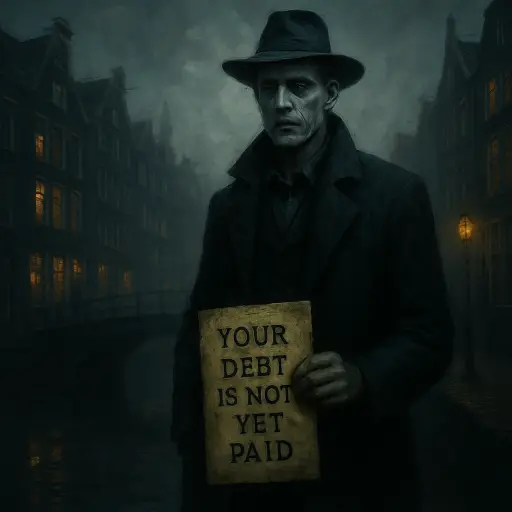
The Napkin Under the Glass
The dead man at our bar ordered jenever with my brother’s voice.
I dropped a crate of lemons. They burst across the tiles, bright and sharp, rolling under stools and boots. The man at the counter lifted two fingers the way Nico used to, as if blessing a card table before robbing it.
“Easy, Sanna,” he said. “It’s me.”
Ten years had scraped him thin. His coat hung wrong on his shoulders. A white seam cut through one eyebrow, and his left hand shook until he trapped it under his right.
But his smile was still the same crooked little knife.
I came around the bar and slapped him so hard the old men by the window stopped arguing about football.
Nico blinked. Then he laughed once, breathless. “Fair.”
“You let me bury you.” My voice came out low. “You let Ma light candles for an empty coffin.”
His smile folded away.
Outside, a tour boat slid along the Prinsengracht, its guide chirping through a speaker about merchant houses and tulips. Inside our café, De Blauwe Reiger, the air smelled of beer, frying onions, and canal damp trapped in old wood.
Nico looked toward the door like he expected it to bite him.
“I came to make it right,” he said. “No tricks. No marks. I’ve got a job lined up at a bike repair shop in Noord. I just need one night.”
“One night is all you ever needed.”
He flinched, and because I loved him, because I had loved him even while hating the space he left at our table, I hated myself for noticing.
He took a napkin from his pocket and smoothed it beneath his empty glass. Grease stains had bled into blue ink. It showed our canal block, narrow bridges, alley mouths, the old lock house, and a crooked X beside the abandoned sugar warehouse.
“I stole this from a man in Rotterdam,” Nico whispered. “He said it shows where debts go when they die.”
I stared at him.
He gave a small, miserable shrug. “I thought it was a con too.”
Then the café lights blinked out, all at once.
In the dark, something wet dragged itself along the front window.
A finger, or something shaped like one, wrote backward in canal slime on the glass.
PAY WHAT YOU OWE
The House That Kept Receipts
We shut De Blauwe Reiger early, which made the regulars grumble until they saw the window.
Henk the postman crossed himself. Old Astrid left without her change. Nobody asked for another drink.
I locked the door and turned to Nico. “Tell me everything. Not the polished version.”
He sat in the corner booth beneath the framed Ajax scarf, rubbing at his wrist. When we were children, that booth had been our ship, our castle, our hiding place while Ma counted coins in the kitchen. Nico could lie to priests, cops, widows, and chess players. He could never lie to me while sitting there.
“In Rotterdam,” he said, “I ran cards for a man called Van der Velde. Private games. Rich fools. I was good.”
“You were always good.”
“Too good. I cheated a guest I shouldn’t have. Old woman. Indonesian, maybe. She saw every move, Sanna. Every one. Afterward she gave me that napkin and said Amsterdam keeps an office for unpaid souls.”
He tapped the map.
“I laughed. Then the men I’d ruined started appearing. Not alive. Not properly dead. In mirrors. Tram windows. The black screen of my phone.”
A tremor climbed his throat.
“They ask for interest.”
“Money?”
“Memory. Skin. Years. The map points to the collector. If I settle the first debt, the others let go.”
“And your first debt is here.”
He looked at the floorboards.
My mouth went dry. “Nico.”
He whispered, “Pa.”
The café seemed to shrink around us. Our father had drowned in the canal behind the sugar warehouse when I was twelve and Nico seventeen. Police called it drink and bad luck. Ma called it God’s cruelty. Nico left two months later.
“What did you do?” I asked.
He pressed his shaking hand flat on the table. “I switched his medicine for sugar tablets. He was going to sell the café. Said I’d end up in prison and drag you with me. I only wanted him sick for a few days. I only wanted time.”
I stood so fast the chair hit the wall.
“He fell,” Nico said. “I found him in the water. I tried—”
“Stop.”
Behind the bar, a glass cracked neatly in half.
Then another.
Above us, in the empty apartment where Ma had died, slow footsteps crossed the ceiling.
Bridges Drawn in Blue Ink
I should have thrown him out.
I should have opened the door, pointed to the canal, and told the ghosts to take him.
Instead, I pulled on my coat and grabbed the heavy flashlight we kept for power cuts.
Nico watched me like a dog afraid of a raised hand. “You don’t have to come.”
“You get lost walking to the dentist.”
His laugh broke in the middle.
We followed the napkin map through our old neighborhood. The canal houses leaned toward one another, tall and narrow, their windows glowing with other people’s dinners. Bikes clattered over brick. Somewhere, students sang badly from an open window.
Amsterdam looked alive.
But under the bridges, the water made sounds like teeth.
At the first X on the napkin, a small bronze plaque had been bolted to a canal wall. I knew that wall. Kids tied lost balloons there. Lovers sat there with fries after midnight.
The plaque had not been there yesterday.
HENDRIK DE WIT
DEBT: ONE FATHER
PAYMENT: CONFESSION
Nico touched the letters. They sweated dark water.
“My name,” he said. “The name I used in Rotterdam.”
“Then confess.”
“To who?”
The canal answered.
Bubbles rose in a straight line from beneath the bridge. Then a head broke the surface, hair plastered flat, face pale as fish belly. Our father looked younger than he had in his coffin picture and older than any living man.
His eyes were open. Canal weed threaded his teeth.
Nico made a sound I had never heard from him, small and childlike.
“Papa,” he said.
The thing in the water smiled around weed.
“My son,” it said, but the voice came from inside my own mouth.
I gagged and clapped a hand over my lips. Nico grabbed my shoulders.
“Sanna?”
The voice forced itself through my fingers. “Always quick with cards. Slow with truth.”
Nico dropped to his knees on the brick. “I changed your tablets. I wanted the café. I wanted to prove you wrong. I killed you.”
The water stilled.
For one moment, our father’s face softened.
Then something beneath him pulled.
His jaw stretched wide, wider, until darkness filled his mouth. Inside it, dozens of hands paddled upward.
“Payment accepted,” my mouth said.
Nico screamed as the hands surged over the canal edge.
The Collector Beneath the Warehouse
We ran.
The dead hands slapped brick behind us, wet palms smacking stone. Nico’s breath tore in and out. I dragged him past locked boutiques, past a bakery vent breathing warm sugar into the cold, past a couple who cursed as we shoved between them.
“Warehouse,” I gasped. “The big X.”
“No. Sanna, no.”
“You said settle the first debt.”
“I think it wants more.”
At the abandoned sugar warehouse, the napkin had changed. The blue ink crawled while we watched, drawing a door where the brick wall stood solid.
“That was never there,” I said.
Nico wiped his mouth with his sleeve. “In my work, doors that were never there are bad.”
“Your work was stealing watches from lonely tourists.”
“And sometimes doors.”
I nearly laughed. The sound died when the brick door opened inward.
Below waited stairs slick with syrupy black water. The smell rose thick and sweet, rotten caramel and canal mud. Nico took my hand. His palm was cold, but he squeezed twice, our childhood signal for stay close.
At the bottom was an office.
Not a grand haunted chamber. An office. Low ceiling. Filing cabinets. A desk with green-shaded lamps. Hundreds of napkins, receipts, tram tickets, coasters, and cigarette papers were pinned to the walls, each covered in maps and names.
Behind the desk sat a woman in a brown cardigan, hair rolled neatly, spectacles on a silver chain.
She looked up from a ledger. “Hendrik de Wit. Returned to Amsterdam after ten years. Intention: reform.”
Nico swallowed. “Yes.”
“Admirable. Rarely relevant.”
I stepped forward. “He confessed.”
The woman turned a page with gray fingers. “Confession opens the account. It does not close it.”
“Then what closes it?” Nico asked.
She smiled as if he had asked the price of bread.
“A life honestly given.”
My hand tightened on the flashlight.
Nico moved in front of me. “Take mine.”
“No,” I said.
He did not look back. “I came home to stop running.”
The woman dipped her pen in a pot of black ink that smelled of deep water.
“Sign.”
She slid a contract across the desk.
I, HENDRIK DE WIT, OFFER MY REMAINING YEARS IN SETTLEMENT OF BLOOD DEBT.
Nico reached for the pen.
I hit his hand away.
What the Canal Could Not Keep
“Sanna,” Nico said softly.
“Shut up.”
The woman behind the desk watched us with pleasant patience. On the wall, a pinned coaster twitched like a trapped moth.
I picked up the contract. The paper felt warm, almost fleshy.
“You want an honest life?” I asked.
The collector’s smile thinned. “Given freely.”
“Good.”
Nico stared at me. “Don’t you dare.”
“I’m not giving mine.”
I turned the contract over. Blank. Then I grabbed the napkin map from Nico’s coat pocket and laid it beside the paper.
“He stole under false names,” I said. “He lied, cheated, forged, charmed, vanished. But Hendrik de Wit isn’t real. You opened an account for a mask.”
The office lamps flickered.
The collector’s fingers stopped on her ledger.
Nico whispered, “Sanna.”
I kept going, because the first rule of surviving my brother was learning how cons worked. Every trick has a hunger. Every hunger has a blind spot.
“My brother’s name is Nicolaas van Dijk. Born upstairs from De Blauwe Reiger. He didn’t come here as Hendrik. He came home as Nico.”
The napkin ink began to boil.
“The debt belongs to the liar,” I said. “So take him.”
The collector’s mouth opened, and a canal’s worth of voices poured out, all speaking at once.
Nico backed away. “Who?”
I pointed to the napkin.
The blue lines had curled into a man’s silhouette: Hendrik de Wit, handsome and empty-eyed, made of every false signature Nico had ever used. It peeled itself from the napkin, paper-thin at first, then thickening into flesh-colored wax.
It wore Nico’s old crooked smile.
“No tricks,” it said in his voice.
The collector lunged, not at us, but at the thing.
The office folded inward. Filing cabinets banged open. Dead hands burst from drawers and seized the wax man by the throat, wrists, hair. It laughed until its face tore.
Nico grabbed me and we ran up the stairs as the collector shrieked, “Invalid tender! Invalid—”
The brick door spat us into dawn.
Behind us, the warehouse wall sealed with a wet sigh.
Three months later, Nico fixes bicycles in Noord. He comes to the café every Sunday with grease under his nails and pastries in a paper bag.
Ma’s old apartment is quiet now. The window stays clean. No footsteps cross the ceiling.
But last week, while wiping tables, I found a napkin under Nico’s usual glass.
On it, in blue ink, someone had drawn our café, the canal, and a small X over the booth where we used to hide as children.
Underneath, in my handwriting, though I had not written it, were four words.
LOVE IS ALSO DEBT
I burned the napkin over the sink.
For a moment, in the smoke, a paper-thin man smiled at me.
Then Nico came in from the cold, cheeks red, holding a bag of warm apple beignets, and said, “Sanna, you’ll never guess what I found.”
In his hand was a spotless white napkin.
Folded into the shape of a boat.
This story was created with the help of AI writing tools and published by Storyleo Editorial.