Thirteen Dead Faces and One Dollar for a Father
A penniless musician claims a stranger’s photograph as family, and the dead begin believing him.
- Horror
 By Storyleo Editorial
- 6 min read

Listen to this story · narrated, 8 minutes
The Man Behind My Shoulder
The first man I brought back from the dead complained that my concertina was out of tune.
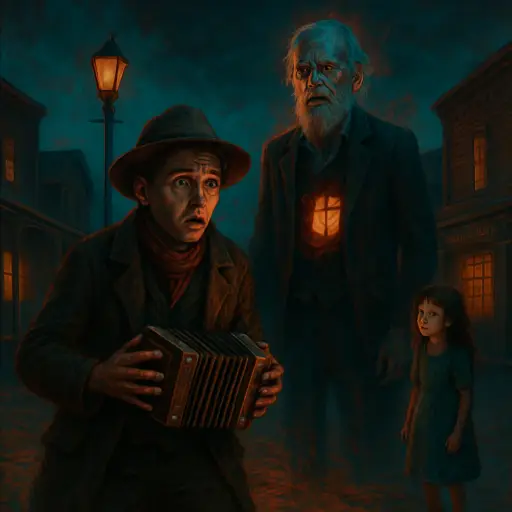
This was in Wyoming Territory, in the cattle town of Medicine Bow, the summer of 1886. I played outside a chop house, where the smell of frying onions made an empty stomach contract like a fist. My hat contained eleven cents and a brass button.
The man who spoke stood behind my left shoulder. He wore a scorched Sunday coat. Through a hole below his collarbone I could see the chop-house window.
“Your third reed,” he said. “It catches.”
Minutes earlier, there had only been a photograph.
A peddler named Haskett had offered it to me for my remaining coins: a brown, curled picture of thirteen people gathered outside a timber hall. An old musician sat among them, holding a concertina almost exactly like mine.
“Know that fellow?” Haskett asked.
Three drovers had stopped to listen. One held a silver dollar between finger and thumb.
“My father,” I said.
My father had sold buttons in Cincinnati and hated music. But the drover lowered his dollar into my hat.
“Dead these twenty years,” I added, encouraged.
Haskett’s fingers closed so suddenly that the photograph bent.
“Don’t,” he said.
Then the man behind my shoulder spoke.
I turned. His beard smelled of wet ashes. He smiled with a father’s patient disappointment.
“Well, Owen,” he said. “Aren’t you going to introduce me?”
I had not told Haskett my name.
The drovers backed away. One crossed himself; another laughed once, sharply, as if something had struck him.
Haskett pushed the photograph into my coat.
“Take it back,” I whispered.
“Can’t. You’ve put yourself in it.”
He walked away without collecting his money.
I looked down. In the photograph, beside the seated musician, stood a young man in my frayed coat.
His face was turned toward the hall.
A Family I Had Never Lost
I ran toward the railway station. The dead man kept pace without disturbing the dust.
“You always did hurry,” he said.
“You aren’t my father.”
He caught my wrist. His fingers felt like utensils left outside in winter.
“Then why,” he asked, “did you leave me burning?”
The station clock struck six. Blood darkened the hole in his coat, thick as blackberry preserves.
I could have told the truth then. I have had years to examine that moment. There was room enough for five plain words: I wanted the silver dollar.
Instead, I said, “I tried to save you.”
His grip loosened.
In my pocket, the photograph crackled.
Now my little pictured figure stood at the hall’s open door, one arm extended. Smoke curled from the roof.
“You did,” the old man said wonderingly. “You pulled me out.”
The wound closed. Not healed: simply absent, with the cloth whole above it.
“But your mother was still inside.”
A woman appeared beside the freight platform.
Her hair had burned down to black curls against her scalp. She carried a shoe containing a small foot.
“Our boy,” she said.
I pushed through the station door and begged the agent for a ticket east. My hands shook so badly that my coins scattered across his counter.
“Train tomorrow,” he said. Then he saw what waited outside.
He ducked beneath the counter.
The woman pressed her ruined face to the glass.
“You saved me too, didn’t you, Owen?”
I nodded.
Her hair lengthened. The shoe disappeared. She came through the closed door and embraced me, smelling of flour and hot iron.
Behind her stood a girl of perhaps eight, wearing one shoe.
“And me?” she asked.
I said yes before I could stop myself.
She took my hand. Something inside her sleeve moved like a mouth chewing.
“Then the others,” she said. “You must remember the others.”
Through the window, I saw people gathering beside the tracks.
Every one of them was in the photograph.
The Hall With No Door
They followed me back into town: thirteen at first, then more. The photograph had widened. Faces crowded its edges, where there had previously been empty prairie.
A barber dropped his razor when he saw them.
“That’s the Wetherby dance,” he said. “Outside Laramie. Seventy-one.”
My borrowed mother turned toward him.
He slammed his shutters.
Later, I learned there had been a wage meeting in that hall. Someone had chained its doors. The newspaper called the fire an overturned stove. Nobody explained the gunshot wounds.
But that evening I knew only that the dead kept asking whether I had saved them, and that each yes brought another person out of the picture.
By dusk, they filled the street.
“All of you,” I shouted at last. “I saved all of you. Now leave me alone.”
The concertina sounded in my hands, although I had not moved it.
One long, wheezing chord.
Across the street, the chop house changed.
Its windows narrowed. Fresh boards became old timber. The painted storefront stretched upward into a hall with a steep roof.
Inside, men began screaming.
Living men.
The cook struck the window with a cleaver. Behind him, customers shoved against a door that now had a chain across it.
My supposed father squeezed my shoulder.
“You saved us,” he said. “Somebody still has to burn.”
The little girl watched orange light climb the curtains. Her stolen life had put color in her cheeks.
“Will it hurt them?” she asked.
I tried to force the hall door. The handle blistered my palm. A boy inside pressed both hands against the glass.
“Please, mister.”
I smashed my concertina against the window. Wood cracked; the glass did not.
The dead recoiled at the broken note.
For the first time, my father looked frightened.
I pulled out the photograph.
My pictured figure held the chain.
The Price of an Honest Tune
“I lied,” I said.
The street went quiet except for the fists against the windows.
My borrowed mother touched her hair. It came away in her fingers.
“You’re not my family. I never knew any of you.”
The girl’s cheeks sank. Her shoe struck the ground, empty.
“Keep talking,” my father whispered.
His coat had opened again at the breast.
“I said it for money. One dollar.”
The hall trembled. For a moment I saw the chop-house tables through its walls, and the cook crouched beneath one with his arms over his head.
But the chain remained.
In the photograph, my small self had turned toward me. Its mouth was open. Mine was closed.
“That’s enough truth,” I said desperately.
The old man shook his head.
Beyond him, the others stood as they had died. They had stopped reaching for me.
I looked at the boy behind the glass.
“I knew something was wrong after the first lie,” I said. “I kept doing it because I was afraid.”
The chain fell.
The hall doors burst outward. People tumbled into the street, coughing, beating sparks from their clothes. The boy ran through me.
I felt his ribs pass through my ribs, warm and quick.
Then the street tipped sideways.
I have watched forty summers pass across counters and mantelpieces. I know them by the flies settling on the glass.
The photograph is small again. Thirteen people stand outside a timber hall. I sit in front with a broken concertina across my knees.
They do not speak to me. At night, when no one is looking, I mend the reeds. By morning they are broken again.
Today a dealer showed us to a young woman.
“Any idea who they were?” she asked.
He studied my face.
“My grandfather, I believe. Quite a famous musician.”
Behind me, thirteen heads began to turn.
I pulled the bellows apart and played the loudest, ugliest note I could.