Why Can’t the Boy in the Photograph Rest?
A girl draws a bench for a photographed boy, and her aunt’s ranch falls asleep.
- Fantasy
 By Storyleo Editorial
- 7 min read


A Bench for the Barefoot Boy
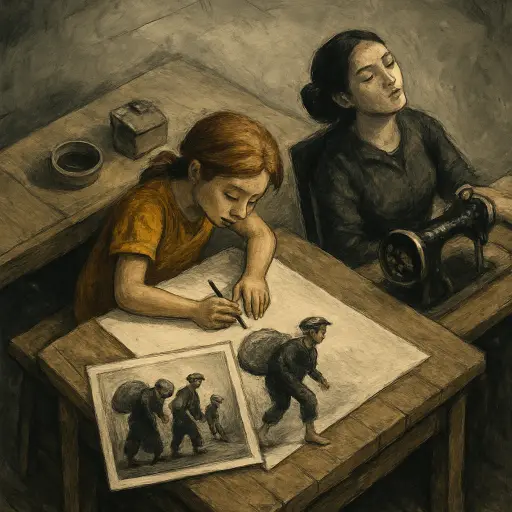
Malena had almost finished drawing the bench when the boy in the photograph lowered his sack.
She dropped her pencil. It rolled beneath the kitchen table, through a dusting of flour.
“You moved.”
The boy stood among eleven adults outside the ranch’s old shearing shed. Everyone wore stiff, dark clothes, though the grass behind them looked bleached by summer. His sack was bigger than his chest. Malena was seven; she thought he might be eight.
“Only my shoulders,” he said. His voice sounded like paper rubbed between fingers. “Could you make the seat wider?”
Malena retrieved her pencil.
Her aunt had left the photograph on the table beneath a saucer. A dealer was coming from Buenos Aires to buy it, and Malena had been told not to get jam on the corners.
“I’m drawing on the paper underneath,” she explained. “Not on you.”
“That seems to work.”
She widened the bench. Its legs were uneven, so she added a stone beneath one foot.
The boy sat.
Across the kitchen, Aunt Inés’s sewing machine stopped in the middle of a stitch.
Outside, the windmill gave one long squeak. Its blades hung motionless against the enormous blue sky.
Malena peered through the doorway. The pampas grass still bent in the wind.
“Thank you,” the boy said.
His sack sagged beside his feet. Something golden sifted through its seams—not grain, exactly, but little flecks that vanished before they reached the photographed ground.
“What’s in there?”
“Later.”
“Later what?”
He rubbed the red-looking marks the sack had left on his gray shoulders.
“That’s what they always called it. When we asked to stop.”
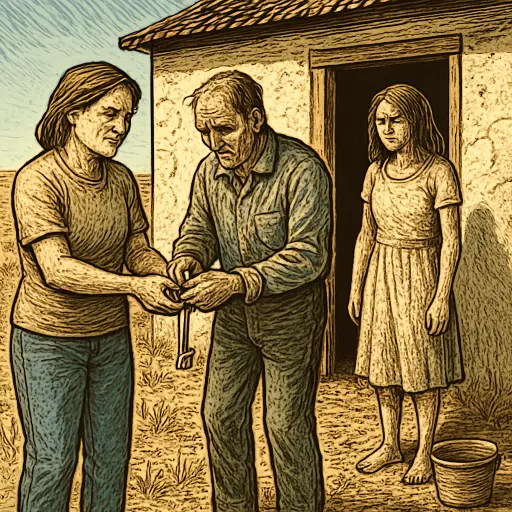
Malena looked toward her aunt. Inés had fallen asleep sitting upright, one hand still guiding a pair of work trousers beneath the sewing machine’s needle.
Inés Counts the Hours
Inés woke with her niece patting her cheek.
“Don’t be cross. I only gave him somewhere to sit.”
The kitchen clock showed the same minute as before. Yet Inés had dreamed a whole night: cool sheets, no sums, no broken pump, no counting sheep that needed shearing before the heat worsened.
She stood too quickly. Her knees loosened beneath her.
“Who did you give—”
Then she saw the photograph.
For a week she had studied it through a magnifying glass, searching for damage that might reduce the dealer’s offer. The barefoot boy had stood at the far left. Now he sat on a penciled bench beyond the photograph’s white border.
“Malena. Step away from the table.”
“He hasn’t done anything bad.”
Inés wanted to say photographs did not do anything at all. Instead she went outside.
The sheep lay scattered across the holding paddock, breathing steadily. A beetle slept halfway up a fence post. When she tried the pump handle, it folded gently from her hand, as if excusing itself.
A truck stood beyond the gate. Its driver slept against the window.
The dealer had arrived.
Inés returned to the kitchen and planted both palms on the table.
“What have you done to my ranch?”
The boy lifted his head. Behind him, one of the photographed women was watching the bench.
“Nothing yet,” he said. “There’s an awful lot owing.”
Inés’s grandmother had spoken of a photographer hired by an early owner of the estancia. His pictures made obedient workers, she had said. Inés had taken it for an unpleasant joke.
“What is in that sack?”
“Our rests.”
Malena’s small fingers crept into Inés’s hand.
“He said they had to have them later.”
Inés looked at the woman’s lowered head, the men’s rigid backs. Every person in the picture carried a sack.
“Draw Another Chair”
Malena disliked the way grown-ups studied a problem until it became too large to touch.
She fetched another sheet of paper.
“You can have a chair,” she told the woman nearest the boy. “I’m better at chairs.”
“Wait,” Inés said.
Malena stopped with the pencil above the page.
Her aunt had put on the voice she used when a sheep was caught in wire: low and careful, with no spare words.
“If everyone sits down, what happens?”
The boy glanced behind him. His companions had begun to shift. A man eased one finger beneath the strap across his forehead.
“We don’t know.”
“Can you stand up again?”
Malena moved between her aunt and the picture.
“His feet hurt.”
“I can see that, love.”
But Inés did not ask him again.
The dealer entered without knocking. He wore a cream linen jacket and carried a flat leather case. One cheek was creased from sleeping against his truck window.
“Remarkable,” he said.
He leaned over the table, and Malena pulled her drawing closer.
“You knew,” Inés said.
“I suspected. There are three surviving examples of this photographer’s work. None active.”
“Active?”
“Productivity pictures. Rather ingenious things.”
He took a silver knife from his case.
“We remove the added paper, return the figure to position, and seal the frame. Your mill will turn. Your animals will wake. I’ll double my offer.”
Inés’s fingers tightened around the back of a kitchen chair.
Malena knew that offer mattered. Yesterday her aunt had emptied three envelopes onto the table and counted the same banknotes twice.
“Will he have to hold it again?” she asked.
The dealer did not answer her.
“Think of the practicalities,” he told Inés. “You have a child to provide for.”
Malena put her bare foot beside the boy’s tiny photographed one.
“So did somebody else.”
Twelve Openings
Inés took the knife before the dealer could touch the drawing.
For months she had measured every decision against the cost of keeping the ranch. Pump washers. Diesel. School shoes. She had stopped buying coffee and begun waking before daylight to do work she once paid someone to share.
The boy watched the blade.
She set it down.
“Tell me how to let you out.”
The dealer shut his case with a crack.
“You’ll destroy its value.”
“That wasn’t my question.”
The woman in the photograph spoke. Her voice was rougher than the boy’s.
“The border. It keeps the day from ending.”
Inés fetched her sewing scissors.
“Not through anyone,” Malena said urgently.
“No. Not through anyone.”
She made a cut in the white margin beside the boy.
Warm air spilled over her knuckles, carrying the smell of sheep grease, trampled clover, and bread just broken. The boy stood—not to lift his sack, but to step through the opening.
He was no taller than her thumb.
Then he was the size of Malena.
He stretched both arms above his head. His sack opened.
Inés sat down hard.
She felt an afternoon she had never been allowed: no emergency, no guilty inventory of unfinished tasks. Just shade and enough time to notice it.
“Keep cutting,” the boy said gently.
She did.
The others came through one by one. The dealer retreated to the door, protesting, until a broad-shouldered woman touched his forehead with two fingers. He slid onto the doorstep and slept.
Beyond him, the golden dust spread low across the paddocks. It passed through fences and traveled outward over the pampas.
Inés felt its invitation in her bones.
“The sheep,” she murmured.
“Are resting,” said the woman.
“Tomorrow—”
“Will come.”
Malena climbed into her lap. Inés let her scissors fall onto the table.
Grass After Sleeping
Malena woke hungry beneath the kitchen table.
Someone had tucked a folded saddle blanket around her. Her aunt slept nearby with her head on her arms, and sunlight lay warm across the floor.
The kitchen clock had advanced one minute.
Outside, the windmill turned.
The photograph lay among twelve slivers of white card. It showed an empty yard, a shearing shed, and abandoned sacks. The penciled bench was empty too.
Malena crawled out and went to the door.
The boy stood at the gate with the others. Without his burden, he looked smaller.
“Are you going home?” she called.
“We’re going to see what’s there.”
“Will you be tired?”
He considered this.
“Probably. But now we can stop.”
They walked into the long grass. Malena watched until she could no longer tell their clothes from the moving seed heads.
By evening, people were arriving at the ranch.
A shearer had slept beneath his truck while replacing a tire. The woman who ran the village store had dreamed of swimming and awakened with her aching shoulder loose. Everyone’s clocks had lost the same twelve hours.
Inés brought chairs into the yard and explained what she could.
The dealer left without the photograph.
When Inés admitted there was no money for the shearing crew, the shearer scratched his chin.
“You’ve still got that spare water tank?”
They went to look at it. No one hurried.
Later, Malena found her aunt studying the ruined photograph.
“Are you sorry?”
Inés turned it over, then set it carefully in a drawer.
“About the money? A little.”
“About my bench?”
Her aunt drew her close.
Across the district, the strange afternoon returned each year. Machinery stopped. Bread waited unburnt in ovens. People learned to leave their gates unlatched.
At the ranch, Inés carried two cushions into the grass, and Malena chose where they would lie.