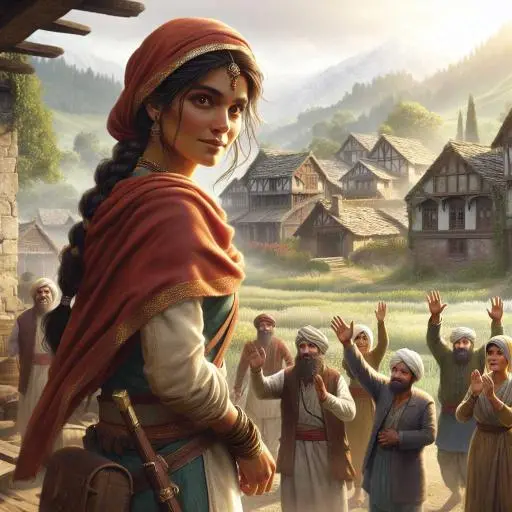
A Chair for the Walking Acre
A stranger carrying her shadow offers two estranged siblings a bargain their failing farm cannot afford.
- Fantasy
 By Storyleo Editorial
- 7 min read


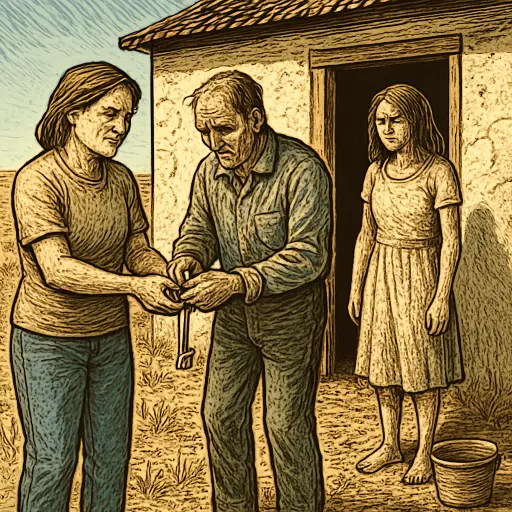
The Woman in the Furrow
Dorothy was halfway through selling her brother’s tractor when a woman climbed out of the wheat field carrying her own shadow in a bucket.
“That isn’t included,” Dorothy told the auctioneer.
The woman stopped beside the fence. Dust whitened her eyelashes. Behind her, the ruined wheat stood knee-high and brittle, its heads empty after eleven weeks without rain.
From the machine shed, Frank shouted, “Get off that tractor.”
Dorothy took her hand from the hood. Her brother had acquired their father’s voice along with his stoop.
“The bank comes Thursday,” she said.
“Then let them come Thursday.”
The auctioneer studied the stranger, then his watch. “I’ll call tomorrow.” His truck left a plume that hung over the county road.
Dorothy had driven four hours from Wichita to settle the estate. After six years away, she had expected accusations. She hadn’t expected a woman whose bucket contained a patch of darkness moving against the sunlight.
“Could I sit?” the stranger asked.
Frank looked toward the house. Every chair on the porch held tools, feed sacks, or their father’s unsorted belongings.
“We’re busy,” he said.
Dorothy dragged a kitchen chair outside. One rung scraped her ankle. She set it beneath the narrow shade of the windmill.
“There.”
The woman lowered herself carefully, holding the bucket between her feet.
“Nobody’s offered a chair in eighty-three miles.”
“You walked?”
“There isn’t another way for me.”
A brass key lay among the rubbish on the porch table. Dorothy picked it up to make room for a glass.
Frank caught her wrist.
“Dad said never throw that away.”
“It doesn’t fit anything.”
The stranger lifted her head.
“No,” she said. “It wouldn’t. Locks came later.”
An Acre Wearing Shoes
Frank wanted the woman gone before Dorothy found another reason to call him incapable.
He had kept the farm operating through their father’s illness, the failed sorghum, and the pump that brought up sand. Dorothy had sent money twice. He had returned it twice.
He remembered that now with particular discomfort.
The stranger slipped off one shoe. Black earth spilled onto the concrete.
Not dust. Earth.
It smelled of mushrooms, cut roots, and the cool underside of a stone.
Frank crouched before he could stop himself.
“What are you?”
“An acre.”
Dorothy folded her arms.
“Of course.”
“A resting acre,” the woman said. “I used to be left alone every seventh year. Then every tenth. Then never.” She rubbed a heel split with fine, pale cracks. “When a field has nothing left to give, sometimes it gets up.”
Frank touched the spilled soil. A white root curled around his fingertip, then withdrew.
Not heatstroke, he thought. Dorothy was staring too.
The woman pointed at the key.
“Your people kept a welcome once. An acre for an acre. That opens the boundary.”
“And then?” Frank asked.
“I rest here. One of your acres walks with me when I leave. We carry what we learn from place to place.”
“We can’t spare land.”
She looked across his wheat without answering.
Dorothy turned the key over. Its teeth resembled tiny stairs.
“Does this cure drought?”
“No.”
“Pay debts?”
“No.”
Frank stood.
But the stranger added, “I remember grasses that live through dry years. Roots that loosen hard ground. Ways for rain to stay when it finally comes.”
He looked again at the handful of earth.
His own fields hadn’t smelled like that since he was a boy.
The Price of a Boundary
Dorothy followed Frank into the kitchen, where their father’s medicine timetable still hung above the telephone.
“Don’t,” she said as he reached for the land survey.
“You heard her.”
“I heard a woman promise agricultural advice in exchange for real estate.”
He spread the survey over a scatter of unopened envelopes.
“This is why I didn’t ask you to come.”
Dorothy pressed both palms against the table.
“You did ask. You said you couldn’t sleep. You said you sat beside the pump because you could still hear it running when it wasn’t.”
Frank’s fingers stopped moving.
Through the screen came the dry metallic tapping of the windmill.
“I didn’t ask you to sell everything.”
“And I didn’t leave because I hated this place.”
He looked at the timetable.
“You left me with him.”
“He told me not to come back with a woman’s name on my wedding invitation.”
“I know what he said.”
“You stood beside the refrigerator and peeled an orange.”
Frank sat down.
She remembered the small spray of rind oil. The knife. How carefully he had avoided looking at her suitcase.
“I kept waiting,” she said, “for you to put it down.”
Outside, the stranger coughed. A grasshopper sprang from the cuff of her dress.
Frank pushed the survey toward Dorothy.
“I should have.”
She found nothing useful to say to that. Not yet.
They went outside together.
The woman examined the survey.
“There’s another condition. The resting ground can’t belong to either of you. Not while I’m there. Anybody may walk it. Anybody may gather seed.”
Frank pointed reluctantly at the north corner.
“There’s an acre by the road.”
“That’s the house,” Dorothy said.
“The house sits on it.”
Behind them, a loose shutter struck the siding.
The Door Without a House
Frank had meant to offer the poorest corner, but the words had come out differently.
The house acre held their mother’s peonies, the dry kitchen garden, and the patch where Dorothy had once sold mud pies for actual nickels. It also held a roof he couldn’t repair and rooms he no longer entered.
“We’d have to leave?” Dorothy asked.
“The buildings can stay,” said the woman. “But no locking anyone out of the ground.”
Frank glanced at his sister.
“That seems fair.”
They marked the acre with four fence posts. Dorothy carried the survey; Frank carried the driver. At the last corner, the stranger emptied her bucket.
Her shadow spread across the stubble.
It rose slowly, folding upward until a black doorway stood unsupported in the afternoon.
“Both owners,” she said.
Dorothy held the key. Frank closed his hand around hers.
There was no keyhole. Only darkness cool enough to raise bumps along his wrist.
“Turn,” the woman said.
They turned.
Click.
The sound came from underneath them.
Frank stumbled as the ground took a long, deep breath.
Across the acre, cracks drew together. The peonies lifted their dusty leaves. Beneath the porch, something rustled with the rich, busy sound of paper being crumpled by many small hands.
The woman stepped through the doorway.
For an instant Frank saw a hillside purple with flowers, then snow over stubble, then a vast brown river. The doorway flattened into her shadow again.
She settled onto the kitchen chair.
“Thank you,” she said, and became a low mound of dark soil.
Her dress loosened into dried leaves.
Dorothy knelt. Between two fingers she lifted a green shoot, scarcely longer than an eyelash.
Frank waited for her to speak.
Instead, she held it where he could see.
What Stayed Open
By October, people were coming from three counties to stand in Frank and Dorothy’s yard.
There had been no miraculous harvest. The bank took the tractor. Frank sold the empty grain bins, and Dorothy negotiated payments with a banker who disliked both unusual collateral and being interrupted.
But the house acre stayed green.
Not lawn green. It grew silver-leafed plants, tough bunches of grass, flowers no local guide could name. When September finally brought an inch of rain, the water disappeared into that acre instead of carrying its surface into the ditch.
The extension agent came with sample bags. Then she came with students.
Frank learned to say, “Take some seed. Leave enough.”
Dorothy came on weekends with her wife, Joan, who repaired the porch railing and refused to sleep in the room containing their father’s boots.
Frank moved the boots.
One Sunday, he made supper without asking when they planned to drive home.
“There’s room,” he said, setting a third plate down.
Dorothy passed him the potatoes.
The traveler returned in November, rising barefoot from the garden. Her face had filled out; fine root hairs silvered her wrists.
“Time,” she said.
Frank fetched Dorothy from the house.
Their resting acre gathered itself with a sound like a quilt pulled across a bed. A young man stood beside the traveler, blinking, his hair the tawny color of wheat.
Frank gripped the porch post.
“Which acre are you?”
The young man pointed beneath their feet.
“But the house—”
“Ground stays,” the woman said. “What it knows travels.”
The young man offered Dorothy the brass key.
She shook her head.
“You might need a chair somewhere.”
He pocketed it carefully.
They walked toward the county road, leaving dark footprints in the frost. At the gate, the young man paused to pick a pebble from the woman’s shoe.
Dorothy watched him kneel.
Beside her, Frank left the gate open.