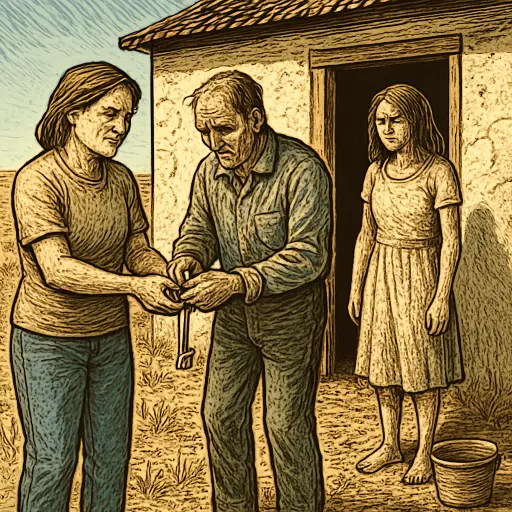
The Night Skarvøy Harbor Lost Its Water
A stranger’s napkin map empties an island harbor, leaving a newcomer to decipher his plea.
- Fantasy
 By Storyleo Editorial
- 6 min read



The Harbor in My Pocket
On my ninth evening in Norway, I unfolded a napkin and spilled a harbor onto the kitchen floor.
Seawater spread beneath the table. Three tiny boats knocked against my boot. Beyond them stood a thumb-high warehouse, a red crane, and the fish-packing shed where I had started work that morning.
Someone hammered on my door.
“Don’t fold it!” shouted Astrid, my landlady. “Whatever you’ve brought here, don’t fold it again.”
I stood holding the damp corners. Outside, an engine screamed, then stopped.
I was thirty-two, newly arrived from Gdańsk, and knew enough Norwegian to ask for gloves in my size. I did not yet know the words for the harbor has fallen out of my pocket.
Years later, when people asked what happened on Skarvøy, they usually wanted to hear about the water standing upright. But the trouble began with supper.
Astrid had taken me to the fishermen’s café. While she fetched coffee, a small, wet stranger climbed onto the chair opposite mine.
He wore a coat stitched from something translucent. Fish skin, I thought. His boots left square puddles.
“Home?” he asked.
I pointed uphill toward Astrid’s house.
He shook his head, took my pencil, and drew on a paper napkin: the harbor wall, the narrow channel, six crosses, and an arrow I took to be pointing inland.
“Home,” he repeated.
“You’re lost?”
He pushed the napkin toward me.
I knew that gesture. During my journey north, I had offered tickets, addresses, and my employment contract to strangers, hoping one would understand.
“All right,” I said. “I’ll ask.”
Then Astrid returned, the stranger was gone, and I put his map in my pocket.
Now she stared down at the miniature harbor spreading across her linoleum.
“Irena,” she said carefully. “Who gave you that?”
Six Crosses
By midnight, four fishermen and a woman from the island council crowded Astrid’s kitchen. Nobody stepped into the water.
The real harbor had emptied.
Not of boats. Of water.
Beyond the window, vessels leaned against their mooring ropes over bare mud. At the harbor mouth, a dark wall of seawater rose higher than the packing shed.
“It’s being held back,” said councilwoman Signe. “For now.”
The harbor on the floor smelled of diesel and torn kelp. A tiny loose bucket knocked against a tiny quay.
“A taking chart,” said Einar, the oldest fisherman.
“What does it take?” I asked.
He pointed to the crosses. “Those are the six harbor stones. Our grandfathers put iron beneath them. Keeps the undertide folk outside.”
Astrid translated what I missed. Her hand rested on my shoulder, but when I shifted, she removed it.
“He asked me for help,” I said.
“They do,” Einar answered.
Someone suggested burning the napkin.
“With the harbor inside it?” Astrid snapped.
I looked down. On the miniature quay, a red speck moved. Signe’s daughter had left her bicycle outside the café. Its front wheel was turning in the breeze.
“We find the stranger,” Signe said. “Before the tide turns.”
“And then?”
Einar lifted the iron poker from beside Astrid’s stove.
I put my palm over the napkin.
Every boat below us lurched.
“No,” Astrid said sharply.
I pulled my hand away. My fingers were numb to the wrist.
“I won’t damage it,” I said. “But nobody is going to hit him before I hear what he meant.”
Outside, the suspended sea gave a heavy, wooden knock.
Every cupboard door in the kitchen swung open.
The Wrong Direction
We carried the napkin downhill on Astrid’s largest baking tray. I held one end; she held the other. The miniature water shivered with each step.
People waited along the road in slippers and work boots. A man clutched a box of flare cartridges. Two children watched from a bedroom window, their chins balanced on the sill.
At the harbor, we found the stranger sitting beneath the crane.
He was scarcely taller than my knee. Without his café chair, I could see that his coat had no sleeves. What I had taken for hands were pale fins folded against his chest.
Einar brought the poker forward.
The stranger scrambled backward and struck his head against a bollard.
“Wait,” I said.
I crouched beside the tray and pointed at the map.
“Home?”
He nodded so hard that water flew from his collar.
Then he pointed beyond the upright sea.
“He wants our island,” Einar said.
“He’s pointing the other way.”
“Look at the arrow.”
I did.
All evening we had held the napkin as the stranger had pushed it toward me. But he had drawn it from the opposite side of the table.
I walked around the tray.
The arrow led out through the harbor mouth.
The six crosses were not targets. Each had a short line across its seaward side, like a gate.
I pointed to a harbor stone. The stranger recoiled.
Then he pressed both fins against an invisible wall.
“Not taking,” I said. “Trapped.”
He slapped his wet chest.
“Home.”
Astrid knelt beside me. “He came in with a boat. Then someone repaired a ward.”
Behind us, Signe covered her mouth.
“The eastern stone,” she said. “We reset it this afternoon.”
Room for a Guest
“Then lift it again,” I said.
“With that waiting outside?” Einar pointed at the sea.
A broad shape moved within the water wall. For a moment, pale fingers showed through its surface, each longer than a fishing boat.
The little stranger reached toward them.
“His mother,” Astrid whispered.
Something struck the other side. Water burst upward in white feathers.
On the tray, the miniature harbor wall cracked.
Signe ran for the crane controls.
“No,” Einar said. “Pull that stone and everything comes through. That’s why there are six.”
He was shaking. The poker rattled against his boot.
“There’s a guest way,” Astrid said.
Everyone looked at her.
“My grandmother told me. The wards leave a passage for someone under a household’s protection.” She rubbed her forehead. “But someone ashore has to claim them.”
“Then claim him.”
She looked toward the immense hand beyond the harbor mouth.
Nobody spoke.
I could hear the stranger breathing: quick little gulps, like a pump drawing air.
“What would I have to do?” I asked.
Astrid caught my sleeve. “You don’t know what you’d be promising.”
“Then tell me.”
“A welcome whenever he returns. Food. Shelter. You can’t invite him only to throw him out once you’ve got what you need.”
I looked uphill. My rented room contained two suitcases, a saucepan, and a photograph of my parents standing stiffly beside their allotment.
“Can I promise someone shelter in your house?”
Astrid pressed her lips together. Then she took off one glove and gave me her bare hand.
“In our house,” she said.
I faced the stranger.
“You are my guest. There is room for you where I live.”
The six harbor stones rang.
Between two of them, the suspended sea opened into a narrow blue corridor.
What the Map Remembered
The stranger did not move.
He pointed at the napkin, then at me.
“You can take it,” I said.
He shook his head and mimed unfolding something.
Astrid and I lifted the napkin from the tray. It had grown heavy as a soaked blanket. Beneath the drawn harbor I felt pilings, chains, the dragging weight of anchors.
“Gently,” she said.
We opened the last crease.
The water left us.
It poured without wetting our shoes, racing across the quay in silver ropes. Boats rose from the mud. Mooring lines snapped taut. Out beyond the ward stones, the great waiting figure lowered both hands.
The stranger ran down the blue corridor.
Halfway through, he turned and waved one fin.
I waved my pencil back. I had been gripping it all night.
Then the passage closed, and ordinary waves slapped the harbor steps.
That was thirty-one years ago.
I still live in Astrid’s house, though it became mine after she died. I married a refrigeration mechanic from Bodø, raised two children, and learned enough Norwegian to argue about drainage at council meetings.
The stranger visits every February.
He is taller now, though he still prefers the low kitchen stool. I put out a basin for his feet and serve whatever soup we are having. He brings news I can mostly understand and gifts I mostly cannot use.
There is a pearl in my cutlery drawer that keeps the spoons cold.
The napkin hangs above the table, protected behind glass. Its harbor has faded to a few gray lines.
But after his third visit, another mark appeared: a small square uphill from the quay.
My house.
Beside it, in the careful Norwegian letters I had been teaching him, he had written:
Home, also.