Can a Borrowed Compass Get Them Out?
An elderly woman’s warning sends a former children’s home resident into a deadly trap.
- Suspense
 By Storyleo Editorial
- 6 min read


Mrs Baines’s Compass
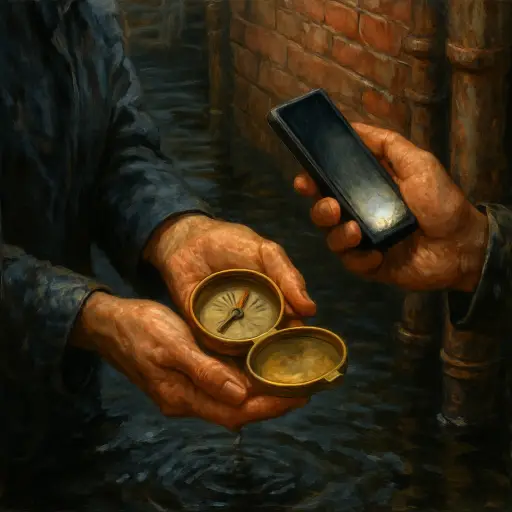
The woman in the wheelchair put a brass compass into my wife’s hand and said, “If I’m dead by supper, don’t let them call it natural.”
Across the lounge, a carer continued spooning custard into a sleeping man’s mouth. Beyond the windows of Seabank House, Brighton’s sea glittered hard enough to hurt.
Helen crouched beside the wheelchair. Her ranger’s trousers still carried chalk dust from the South Downs. She had refused to change before coming.
“Who’s ‘them’, Mrs Baines?”
“Agnes. You’re forty-six, not nine.” The woman glanced at the doorway. “And your husband should stop looking at the emergency bell. It rings in the office.”
I lowered my hand.
Helen hadn’t entered this building in thirty-four years. Before it became a retirement home, it had housed children whose parents couldn’t keep them. She had spent six years here and would tell me almost nothing about them.
Then Agnes, once the cook, had telephoned.
“You said you’d come back for me,” she reminded Helen.
Helen rubbed the compass lid with her thumb. “I was twelve.”
“I know. I shouldn’t have said it.”
A tall man appeared carrying three cups of tea. His name badge identified him as Martin Kershaw, director. He set the tray down so carefully that the teaspoons didn’t move.
“Agnes does enjoy a drama,” he said. “We’ve had some confusion about her medication.”
“I’ve been hiding it in my cardigan,” Agnes said.
“You see?”
Helen stood. “She asked us to take her out.”
“And you’re welcome to. We just need her coat and transfer chair. There’s a step at the front.”
He smiled towards me, inviting the reasonable man to assist.
Agnes dug her nails into Helen’s palm.
“Laundry cupboard,” she whispered. “Under the blue towels. My bank statements.”
Kershaw lifted the tray again.
“I’ll fetch her things. Wait here.”
When he left, Helen opened the compass. Its needle swung, trembled, settled.
“You still use one?” Agnes asked.
“Every week.”
“Good. They haven’t improved north, then.”
Helen almost smiled. Then she handed me Agnes’s cardigan.
“Get her ready, Peter.”
Under the Blue Towels
We should have stayed together. I have replayed that division of labour more often than anything else.
Agnes’s shoes wouldn’t fit over her swollen feet. While I loosened the straps, she watched the doorway.
“He sells things for us,” she said. “Jewellery. Investments. Houses, sometimes. Says it pays for extras.”
“Have you called the police?”
“On the telephone he keeps in his office?”
I took out mine. One bar. I had begun explaining our address to the emergency operator when Kershaw returned without a coat.
“Your wife’s had a fall.”
I stood so quickly Agnes’s shoe dropped.
“Where?”
“Back stairs. Come.”
Agnes caught my eye and shook her head.
I told the operator what he had said. Kershaw looked at the phone, then at me. For a moment he appeared merely inconvenienced.
Then he ran.
I went after him through a fire door and down stone steps smelling of detergent. Helen was standing at the bottom, holding a bundle of papers.
“Peter, no—”
Kershaw shoved me past him. My shoulder struck the wall. The door slammed above us, followed by the scrape of a bolt.
Helen climbed the steps and drove her boot into the door.
“Police are coming!” I shouted.
“Good,” she said, but she was looking down.
Water slid around my shoes.
At the foot of the stairs, an open steel hatch led into a low brick passage. Water poured through it, carrying strands of brown weed.
“Old sea intake,” Helen said. “They used seawater for the baths here. It was supposed to be sealed.”
She kicked the door again. Nothing gave.
“He was waiting downstairs,” she said. “Told me Agnes had more papers stored here.”
“How long before the police get in?”
She looked at the water climbing the bottom step.
“I don’t want to make that our only plan.”
I pulled out my phone. The call had disconnected. No signal.
Helen tucked the statements inside her jacket.
“There’s another staircase,” she said. “We used to dare each other to find it.”
Follow the Red Needle
The passage divided beyond the hatch. Helen opened Agnes’s compass while I held my phone’s torch above it.
“Sea’s south,” she said. “The other stairs were towards the road. North, then east.”
“You remember?”
“I remember getting punished for coming out through them.”
She stepped into water halfway up her shins. I followed, one hand against the brickwork. Something soft brushed my ankle, and I bit the inside of my cheek.
Helen stopped at the junction.
“Keep the light behind me. I need to see the floor.”
For twelve years I had watched her study mud, bent grass, a gate hanging differently on its hinges. I had sometimes teased her for being unable to take a walk without conducting an inspection.
Now she tested each step with her heel before putting her weight down.
“There’s a drop on your left. Stay against my side.”
The ceiling lowered. We passed rusted pipes and a doorway packed with bricks. At the next junction the compass needle pulled sharply sideways.
Helen backed away from a thick iron pipe and checked again.
“Not there. This way.”
Water slapped my thighs. My trousers dragged at my knees.
“Did you really promise to come back?” I asked.
“Yes.”
“Why didn’t you?”
She kept moving. “I thought she’d meant it when she said she never wanted to see me again.”
“Agnes?”
“They sacked her for feeding us after lights-out. I thought it was my fault. She was angry. So was I.”
A flight of steps rose ahead.
Helen climbed, dripping, and pushed the door at the top. It opened two inches against a mound of gravel.
Through the gap I could see daylight and the wheel of a parked car.
“Help!” I shouted.
No answer.
Helen felt around the frame, then took the compass from her pocket.
“Hold the door.”
She wedged its thick brass case into the gap, crouched on the upper step and began scraping gravel towards us with both hands.
I knelt beside her.
“Don’t block the opening,” she said. “Throw it down the stairs.”
So I did.
Chips for Agnes
We had cleared enough space to force an arm outside when someone gripped my fingers.
“Ambulance service. Can you move back?”
A shovel scraped beyond the door. Helen sat down hard on the step beneath me. The water had reached the landing at the bottom.
I put my hand on her wet hair. She leaned against my knee without looking up.
When the door opened, the compass fell between us. Its glass had cracked across the centre.
Helen picked it up.
“Borrowed,” she told the paramedic, as though that explained why she couldn’t leave it.
Kershaw was in the front garden between two police officers when they brought us round under blankets.
“I told you where they were,” he was saying. “I went straight to let the ambulance in.”
Helen stopped.
“You bolted the door.”
“It sticks. I warned you about the basement.”
Agnes sat beside the ambulance with a policewoman crouched next to her. She raised my phone.
“You dropped this on my chair, Peter.”
I stared at it.
“Mine’s in my pocket.”
“Then your wife dropped it. Honestly, must everything be an argument?”
Helen reached under her blanket and felt her empty trouser pocket.
“I started recording when he came into the lounge,” she said.
“And gave it to me with my cardigan,” Agnes said. “I pressed nothing. I’m always being told not to press things.”
The policewoman stood and spoke quietly to her colleague. Kershaw stopped explaining.
Helen sat on the ambulance step beside Agnes and placed the compass in her hand.
“I’ve broken it.”
Agnes examined the cracked glass. Beneath it, the red needle still pointed steadily.
“I’ll have it repaired,” Helen said.
“You’ll take me for chips. They’ve given me steamed fish every Friday for eight months.”
“When the police have finished.”
“And next Friday?”
Helen took out her phone, now sealed in an evidence bag, and looked helplessly at it.
I offered mine.
She opened our calendar and handed it to Agnes.
“Put yourself in,” she said.
Agnes held out one blunt finger.
“Show me what to press.”