
Can a Ship in a Bottle Save Them?
Hiding from a robber, a boy clutches his grandfather’s fragile gift—and a promise.
- Suspense
 By Storyleo Editorial
- 6 min read


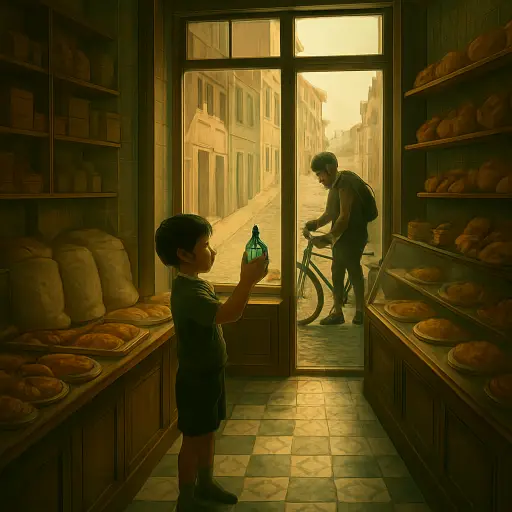
The Captain Under the Counter
Mateus saw the knife before his aunt did, because seven-year-olds could see beneath a bakery counter and grown-ups usually couldn’t.
It hung beside the stranger’s thigh, narrow and bright, between a flour sack and Aunt Sofia’s blue shoes.
“Lock the door,” the man said.
Mateus stopped pushing his ship across the floor. Inside its green glass bottle, the little wooden vessel leaned over a sea of painted plaster. His grandfather had made every rope from sewing thread.
That morning, before leaving for the hospital, Grandfather had pressed the bottle into his hands.
“Bring her back without a scratch, Captain.”
“Promise.”
Now Mateus pulled it against his chest.
Above him, a teaspoon rattled against a saucer. Outside, a tram ground uphill through Alfama, its wheels shrieking around the bend.
“The morning money’s already gone,” Sofia said.
“Then we’ll wait for the safe.”
Mateus knew that voice. The man had fixed the mixer last Thursday. He had eaten three custard tarts standing up and complained that Sofia counted them.
A shoe turned toward the counter’s open end.
Sofia dropped a tray.
The crash made Mateus bite his sleeve.
“Sorry,” she said quickly. “My hands.”
Under cover of the noise, her foot slid across the tiles and pushed the counter’s little cupboard door inward. Mateus squeezed behind it, knees against his chin.
“Anyone else here?”
“Just me.”
“I heard talking.”
“I talk to myself. Ask the customers.”
The cupboard smelled of paper bags and cinnamon. Through the hinge gap, Mateus watched Sofia’s shoes retreat toward the kitchen.
He wanted his mother. He wanted Grandfather out of the hospital, sitting beside him, explaining that something frightening was only something not yet understood.
The stranger’s shoes followed Sofia’s.
“And don’t get clever,” the man said. “I know every way out of this place.”
Mateus looked down at the bottle. In the greenish light, its little sails had turned the colour of teeth.
Twelve Minutes
Sofia entered the safe code incorrectly.
The keypad gave a flat electronic complaint.
“Again,” Rui said.
She had trusted him with her keys while he repaired the mixer. Now he stood between her and the kitchen doorway, holding a knife from her own drawer.
“You’re shaking me.”
“Then stop shaking.”
She entered the correct numbers. The display began counting down from twelve minutes.
Rui struck the safe with his palm.
“You put that on.”
“The insurance company did.”
He snatched her phone from her apron and dropped it into a jug of washing water. Bubbles rose around the case.
Sofia kept her eyes on the jug. Looking toward the counter would be like pointing.
Mateus was quiet when frightened. At four, he had hidden a broken cup for two days because he thought she would stop letting him visit. She had found him beside it, feeding biscuit crumbs to the painted bird on the largest piece.
Stay quiet now, sweetheart.
Rui wiped his forehead with his wrist. Flour clung to the damp skin.
“Back door.”
“Bolted.”
“Show me.”
She led him past the cooling racks. The kitchen air was buttery and hot, with the sharp sweetness of scorched sugar. Through the rear window, barely wider than a baking sheet, she could see a square of bright sky.
“Bolt it properly,” he said.
She did. No escape there anyway: the window opened above a steep service shaft.
Then, from the shop, came a small, unmistakable sound.
Glass tapping tile.
Rui turned.
“Old pipes,” Sofia said.
He caught her apron and pulled her back with him.
Behind the counter, the cupboard door stood open by a finger’s width.
Beside it lay one small blue trainer.
Sofia had bought those shoes herself. They lit up when Mateus stamped his feet.
Rui stared at the shoe, then at her.
“Just you?”
She moved in front of him.
“He hasn’t seen your face.”
Rui’s grip tightened until the apron stitching began to tear.
A Ship Cannot Shout
Mateus had left his shoe because it squeaked.
In his socks, he had slipped behind the stacked flour sacks while Aunt Sofia and the man went to the back door. Now he crouched at the far end of the counter, beside the front window.
He could see the street through a gap between boxes of biscuits.
A woman carried flowers downhill. A delivery rider stopped to adjust something on his bicycle. People were so close that Mateus could hear the rider’s music, thin and tinny from a pocket.
“Come out,” Rui said.
A cupboard door banged against the counter.
“Mateus,” Sofia called, “don’t move.”
“You don’t give orders.”
There was a thump. Sofia sucked in a breath.
Mateus pressed his forehead to the cold bottle.
He could stand up and wave. But Rui would see him, and the window lettering would hide most of him from outside. He had helped Sofia wash that window. The clear pane above the painted cups began just beyond his reach.
The bicycle rider put one foot on a pedal.
Mateus lifted the bottle.
Then lowered it.
Grandfather had needed glasses and a magnifying lens to tie those ropes. His fingers had started trembling lately. Last Sunday, Mateus had threaded three needles for him.
Without a scratch.
“I can see you,” Rui lied.
Mateus almost answered.
Instead, he stood. He held the bottle by its neck, the way Grandfather had specifically told him never to hold it.
“Sorry,” he whispered.
He swung with both hands.
The bottle struck the window with a hard, disappointing knock. A white star appeared in the pane. Outside, the rider looked up.
“There!” Rui shouted.
Mateus swung again.
This time the window burst outward. The bottle tore from his hands and struck the pavement, scattering green glass around the bicycle wheel.
“HELP!” Mateus screamed through the hole. “HE’S GOT A KNIFE!”
The rider dropped his bicycle.
Behind Mateus, something heavy slammed against the counter. Sofia cried out, and a hand closed around the back of his shirt.
What Came Ashore
Sofia dragged Mateus away from the broken window just as Rui lunged for him.
She fell against the cake display with the child underneath her arm. Plates slid. A chocolate cake struck the floor, releasing the rich smell of orange peel.
“Stay down,” she said into his hair.
Rui stood over them. For a moment, he seemed unable to decide whether the knife was useful anymore.
Outside, the delivery rider shouted into his phone.
“A robbery! There’s a child inside!”
The woman with the flowers began hammering on the locked door. Someone across the street raised a phone, aiming its camera through the broken pane.
Rui backed toward the kitchen.
Sofia watched him remember the rear bolt, the narrow window, the service shaft. He knew every way out. She saw him count them.
“Put it down,” she said.
“Shut up.”
But the knife was lowering.
A man outside shouted that the police were coming. Rui laid the blade on the counter and stepped away from it, both hands spread.
From the kitchen, the safe gave a cheerful beep.
Later, Sofia sat with Mateus on the doorstep while a police officer asked questions inside. His feet rested in her lap. She had found his other shoe, but he wouldn’t let her put either one on.
“My ship,” he said.
“We’ll look when they’ve cleared the glass.”
He shook his head. “I promised him.”
Sofia rubbed a patch of dried flour from his cheek with her thumb. Her own hands were still trembling.
The delivery rider approached carrying a pastry box.
“Found this under my wheel.”
Inside lay the little ship. One mast had snapped, and its painted sea was gone, but the hull was whole.
Mateus touched it with one finger.
That evening, Sofia took him to the hospital. He placed the box on Grandfather’s blanket and explained everything without looking up.
Grandfather studied the broken mast.
“I can mend that.”
“Not the bottle.”
“No.” He lifted the ship carefully, testing its weight in his palm. “But look what you brought home.”
Mateus looked.
Grandfather reached past the box and took his hand.