Ada Risks Her Name for the Strongman
A librarian can clear a circus strongman of murder, but her alibi could cost her freedom.
- Mystery
 By Storyleo Editorial
- 6 min read



The Cage at Supper
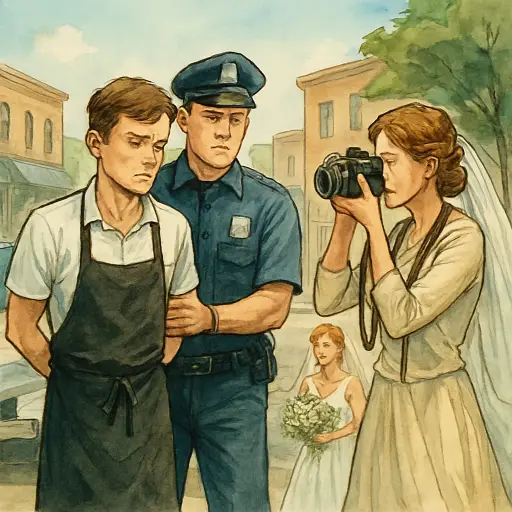
When the carabinieri dragged the strongman past our supper table, Ada put down her spoon and asked why his birdcage had no perch.
No one answered. Beyond the circus wagons, a trumpet player was practicing the same six notes, unaware that his employer lay dead beneath a sheet.
“Stay out of it,” I whispered.
Ada folded her hands beneath the table. In Faenza’s municipal library she could silence schoolboys by lifting one finger; among strangers, she sometimes could not make herself ask for bread.
But she watched the cage.
We had come to collect the circus’s borrowed books before it left for Rimini. I was the library’s bookbinder, and I carried whatever Ada needed carried. That evening it was a basket of repaired novels and the hope that she might let me buy her supper afterward.
Instead, we had been detained with everyone else.
“Cesare threatened him this afternoon,” said Vittorio, the circus treasurer. He stood beside us, stroking his narrow mustache. “Half the company heard.”
The dead man, Ugo Bellandi, owned the circus. According to the sergeant, someone had driven a narrow metal spike into his chest between eight and half past. His wages chest stood open and empty.
Cesare had been found beside the wagons carrying a covered brass cage.
“An odd parcel for a man leaving in a hurry,” Vittorio said.
“He wasn’t leaving,” Ada murmured.
The treasurer bent toward her. “Pardon?”
She pressed her lips together.
I knew that gesture. Every few weeks she returned to the library with it, then worked late shelving books no one had officially borrowed.
The sergeant came back holding the cage by its hook.
“Empty,” he said. “He claims it held library books.”
Ada reached beneath the table and caught my wrist. Her fingers were cold despite the heat trapped under the canvas awning.
“Did it?” I asked her quietly.
She looked toward the wagon where Cesare was being held.
“Paolo,” she said, “I need you not to ask me that yet.”
What the Brass Remembered
The sergeant allowed Ada to examine the cage because she said it belonged to the library. That was a lie. I had repaired every battered object in that building, and none had brass lions for feet.
We worked on an upturned crate beside the cook’s wagon. The air smelled of frying onions, hot axle grease, and the sharp soap with which somebody was scrubbing Bellandi’s steps.
“You could simply tell him,” I said.
“No.”
“Cesare may hang.”
Her hand stopped over the cage door.
“I know.”
That frightened me more than anything.
Two threaded sockets faced each other inside the cage. One held a small brass cap. The other stood bare.
“A removable perch,” I said.
Ada nodded. “It was there this afternoon.”
“You saw him?”
She did not answer. Instead, she lifted the cage and shook it gently. Something scraped beneath the floor.
I found a catch concealed inside one lion’s open mouth. The bottom hinged down.
Inside lay a thin account book.
Ada’s shoulders dropped, but not with relief.
The pages contained dates, towns, and sums in two columns. The first was headed with ticket receipts; the second recorded what Bellandi had actually received. The difference grew steadily larger.
On the final page he had written:
Vittorio. Monday. Repayment or police.
“So Bellandi knew his treasurer was stealing,” I said.
“And hid the proof where Vittorio would never ordinarily look.”
“In a birdcage?”
“Bellandi’s wife kept her canary in it. Since she died, it has hung outside his wagon. Cesare borrowed it today.”
Ada touched a small brown stain beside the bare socket. Then she drew her hand away.
The sergeant approached, boots crunching nutshells.
“Found your library books?”
She gave him the accounts instead.
He read the last page twice.
“Where was Cesare at eight?” he asked.
Ada looked at me. I had loved her for four years without ever seeing her ask so plainly for help.
I could offer none that would let her keep everything.
The Books Without Stamps
“He was with me,” Ada said.
The sergeant waited.
“From a quarter before eight until half past. In the disused ticket wagon. He was returning books.”
“Why didn’t you say so?”
She rubbed the place on her finger where her pen rested.
“They were not books the municipality permits me to lend.”
Behind us, a pan struck the cook’s stove with a flat clang.
It was 1934. The sergeant did not need to ask which books she meant. I pictured the cupboard behind Ada’s desk, its loose backboard, the volumes I had repaired without entering them in my binding register.
Not carelessness, then. She had been trusting me.
“Names?” he said.
“Cesare’s. Mine. No others.”
“You understand your position?”
She caught her skirt between her knees to stop her hands shaking. “Better than Cesare understands his.”
The sergeant closed the account book.
“Stay here.”
We sat without speaking until Vittorio appeared between two wagons.
“An unfortunate business,” he said. “A woman with a respectable post, lending that sort of rubbish.”
Ada looked up. “How did you know what sort?”
He glanced toward the sergeant’s wagon. “Everyone knows now.”
“Not everyone,” I said.
Vittorio ignored me. “Cesare cannot be trusted. He stole that cage. Bellandi would never have lent it to him.”
“Yet you believed it held stolen wages,” Ada said.
“It might have.”
“There wasn’t room.”
“Under the floor there was.”
He stopped.
The trumpet had finally fallen silent. Somewhere behind the tent, a woman was shaking sawdust from a carpet.
Ada stood, carefully smoothing her skirt.
“When did you open the bottom, Signor Vittorio?”
He turned to go, but I stepped into the passage. I am neither large nor brave. Fortunately, the cook had been listening, and she came out holding a ladle as long as my arm.
“Sergeant!” she shouted.
Vittorio shoved me against a wheel. Before he reached the next wagon, two canvas workers caught him.
Ada stayed beside the crate, one hand resting on the empty cage.
Room for Something Living
They found the perch in Vittorio’s traveling trunk, wrapped in a bloodstained handkerchief beneath the missing wages. Its threaded end fitted the bare socket.
He had gone to Bellandi’s wagon to argue about the accounts. Cesare had already returned the cage to its hook. During the quarrel, Vittorio had unscrewed the perch; afterward, searching for the ledger, he had discovered the hidden compartment.
He had not discovered its contents. The thin book had slipped behind the wooden lining, where our shaking had dislodged it.
“I thought he’d hidden the money there,” Vittorio insisted as they took him past us.
Ada did not look at him.
The sergeant summoned her alone. I waited outside his wagon, picking a splinter from my palm until blood spotted my cuff.
When she emerged, she carried the cage.
“Well?”
“I must report to the station tomorrow. And the library committee on Monday.”
“What did you tell him?”
“Enough to release Cesare. Nothing about anyone else.”
She tried to fasten the cage door. Her fingers would not manage the little hook, so I did it for her.
The committee dismissed her on Monday. By Friday, I had resigned. Ada argued with me for nearly an hour.
“You have rent to pay, Paolo.”
“So do you.”
“That is not an answer.”
“Cesare has found us work.”
The circus needed someone to mend costumes and canvas. It also needed, Cesare said, someone to teach the children while their parents rehearsed.
“And the adults?” Ada asked him.
The strongman studied his enormous hands. “Some of us, too.”
That settled it.
Before we left Faenza, I fitted wooden shelves inside the cage. It held twelve books if you chose thin ones. Ada hung it outside the school wagon, where anyone could reach the latch.
“You realize,” she said, “you have run away with a librarian.”
“I was hoping with was the word.”
She took my splintered hand, examined the healing palm, and kept it.