A Torn Waiter’s Sleeve in the Wedding Money Box
A teenage waiter faces arrest, but a wedding photographer’s undeveloped film could change everything.
- Mystery
 By Storyleo Editorial
- 6 min read


The Empty Wishing Well
The bride put her hand through the slot in the wedding-money box and came out holding a strip of somebody’s sleeve.
“That,” she said, “is not eighteen hundred dollars.”
It was September 1986, in a reception hall behind a butcher’s shop in Coburg. I was twenty-nine, with two cameras round my neck and a mortgage depending on people continuing to marry. Even now, forty years later, I remember the smell of that room: roast lamb, hairspray and the hot dust inside my flash unit.
Teresa Russo shook the wooden box. Something scraped inside. Her husband, Vince, stood beside her with his airport tickets protruding from his breast pocket.
“Perhaps your mother collected it,” he said.
“Mum doesn’t have the key.”
Her uncle Raymond did.
Raymond came across from the bar, his right arm resting in a broad sling made from a hand-knitted scarf. His sister had knitted it in purple and mustard wool, with one green patch where she’d run short.
“Don’t look at me like that, love.” He set his beer down. “I’ve been sitting here with this bloody wrist.”
He’d fallen from a ladder on Thursday. Everyone knew; he had described the fall between every course.
Teresa held up the torn fabric.
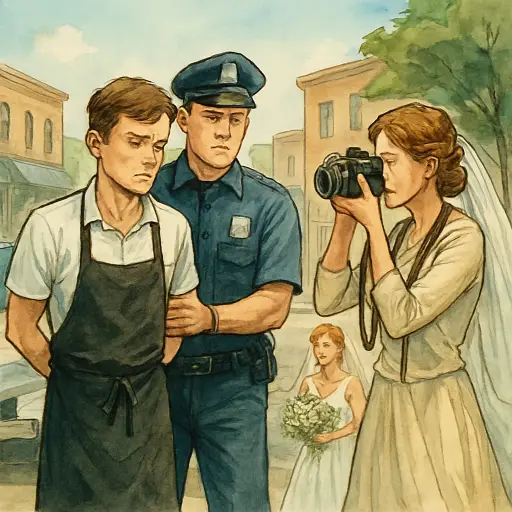
A waiter near the kitchen stopped stacking plates.
His white jacket had a rip under the pocket.
Raymond pointed with his good hand. “That’s your answer.”
The waiter’s name was Nabil. He was seventeen, narrow as a coat hanger, and had spent lunch fetching extra gravy for people who called him Neil.
“I caught it on the storeroom door,” he said.
“We’ll let the police decide.”
Teresa looked at the clock. The airport minibus was coming at five. It was twelve minutes past four.
“Nobody leaves,” she said.
Raymond gave a patient smile. “You’ve got a honeymoon to catch.”
I looked down at my cameras. I had photographed that box perhaps twenty times.
“Give me half an hour,” I said.
What the Film Kept
Raymond objected to that.
“They’re wedding pictures, not fingerprints.”
“Pictures have settled worse arguments.”
“And started them,” Teresa’s mother muttered.
She drove me to my studio, six streets away. I took the roll from my second camera—the one loaded with black-and-white film for the older relatives, who thought colour photographs faded before the marriage did.
In the car she introduced herself again.
“Carmela. You’ve been calling me Mrs Russo all day.”
“Graham.”
“I know. I wrote the cheque.”
At the studio, she sat outside the darkroom while I wound film onto a steel reel in complete darkness. The reel slipped. My fingertips were damp.
Slow down.
Through the door, Carmela said, “The boy didn’t take it.”
“You saw something?”
“He asked permission to eat a bread roll. A thief wouldn’t ask that.”
I didn’t answer. I had photographed enough families to distrust character references.
The developer smelled sharp and metallic. I agitated the tank, watched the timer, and asked her to telephone the hall.
She returned before the fixing was finished.
“Police are coming. Raymond says the boy admitted being alone with the box.”
“Did he admit taking anything?”
“No.”
That distinction seemed likely to shrink before I got back.
I rinsed the negatives and held the wet strip beneath the light. Small pale faces grinned upside down. There was the cake. The speeches. Teresa bending over her grandmother.
Then the gift table.
I put the strip in the enlarger without waiting for it to dry properly.
The first print showed Nabil beside the box, clearing glasses. His jacket was already torn. Behind him stood Raymond, sling bright against his charcoal suit.
The next frame had caught Raymond laughing.
His right hand was out of its sling, holding a glass.
“Perhaps it’s only sprained,” Carmela said.
But I was looking at the scarf.
A Change in the Knitting
“Did you knit it?” I asked.
Carmela nodded. “For his birthday. He complained it was too wide. Now it’s useful.”
I slid another negative into the enlarger: Raymond arriving, taken outside beneath the hall’s striped awning.
The scarf made a shallow cradle beneath his wrist. Its green patch sat squarely under his thumb.
In the picture beside the gift table, that patch had vanished into a thick bundle against his stomach.
“He tightened it,” Carmela said.
“Or put something in it.”
She leaned closer. The enlarger’s fan rattled above us.
“That scarf stretches. Terribly. I told him not to hang it on a hook.”
I made two prints, then another from the frame between them. Raymond had been standing behind the bride while she cut the cake. Nobody had been watching him. His left hand lay over the wooden box; his right was down inside the open lid.
The edge of the cake hid most of it.
“Can the police use that?” Carmela asked.
“It shows he opened it. He can say he was checking the money.”
She pressed a finger to the pale blur of his hand.
“He told me yesterday he couldn’t even hold a fork.”
The telephone rang in the outer room. It was Teresa.
“They’re taking Nabil to the station. Raymond says he’ll make a statement after he drops our luggage at the airport.”
I checked my watch. Four forty-seven.
“Don’t let him take your cases.”
“He’s already outside.”
“Tell the police to look in his sling.”
There was a pause.
“Graham, are you sure?”
Behind me, Carmela took the wet prints from their tray. Water ran over her cuffs.
“Tell her I’m coming,” she said.
She drove back with both hands tight on the wheel. At one junction she stopped so abruptly that the prints slid off my lap.
“He borrowed money from me in June,” she said.
I gathered the pictures from the floor.
“Did he repay it?”
The light changed. She drove on.
The Last Group Photograph
The minibus stood outside the hall, its diesel engine shaking the ribbons on the bridal car. Raymond was loading a suitcase with his good arm. Nabil sat in a police car, staring at his shoes.
Carmela got out before I had gathered the prints.
“Take it off,” she told her brother.
“What?”
“My scarf.”
He glanced towards the constable standing beside Teresa.
“Don’t be ridiculous. You’ll hurt my wrist.”
I handed over the photographs. The constable studied them while Raymond talked about angles, shadows, wedding nerves.
“You’re welcome to look,” he said at last. “But I want witnesses to how you treat an injured man.”
He began loosening the knot at his neck.
Carmela stepped forward and caught the bottom of the sling.
“Not over the gutter,” she said.
The first envelope fell onto her shoe.
Then three more slipped out, followed by a folded bundle wedged inside the green patch. One envelope had a lipstick kiss beside the flap.
Teresa picked that one up.
“That’s from my grandmother.”
Raymond’s arm hung perfectly straight.
“I was keeping it safe.”
“From Nabil?” she asked.
He said nothing.
The constable asked him to come away from the bus. Carmela kept hold of the scarf until every envelope had been counted out across the bonnet of the bridal car.
There were two thousand and sixty dollars. More than Teresa had thought.
The money wasn’t the last thing found. When the constable turned out Raymond’s pockets, a small pair of nail scissors landed among his keys.
Nabil touched the rip beneath his pocket.
“He brushed past me in the pantry,” he said. “Said I was blocking the beer.”
We missed the airport minibus. The driver refused to wait through the statements.
So I drove the couple myself, with Nabil in the front because Teresa insisted he come along. Before we left, she asked for one final photograph.
Carmela stood beside her daughter, holding the stretched scarf. Nabil kept his torn jacket on.
Years later, when Teresa ordered another print, she asked me not to crop him out.
“That one,” she said, “is the family photograph.”