A Radio Too Honest for Supper
As floodwaters rise, a widower’s peculiar radio broadcasts everything he and his unexpected visitor conceal.
- Love
 By Storyleo Editorial
- 4 min read


Listen to this story · narrated, 7 minutes
The Voice in the Tin Box
The radio offered Amos Bell a kiss while he was gutting a whitefish.
“Not on the mouth,” it crackled. “Not with everybody looking.”
Amos stopped his knife. Outside his shack, the Yukon evening shone yellow on sluice boxes and heaps of frozen gravel. Inside, fish scales glittered on his cuffs.
He turned the dial.
“I haven’t found a speck since February,” said another voice. “I’ve been buying flour on credit.”
That was Gilbert from the upper claim. Gilbert had spent breakfast boasting about his latest strike.
Amos unplugged the set.
Someone hammered on his door.
The woman outside carried a tool roll beneath one arm. Her gray hair had escaped its pins, and her boots were wet to the ankles.
“Mrs. Baines?” he asked.
“Winifred. Unless you’re collecting a debt.” She shouldered past him. “Camp foreman says you’ve got the only working receiver.”
“That depends what you want to receive.”
“River’s taken the lower landing. The transmitter at the office is underwater. I need your set for parts.”
Amos put his knife down carefully. At seventy-three, he still delivered fish to every cookhouse along this stretch. His boat was tied at the lower landing.
“My skiff?”
“Safe above the bank. I moved it.”
He reached for his coat.
She caught his sleeve. “We need a boatman and somebody who understands valves. Congratulations. We’re both employed.”
From the unplugged radio came a whisper.
“Please don’t let him be another man who shouts.”
Winifred’s fingers tightened on his sleeve.
What the Set Wouldn’t Keep
Neither spoke until Amos had shut the door.
“Was that you?” he asked.
“Did you see my mouth move?”
“No.”
“Then fetch a screwdriver.”
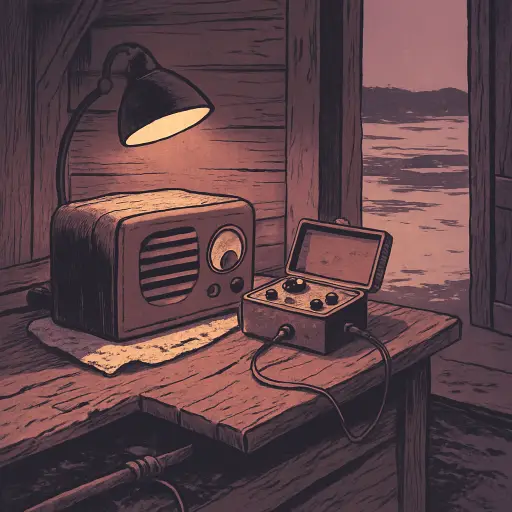
He fetched three. She selected the smallest and opened the radio’s wooden back.
Amos had bought it from a departing prospector that morning, hoping for weather reports and perhaps a little music. Since his wife’s death eleven years earlier, supper had become a remarkably noisy business: fork, plate, stove lid, nothing else.
“I wish she’d stay for supper,” the radio said in his voice.
He dropped a screwdriver.
Winifred studied the valves with fierce attention. “Something hot would be welcome.”
“There’s fish.”
“I’d gathered.”
Beyond the window came a heavy, grinding crash. River ice struck the bank; water spilled through the camp between the cabins.
Winifred pulled a compact transmitter from her tool bag. “Battery drowned. If I can borrow your power supply, we can reach the freight station. They’ve got a launch big enough for everyone.”
“And if you can’t?”
“We’ve got your skiff and eighteen people.”
He set the kettle on.
“You’re taking this calmly,” she said.
“No sense facing arithmetic without tea.”
Her mouth twitched.
As she worked, he learned she had repaired wireless sets aboard coastal steamers and had come north for wages nobody could quietly hand to a husband.
“There isn’t a husband,” she added.
The radio hissed.
Amos laid a folded towel over it.
“That,” said Winifred, “is the nicest thing anybody’s done for me all week.”
A Wire Across the Water
By midnight, water knocked loose boards against the doorstep.
The transmitter’s needle trembled but would not rise. Winifred checked a soldered joint, then checked it again.
“Earth connection,” she said. “We need bare metal sunk deep outside.”
Amos looked at the iron stove, then at the floor.
“There’s a gravel seam beneath the shack. Stays damp all summer.”
“Can we reach it?”
He took up his fish gaff.
“I own the floor.”
They pried up two boards. Cold, mineral-smelling air breathed through the gap. Amos drove a length of pipe into the gravel while Winifred held the lamp.
His swollen knuckles slipped on the hammer.
“Let me.”
“I can manage.”
“I know. Let me anyway.”
He handed it over.
From beneath the towel, his own voice murmured, “She’ll leave when the launch comes.”
The hammer paused.
Amos stared into the hole. Merciless contraption.
Winifred struck the pipe twice more, attached the wire, and sat beside him.
“I usually do leave,” she said. “It’s easier before somebody starts explaining which parts of me need improving.”
“I was going to ask you to improve my stove door.”
She pressed her lips together. Then the laugh escaped, warm and breathless.
The transmitter needle jumped.
Winifred seized the microphone. Amos held the lamp steady as she gave their position, the number stranded, the speed of the rising water.
A distant operator answered through ordinary static.
Under the towel, the strange voices had stopped.
Amos found he missed them less than he had feared.
The Things Asked Aloud
The launch arrived with daylight, pushing broken ice ahead of its bow. Amos ferried the camp’s people from the highest cabins while Winifred kept the freight station informed.
When the last passenger was aboard, she stood outside his shack with her tool roll.
“They’ve offered me passage to Dawson,” she said.
He rubbed a thumb over a fish scale dried onto his cuff.
“Sensible.”
“Yes.”
Behind them, his little stove ticked as it cooled.
He wanted the radio to speak. It sat on the table, uselessly discreet.
“I’ll be back when the water drops,” he said. “Shack’s high enough to survive.”
“It needs work.”
“Apparently everything I own does.”
She waited.
Amos took off his cap. “Would you come to supper when I’m settled? Not to mend anything.”
“Will you cook something besides fish?”
“I could learn.”
She stepped close and kissed his cheek, briskly, despite the deckhands watching.
Six weeks later, Winifred returned with potatoes, two oranges, and a replacement valve.
They ate at the table Amos had sanded until his hands ached. Afterward, she repaired the receiver. Music emerged, thin but unmistakable.
“No more secrets?” he asked.
“Only if we tell them ourselves.”
He reached across the table. She met his hand halfway.
“I’d like you to stay tomorrow.”
Winifred turned his hand palm upward and traced a scar with her thumb.
“Ask me again at breakfast.”