
Six Quarters and a Tooth for Grandpa’s Overdue Book
A stranded librarian finds more than an overdue book at a drought-stricken Kansas farm.
- Love
 By Storyleo Editorial
- 4 min read

Listen to this story · narrated, 6 minutes
The Crime Under the Bed
I was seven when I tried to pay a forty-year library fine with six quarters and a tooth.
The tooth wasn’t even mine. It belonged to my cousin Denny, who had forgotten it at our farm after Thanksgiving.
“Keep that,” the man at our kitchen table said, sliding it back. “We don’t accept teeth anymore.”
His name was Adam Reyes. His bookmobile had blown a tire beside our mailbox, and Mom had brought him inside because the Kansas afternoon was hot enough to curl the porch mat.
I had meant to show him my summer reading sheet. Instead, I’d brought the library book I found under Grandpa’s old bed.
Mom stopped pouring water.
“Nora. Where did you get that?”
The book was called Gardening on the High Plains. Its green cover had gone soft at the corners. Inside, a stamped date said it should have gone back forty years ago.
“Are we in trouble?” I asked.
Outside, our corn leaves stood twisted narrow as shoelaces. Mom had stopped watering the vegetable patch to save water for the plants she sold. We didn’t need another bill.
Adam checked the date. Then he checked his phone.
“The tire truck won’t reach me until six.”
Before Mom could answer, something cracked behind the house.
She dropped the pitcher into the sink and ran.
Through the window, I saw our nursery’s shade cloth lifting into the white sky.
People Who Hold On
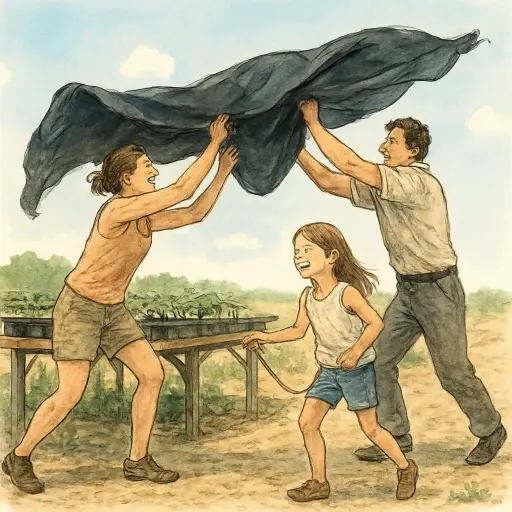
The west support had split. Black cloth slapped above the seedling tables, pulling the next post sideways.
Mom caught a corner with both hands.
“Nora, stay clear!”
Adam caught the other corner. His good shoes sank into the dry soil.
“Where do you want this?”
“Down!” Mom shouted. “Mostly down!”
They had been strangers twenty minutes earlier. Now they were hanging from the same enormous flapping thing.
I fetched the rope Mom pointed at. Then I brought fence staples, a hammer, and the orange bucket she hadn’t asked for but needed anyway.
“You’ve done this before?” Mom asked Adam.
“Absolutely not.”
“You looked confident.”
“That was before it tried to take me to Nebraska.”
Mom laughed. It surprised me so much I dropped three staples.
We pulled the cloth over the low fence and tied it there. Beneath it, hundreds of little plants sat in black pots: peppers, tomatoes, marigolds. Mom sold them at the Saturday market. Lately, she counted the money twice and didn’t buy herself lemonade.
When the cloth finally stopped snapping, Adam’s thumb was bleeding.
Mom wrapped it with a strip torn from her clean handkerchief.
“Librarians aren’t built for this,” she said.
“You should see us move the encyclopedias.”
Her fingers stayed around his hand after the knot was tied. Just a second. I saw it because I was watching for blood.
Then the hose coughed, spat brown water, and went quiet.
What Grandpa Wrote
“The pump’s overheated,” Mom said.
She pressed her lips together and looked at the smallest plants. Their leaves had folded over the rims of their pots.
We carried water from the kitchen while the pump cooled. Adam took two buckets. Mom took two. I had a saucepan, which required more trips but splashed less on my socks.
Afterward, we sat on the kitchen floor because the chairs seemed too far away.
The overdue book lay beside me.
“Grandpa wrote in it,” I confessed. “That probably costs extra.”
I opened to a page about growing windbreaks. Grandpa’s square handwriting filled the bottom margin.
Ask Dorothy to supper. Don’t explain the irrigation system unless she asks.
Mom made a small noise through her nose.
“Dorothy was Grandma,” she told Adam.
Underneath, in Grandma’s slanty writing, was another sentence.
I asked. He explained it. I stayed anyway.
A flat yellow flower rested between the pages. Mom touched its thin brown stem.
“She always said he brought her flowers.”
“He grew them,” I said. That seemed important.
Adam turned the cover over carefully.
“We don’t charge overdue fines now. You can keep this until you’re ready to return it.”
“Forty more years?” I asked.
“Let’s start with a renewal.”
Outside, a truck horn sounded.
Mom stood and brushed dirt from her knees.
“You’ll want to get going.”
Adam looked toward the door. Then at her.
“I’d rather help you straighten that post first.”
Supper, Without Irrigation
He came back Saturday with a borrowed post-hole digger.
“Your tire broke again?” I asked.
“No.”
Mom stood behind me, wiping her hands on her shorts.
“He called first, Nora.”
That was when I began suspecting something.
All through August, the drought stayed. Dust collected in the porch-screen corners. We lost some plants, but not all of them.
Adam came on Saturdays after the market. Sometimes he helped. Sometimes Mom made him sit down while she finished, and they talked across the nursery tables.
He learned which pots were too light and needed water. Mom learned he sang badly when he hammered.
One evening, I found them beside the repaired shade post.
“I’m not very good at this anymore,” Mom said.
“Hammering?”
She pushed his shoulder.
“Starting things.”
Adam set the hammer on the fence.
“We could start with supper.”
I ran inside before they could see me grinning.
The library book was on our kitchen shelf now, renewed. I opened it to Grandpa’s flower and carefully laid my own offering beside it: the receipt from Saturday’s market, where Mom had sold every marigold.
When they came in, Adam was holding her hand.
“Are you staying?” I asked.
“For supper,” he said.
Mom pulled out the chair beside hers.
“And Nora,” she added, “please don’t show him the tooth.”
“He’s already seen it.”
Adam sat down, smiling at her.
“I stayed anyway.”