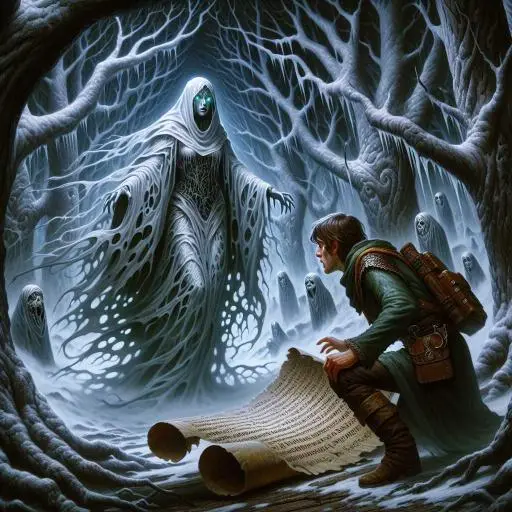
The Whispering Pines: Echoes of Pine Hollow
A novelist seeking solitude discovers voices in salvaged timber—and witnesses who refuse to be rewritten.
- Horror
 By Storyleo Editorial
- 6 min read



The Knot Beside the Bed
Jonathan Carver woke to a woman whispering from a knot in the cabin wall, asking him to take his weight off her hand.
He rolled from the bed before he was properly awake. His bare feet struck cold boards. Behind the pine paneling came a long, relieved breath.
“Who’s there?”
The knot was no larger than a penny. He held his candle against it until hot wax spilled over his fingers. There was no hole.
Outside, the abandoned houses of Pine Hollow stood pale beneath a hard October moon. Nothing moved in the old town square. The nearest inhabited house belonged to his landlady, Mrs. Wilkes, half a mile away beside the graveyard.
“Mrs. Wilkes?”
A dry scraping passed along the wall at shoulder height.
“Not her,” the woman whispered.
Jonathan dressed without turning his back on the paneling.
He had come to this forgotten corner of New England to finish a novel. Six months of city noise, overdue bills, and sympathetic inquiries from his publisher had produced eleven pages about a husband trying to recover his dead wife. Here, he had told himself, there would be quiet.
He put another log on the fire and sat at the table until daylight.
By noon he had found explanations: a squirrel, wind in a wall cavity, a half-remembered dream. He inspected the cabin outside. The boards were sound, smelling of sun-warmed resin.
That evening he wrote three pages.
At midnight, someone beneath the floor began coughing.
It was a wet, laborious cough. Jonathan lifted the hearth rug, found no cellar hatch, and struck the boards with the poker.
“Stop it.”
The coughing stopped.
Then a child said, very distinctly, “You’ll make him swallow his teeth.”
Jonathan backed into the table. His ink bottle fell, spreading black beneath the unfinished reunion of his fictional lovers.
From the wall, the woman whispered, “Please. Before you start inventing things.”
Greta’s Green Stocking
Mrs. Wilkes let him in without asking why he had arrived before breakfast.
“The kettle’s nearly boiled,” she said.
Her sister Greta sat beside the window, knitting a green stocking. Beyond her shoulder, the graveyard grass shone white with frost. Many stones had tipped forward, as though their occupants were trying to read the inscriptions.
Jonathan laid his cabin key on the table.
“There are people inside the walls.”
“Not entirely,” Greta said.
Mrs. Wilkes set down a cup too sharply. Tea jumped into the saucer.
“You might have warned me,” Jonathan said.
“And said what? The plumbing freezes, the chimney draws badly, and sometimes the timber remembers?”
He left the tea untouched.
Mrs. Wilkes sat opposite him. “The cabin was built with salvaged wood. From the last logging camp.”
“Someone died there?”
Greta stopped knitting. “Someone dies everywhere. That isn’t enough to cause this.”
She reached behind her chair and handed him a thin local history. A passage had been marked in pencil.
Following the autumn disturbance of 1891, the remaining mill families departed Pine Hollow. No reliable account of the missing has survived.
“Disturbance,” Greta said. She pulled a stitch so hard the wool squeaked. “Our grandmother called it the collection.”
Jonathan pushed the book away. “I’m leaving.”
“You can,” Mrs. Wilkes said. “But last autumn I visited my daughter in Worcester. I heard my father calling from her breadboard.”
The kitchen clock clicked through several seconds.
“What do they want?”
“To be heard somewhere besides the place it happened.”
“Then why frighten me?”
“Would you have listened otherwise?” Greta asked.
He looked down at his hands. Ink remained beneath three fingernails.
Mrs. Wilkes fetched his coat. “There’s a stone in the oldest pines. People used it as an altar before there was a church. Follow the abandoned tramway.”
“And then?”
Greta resumed her knitting.
“When they show you something ugly, don’t improve it.”
The Stone Beneath the Roots
The iron rails ended at a bank of rust-colored needles. Jonathan continued between pines so thick that his shoulders brushed bark on both sides.
There was no wind, yet the branches whispered overhead.
He heard a saw being sharpened. A spoon scraping a pot. Someone counting wages, then starting again.
Ordinary things, he thought, gripping his notebook. That made it worse.
The stone stood in a shallow clearing, its surface cupped beneath a tangle of roots. Jonathan knelt to pull ivy away. Under his palm, the granite was warm.
A small hand closed around his thumb.
He jerked backward, but the clearing had gone.
He stood inside a bunkhouse packed with people. Damp wool steamed beside an iron stove. A woman held a swollen hand against her chest; through her fingers protruded the white splinter of a broken bone.
Outside, men hammered a plank across the door.
“Company property,” someone shouted. “You stay till the sheriff comes.”
A child beneath a bunk clutched a tin cup in both hands. Beside him, an old man coughed blood into a flour sack.
Jonathan could smell lamp oil.
“Who set it?” he asked.
The woman stared at him. “Does that get us out?”
Flame ran along the windowsill.
Jonathan lunged for the door. His fingers passed through the latch. Behind him, the back wall split—not burning, but opening into upright pines.
Branches reached through.
The child crawled toward them. The woman followed. Flesh tightened into grain; hair snagged and became fine roots. The old man’s cough continued inside a trunk.
They had escaped the fire.
None had escaped the shelter.
More scenes broke over Jonathan: empty houses, a mill owner giving evidence, men cutting trees that bled clear sap around embedded teeth.
“I can write this,” he gasped.
The woman caught his wrist with her ruined hand.
“Not just this.”
She showed him a kitchen before the fire. A loaf cooling. Her son stealing the crust.
Then she began telling Jonathan his name.
The Uncut Pages
When Jonathan returned, Mrs. Wilkes was waiting on the cabin step with a lantern.
“Did you hear them?”
He tried to answer. His throat worked around a sound like a saw caught in wet timber.
She took his arm and brought him inside.
For three days, he wrote.
He abandoned his novel. He wrote the mill families’ names, their debts, their quarrels, the meals they had eaten. He recorded who barred the bunkhouse and who stood nearby doing nothing. When his hand cramped, Mrs. Wilkes took dictation.
At night, Greta read the pages aloud.
Occasionally the cabin corrected her.
“Thursday,” whispered the floor.
“Her blue dress,” said the wall.
Jonathan crossed things out. He did not make the child brave. He did not give the dying old man a speech.
On the fourth evening, the woman asked for her son’s stolen crust.
“It’s here,” Jonathan said, touching the page.
“Read it.”
He did.
A small, delighted giggle came from beside the hearth. Then the cabin settled, and remained still.
His publisher objected to the book’s length and its absence of a central hero.
Jonathan refused the cuts.
The book appeared the following autumn as The Whispering Pines: Echoes of Pine Hollow. He sent the first copies to the sisters and returned before the frost to help them clear the graveyard.
There were names to add.
That night, he slept in the cabin with his bed against the same wall. No one woke him.
In the morning, Greta arrived carrying her copy of the book.
“A woman in Hartford wrote to us,” she said. “She found her great-grandmother in it.”
Jonathan ran his thumb along the book’s uncut pages.
“Did she believe it?”
“She said she’d read the kitchen passage aloud to her children.”
From far beyond the square came the soft movement of pine branches.
Greta looked toward them.
“She said someone asked for another slice.”