The Cat Brought Back a Child’s Plea
A solitary farmer aboard a generation ship follows a hungry cat to thirty-eight forgotten people.
- Fiction
 By Storyleo Editorial
- 7 min read


The Missing Supper
The cat stole Nadiya’s supper while she was arguing with her dead husband.
“You said dwarf beans were worth the trouble,” she told the photograph clipped above the packing bench. “Come down here and untangle them, then.”
A grey paw slid over the edge of her bowl.
Nadiya caught the thief by its loose shoulder skin, supporting its weight with her other hand. Beneath the fur, its ribs felt like the teeth of a comb.
“That’s my egg.”
The cat held a strip of omelette between its teeth. One ear had lost its tip. Its back feet hung without protest, which was worse than scratching.
Beyond the farm’s transparent ceiling, the ship’s axial lamps dimmed toward evening. Nobody aboard the Long Acre had seen an actual sunset; their grandparents hadn’t either. Nadiya had twelve rows of beans, six of sweet potatoes, and forty-three years of flight left before anyone would.
She put the cat down.
“Half,” she said.
It ate three-quarters while she fetched water.
Animals belonged to licensed households or working departments. A loose cat meant forms, quarantine fees, somebody knocking during harvest. Nadiya had stopped inviting knocks fourteen months ago, after Oren’s work boots came back from the machinery deck without him.
She found an empty seed tray and lined it with his old pruning shirt.
“One night. Then we find your people.”
The cat drank until its whiskers dripped. It ignored the bed and slipped behind the wash station.
There was a scrape, a hollow metallic knock, then silence.
Nadiya crouched. Behind a loose inspection grille lay a narrow ledge above the farm’s runoff channel. A faint warmth breathed through it, carrying the smell of hot dust.
“Excellent,” she said. “A tenant with its own entrance.”
She left the remaining omelette beside the grille.
The Red Thread
By morning, the omelette had vanished. In its place lay a short red thread.
Nadiya picked it off the floor. Not thread: wool, twisted into a tiny bracelet. Someone had tied it around something too small for a wrist.
When the cat returned at midday, she caught it gently between her boots.
“You have people.”
It smelled of warm wiring. Grey powder coated its paws.
She fastened the bracelet loosely around its neck and attached a scrap of packing paper.
Your cat is eating at Farm Six. Is anyone feeding it? —Nadiya
“Don’t charge me for delivery,” she told it.
The cat bit the paper, reconsidered, and disappeared behind the grille.
She harvested beans. She cleaned filters. She ate standing up, watching the hole instead of Oren’s photograph.
Two hours later, the paper came back, damp at one corner.
Her name is Button. We feed her but she gives hers to the kittens. There aren’t kittens anymore. Mum says please don’t report us. We’re still waiting for our rooms. —Tessa
Nadiya read it twice.
Beyond that wall was Dormitory Nine, closed when its drinking-water pipes cracked. The farm delivery map showed it stripped and vacant.
She called habitation control.
“Nine was evacuated,” the clerk said.
“A child there has sent me a note.”
Keys rattled. “Temporary accommodation was assigned.”
“Was it occupied?”
“I can open an inquiry.”
“Please do.”
She ended the call before her voice sharpened further.
Then she filled a container with cooked sweet potato, added two eggs, and tied it inside a cloth sling. Button sat washing one dusty foot.
“Show me.”
The cat went through the grille. Nadiya fetched a wrench and followed as far as her shoulders allowed.
Across the dark channel, someone coughed.
The Runoff Channel
“Hello?” Nadiya called.
A light flickered beyond a second grille, several metres away.
“You’re not supposed to fit in there,” a girl said.
“Neither are you.”
“I fit easily.”
A small face appeared behind the bars. Button rubbed against it, briefly blotting out one eye.
Nadiya pushed the food along the ledge with her wrench.
“Where’s your mother?”
“At work. She’s coming back after shift.”
“How many people are there?”
Tessa counted under her breath. “Thirty-eight. Counting Mr. Iqbal’s baby.”
The new rooms, she explained, had mattresses but no functioning toilets. Some families had moved back. Others followed. Their old doors still locked; their cooking plates still worked.
“The corridor lights went off yesterday,” Tessa said. “So we use torches.”
Nadiya looked down. Black water slid beneath the ledge, carrying scraps of bean root toward the reclamation sump.
“Go get an adult.”
The girl’s light withdrew.
Nadiya called engineering from the wash station. Keiko, who serviced her irrigation controls, answered with a mouthful of something crunchy.
“Warm ductwork by Nine,” Nadiya said. “Powder on an animal’s feet. The lights have failed, and there are people inside.”
The chewing stopped.
“Powder what colour?”
“Grey.”
“Could be cable insulation. I’m sending a crew. Keep everyone away from the utility corridor.”
A bell rang beyond the wall.
Not the shipwide alarm. A thin local bell, muffled by steel.
Then came a heavy impact and the rising whine of a fire shutter.
Tessa screamed.
Nadiya dropped onto her knees at the grille. The girl was back, coughing hard enough to knock her forehead against the bars.
“The doors shut. There’s smoke outside.”
Behind her, adults began shouting.
Button sprang across the gap, landed on Nadiya’s shoulder, and dug in.
All right, Nadiya thought, reaching for the wrench. All right.
The Bean Beds
“The runoff culvert connects both compartments,” Keiko said over the handset. “But they can’t crawl through that water. It’s too deep below their access hatch.”
Nadiya had already pulled up the drainage diagram. Oren had taught her the manual controls after a pump failure ruined their first harvest together.
“I can divert it.”
Keiko went quiet.
“Into the beds,” Nadiya said.
“That’s untreated return water. You’ll lose your food certification. Everything growing there will have to come out.”
Through the grille came a man’s voice, counting people. He kept starting again.
“Tell me which valve.”
Keiko told her.
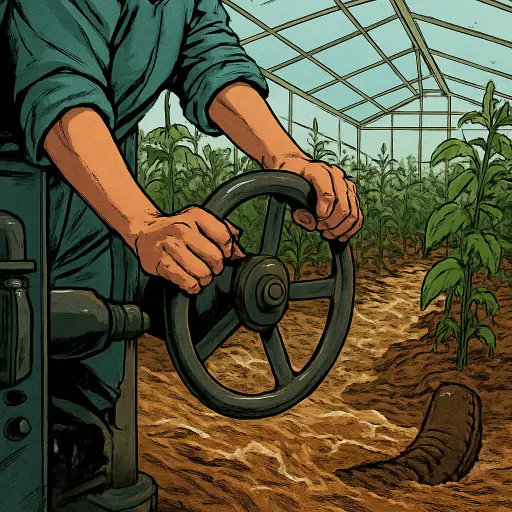
The wheel was beneath the packing bench. Nadiya dragged the bench aside, scattering baskets. Oren’s photograph fell face down.
The valve resisted. She braced one heel against a floor bolt and pulled until something shifted in her shoulder.
Clang.
Brown water burst from the irrigation overflow. It spread between the beans, lifted loose mulch, and swallowed the low sweet-potato leaves.
In the culvert, the water dropped.
“Now!” she shouted.
She tore away her grille. Across the channel, an adult worked on theirs. Metal shrieked; a woman swore with remarkable precision.
Then Tessa came crawling through the shallow sludge, dragging a torch.
Nadiya caught her under the arms.
“Up. Onto the bench. Keep moving.”
A baby followed in a laundry basket. Then a man with a splinted leg. A woman carried two pairs of shoes and no shoes on her feet.
Nadiya cut climbing netting from the bean frames and knotted it into a rope. Hands reached through. She pulled.
Water covered her boots. Bean plants leaned and slowly toppled.
At last a soot-streaked woman climbed out and seized Tessa so tightly the girl squeaked.
“Thirty-eight,” the woman gasped.
Keiko’s voice crackled through the handset.
“Crew’s reached the fire. You’ve got everyone.”
The Long Table
Three weeks later, Nadiya stood ankle-deep in clean planting mix while strangers argued over her furniture.
“Here,” said Tessa’s mother, setting down one end of a table.
“That blocks the trolley,” Nadiya said.
They moved it.
“There?”
“That blocks me.”
They moved it again.
The farm smelled of disinfectant, damp mineral grit, and lunch. Someone had brought lentils with browned onions. Someone else was heating flatbread on the packing-room cooker.
The contaminated crop had gone to the digester. Compensation would cover most of it, eventually. Nadiya had spent two days calculating the rest, then a third day unable to get out of bed.
On the fourth, thirty-eight people had arrived.
Not all could lift. One could mend irrigation mesh. One knew certification law. Mr. Iqbal, with his baby asleep against his chest, had persuaded the farm board to release emergency seed.
There had been hearings, too. Habitation control now checked rooms with human visitors instead of completed allocation forms. Tessa’s family had toilets that flushed.
Nadiya still caught herself turning to tell Oren things.
Yesterday it had been a particularly ugly seed potato. Today it was Button, asleep in his pruning shirt at last.
“About the cat,” Tessa said.
Nadiya’s hand stopped over the seed tray.
The girl shuffled closer. “Our new room doesn’t allow animals. Mum asked. Twice.”
“I see.”
“Could she stay here?”
Nadiya looked at the table, where bowls were appearing among the seed packets. Beyond it, people worked down the bare rows, leaving small green plants behind them.
“She’ll need visitors.”
“Every day?”
“I suppose I could bear that.”
Button opened one eye when lunch was served.
Nadiya put a little egg into a separate dish, then sat beside Tessa. This time, when she turned toward Oren’s photograph, she had a whole table to tell.