Why Does His Teacher Have His Button?
A widow recognizes her son's coat button, reopening a childhood humiliation and threatening his future.
- Drama
 By Storyleo Editorial
- 4 min read


The Button in Her Palm
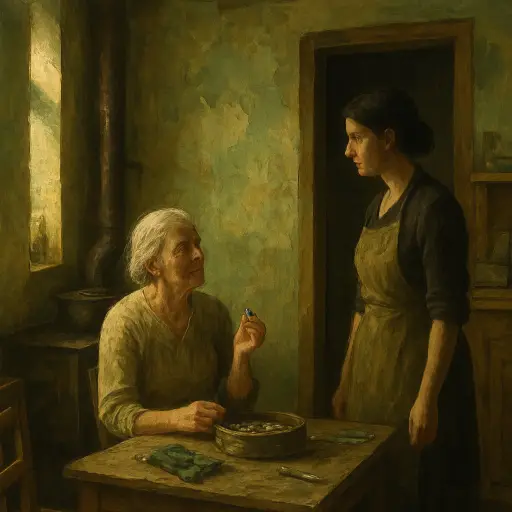
Lucia Ferraro had come upstairs to borrow a needle, but the button in the old teacher’s palm stopped her at the door.
Blue glass. Six shallow ridges. A chip beside one hole.
“Where did you get that?”
Miss Miriam Adler looked up from her kitchen table. Afternoon light crossed the airshaft and caught the silver hairs along her chin. Before her stood a biscuit tin filled with buttons: bone, horn, pearl, brass.
“A coat,” she said.
“My boy’s coat.”
Below them, someone pounded a cutlet. Each blow shook the stovepipe.
Miriam closed her fingers. “Anthony asked me—”
Lucia stepped inside. “You cut it off him?”
“Sit down, please.”
There it was. The schoolroom voice, scarcely changed in twenty-seven years.
Lucia could smell the wet wool of her childhood sleeves. She could feel the place on her neck where a hundred children’s eyes had rested while Miss Adler held up her badly fastened dress.
“You leave his clothes alone.”
Miriam’s chair scraped the floor. “Mrs. Ferraro, you misunderstand.”
“I understood you when I was nine.”
Lucia took the button from Miriam’s hand. She had bought six of them on Hester Street after Anthony’s father died, spending three cents she should have saved because the child had wanted something blue.
“He won’t come here again,” she said.
At the door, she turned.
“And if he owes you money, you ask me. You don’t take pieces off him.”
A Place at the Table
Miriam remained standing after the door shut.
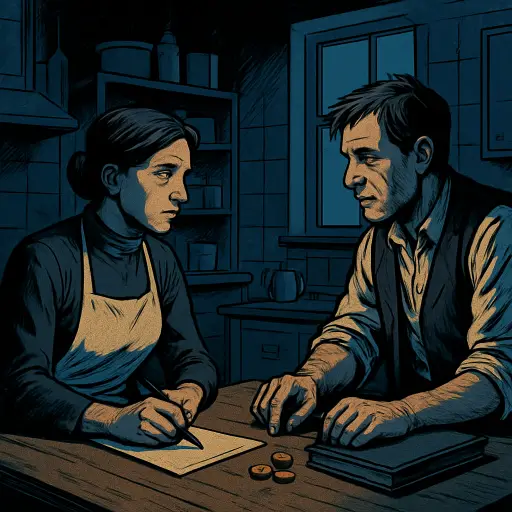
On the table lay Anthony’s application to the city’s technical high school. His arithmetic was excellent; his drawings of engines were better. On Monday, he would face an examination and an interview.
He had brought his coat because the lining dragged below the hem.
“Ma sews till midnight,” he had said. “I thought maybe you knew how.”
“I can manage a button.”
“That’s a beginning.”
His grin had persuaded her. She had removed the loose glass button to secure the torn cloth beneath it, then discovered she had no blue thread.
Now his coat hung behind her bedroom door, its lining neatly shortened by the woman across the landing.
Miriam touched the application’s clean edge. Since retiring, she had arranged pencils every morning for pupils who no longer arrived. Anthony came on Thursdays. She bought two buns on Thursdays.
Tell his mother, she thought.
But Lucia had been nine. What had happened when Lucia was nine?
Memory supplied a classroom, an inspection, a dress fastened unevenly. Miriam had turned the child toward the class.
“Carelessness advertises itself.”
She sat down.
She remembered the sentence with terrible precision. She could not remember whether the little girl had cried.
From downstairs came Lucia’s sewing machine, stopping and starting. Miriam took the coat from its hook.
Then she put it down. She had spent forty years calling children to her desk. This time, she would have to knock.
The Unfinished Seam
Lucia was fitting the blue button into the empty place on Anthony’s spare shirt when he came home.
“That’s from my coat.”
“I know.”
He set his schoolbooks beside the machine. “Did Miss Adler finish it?”
The needle pricked Lucia’s thumb.
Anthony reached for her hand, but she put the thumb in her mouth.
“Finish what?”
He explained the lining. The examination. The interview he had not mentioned because the school lay far uptown and he thought she would need him earning wages.
“You told her before you told me?”
He rubbed a dark smear from one book cover.
“She knows about schools.”
Lucia bent over the shirt. Beneath its collar, her stitches were small and equal. She could make twelve dozen collars in a day. She did not know which school required an interview.
A knock spared her from answering.
Miriam stood outside with the coat over one arm.
“Anthony,” she said, “may I speak with your mother?”
“He can stay,” Lucia said.
Miriam laid the coat on a chair.
“I removed the button to mend the cloth. Nothing more. But what you remembered upstairs—” She gripped her handbag. “I remember it too.”
Lucia waited.
“Your dress was fastened wrong. I made you stand before everyone.”
“My mother left before daylight. I dressed myself.”
“I should have asked.”
“You should have fixed it.”
Miriam lowered her eyes to the coat.
“Yes,” she said. “I should have.”
What Could Be Mended
The machine belt ticked as it settled.
Lucia pulled the blue button free of the spare shirt. “I called you a thief where Mrs. Gold could hear.”
“You didn’t use that word.”
“She heard it.”
Anthony looked from one woman to the other.
“Is the coat all right?” he asked.
Lucia made a sound that caught painfully behind her teeth. Then she held out her hand.
“Let me see.”
The lining was sound. The repair beneath the missing button was a thick, puckered knot.
“Who did this?”
“I did,” Miriam admitted.
“Retirement was sensible.”
Anthony covered his mouth. Miriam’s handbag trembled against her skirt.
Lucia fetched a chair.
“Sit. You’ll pull a hole through it like that.”
While she unpicked the knot, Miriam explained the school’s hours, the carfare, the scholarship examination. Lucia asked about books and winter shoes. Anthony answered when he could.
At last Lucia threaded the needle and offered it to Miriam.
“Not through both layers. Watch.”
Miriam leaned close.
On Monday morning, Anthony left in his mended coat with carfare folded inside his glove.
Lucia went upstairs carrying two buns and found Miriam sorting the button tin.
“Mrs. Gold was on the stairs,” Lucia said. “I put her right.”
“Thank you.”
Lucia set down the buns.
“Thursday. Could you tell me more about that school?”
Miriam cleared a place at the table.
“Of course.”
“And bring that blouse you’ve been fastening with a pin.”
Miriam glanced down at her collar, then opened the tin between them.