
In Cheyenne, Even Hospital Beds Have a Price
A creditor arrives to inventory a failing hospital, but its night nurse needs another pair of hands.
- Drama
 By Storyleo Editorial
- 4 min read


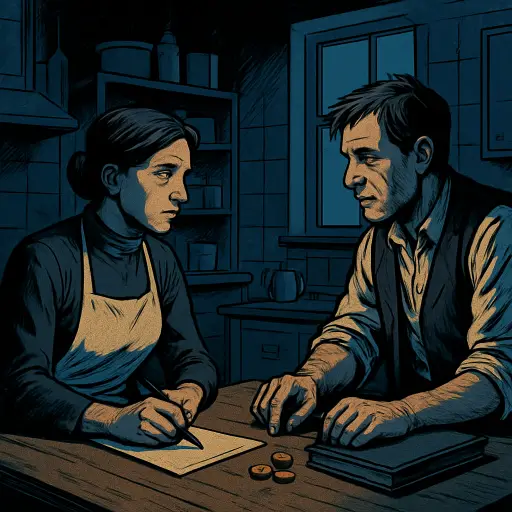
The Man with the Ledger
The stranger put a price on my bed while I was trying to keep a boy from dying in it.
“Iron frame, three dollars,” he said.
I pulled the sheet over the boy’s bare knees. “Put down your pencil and fetch that basin.”
He looked at me, then at the blue pitcher on the washstand. His coat smelled of cigar smoke and the stockyards. Outside, hooves hammered the hard street; Cheyenne was shipping cattle, and nobody had time to be ill.
“I’m here for the creditors, Miss—”
“Miriam Sloane. Night nurse. Basin.”
The boy retched before he brought it. I caught what I could in a towel.
That settled the introductions.
It was September 1886. Our doctor had ridden twelve miles to a difficult birth, the cook had left unpaid, and the hospital’s owner had sent word that everything would be auctioned Saturday. At midnight, with four patients sleeping badly upstairs, I had been writing my resignation.
The stranger laid his ledger beyond the spreading wet patch.
“Walter Finch,” he said. “Where’s this boy’s family?”
“His mother takes washing at the boardinghouse. He came looking for her three hours ago and fell on our steps.”
On the bedside table stood his only possession: a glass globe containing a white church and a drift of artificial snow. A traveling salesman had given it to his mother instead of paying his bill.
Walter reached for it.
I caught his wrist.
“That,” I said, “is not hospital property.”
What Hands Are For
The boy’s name was Ned. His skin burned beneath my palm, and each time I offered water, he turned away.
“He must drink,” I said.
“Then make him.”
I held out the spoon. “You may demonstrate.”
Walter’s mouth tightened. He crouched beside the bed, his watch chain dipping into the basin.
“Come along, lad.”
Ned struck the spoon. Water spotted Walter’s waistcoat.
“His mother,” the boy whispered. “Where’s the little mother?”
I followed his eyes to the globe. Inside the church doorway stood a painted woman, scarcely larger than a grain of wheat.
“Here she is.” I shook it gently. White flakes lifted around the steeple.
Ned watched. While the snow settled, he swallowed one spoonful.
Walter glanced at me.
“Again,” I said.
We worked that way for nearly an hour: snow, spoon, swallow. Then clean linen, another basin, more water heated on the stove. Walter took off his coat. His shirt clung darkly between his shoulders.
“You have other staff?”
“Until the wages stopped.”
“Why are you still here?”
“I haven’t yet learned how to leave while someone is calling.”
Upstairs, a patient knocked a shoe against the floor.
I handed Walter the spoon.
“Don’t give him much at once. Call if he cannot swallow.”
He looked toward his ledger.
“Mr. Finch.”
He loosened his collar and sat down. “I heard you.”
A Church Without Snow
At three, Walter dropped the globe.
I heard glass break from the landing, followed by a silence that brought me down faster than a shout would have.
Water spread beneath the chair. The little church lay among shining splinters.
Ned began to cry without strength enough to make much sound.
“My hand slipped,” Walter said.
“Keep him away from the edge.”
“I know what broken glass does.”
His sharpness stopped me. Then he pressed a handkerchief over the spill, although it was quite useless, and I saw his fingers shaking.
I swept the fragments into a dustpan. The painted woman had lost one arm.
“Can you mend it?” Ned asked.
Walter stared at the ruined toy.
“No,” he said.
I nearly snapped at him. Then he bent close to the boy.
“But I can keep it safe.”
He rescued the church, dried it with the clean corner of his handkerchief, and set it on his open watch case.
“There. Spring’s come.”
Ned considered the bare steeple. His fingers loosened on the sheet.
“She’ll be cold.”
Walter folded a scrap of linen behind the tiny woman to shelter her.
After Ned slept, he said, “My wife used to ask me to sit with her when she was ill. I always had work.”
I waited.
He rubbed the dent left by his collar stud.
“I thought sitting was doing nothing.”
From upstairs came the scrape of the shoe again. This time Walter rose before I did.
The Things We Kept
Ned’s mother arrived at dawn with soap cracked into the creases of her hands. She stood in the doorway until she saw his chest rise.
Then she crossed the room and knelt so hard I heard her knees strike the boards.
“He’s taken water,” I told her. “The doctor should be back shortly.”
Walter brought her a chair. She never asked who he was.
At seven, he opened his ledger on the kitchen table. I set my unfinished resignation beside it.
“Can you stop the sale?” I asked.
“No.”
I picked up my pen.
“But the beds needn’t be sold with the building.” He turned the ledger toward me. “The owner agreed to these valuations.”
Beside each bed stood the same price: three dollars.
“I’ve rented rooms above the saddler’s,” he said. “For my office. There’s water in the yard, and the stairs are sound.”
“Five sick people aren’t office furniture.”
“No. I’ve noticed.”
He counted out fifteen dollars, then pushed the coins toward me.
“Buy the beds. In your name. I’ll move my desk downstairs.”
I touched one coin. “This doesn’t pay a nurse.”
“I know. We’ll have to find people who will.”
For the first time that night, he sounded uncertain. I could work with uncertain.
“You’ll carry basins?”
“Apparently I require practice.”
I turned my resignation over and began a list of supplies.
Before we moved Ned, Walter returned his watch case to him, church and all.
“Until I find you a proper stand,” he said.
The watch itself went loose into his pocket. When Ned’s mother thanked him, he stayed beside her chair and listened.