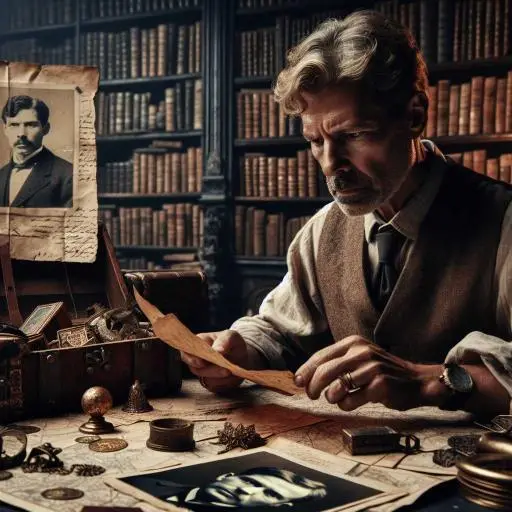
The Mystery of the Whispering Manor
A widow hires a detective when her walls demand money in her dead husband’s voice.
- Detective Fiction
 By Storyleo Editorial
- 6 min read



The Voice Behind the Plaster
The wall told Lady Dana Whitmore to dismiss her detective before Arthur Grayson had taken off his coat.
“Send him away, Dana.” The whisper came through the faded silk above the fireplace. “You promised to trust me.”
Dana’s teacup struck its saucer. Arthur set down his gloves and put his ear against the wall. Behind the voice he heard a small metallic click.
“Was that your husband?” he asked.
“It has his manner. Not quite his voice.” She steadied the cup with both hands. “My husband has been dead eleven years.”
Arthur had arrived from Hollowbrook station with coal grit in his collar and her letter in his pocket. She had asked him to come quietly. Now he understood why.
“What does it want?”
“At first, only my attention. Then it wanted me to leave the house. Last night it asked for money.”
“The dead have become expensive.”
She almost smiled. “Five hundred pounds. Placed in the library desk. For work that would allow him to return.”
At the doorway, Edgar, the elderly butler, shifted his weight.
“Tell him about Bramble, madam.”
The gardener had been found unconscious among the roses six days earlier. Since waking, he had swallowed broth, stared at visitors, and made no sound.
“The doctor calls it shock,” Dana said. “Bramble was never frightened of anything except late frost.”
Arthur asked to see the garden before darkness fell.
Outside, the November air smelled of bruised apples. Beside the rose beds, two parallel grooves crossed the soft earth toward a shuttered cellar window. A thorn held a scrap of black wool, fine enough for a gentleman’s coat.
“Bramble’s clothing?”
“Brown corduroy,” Edgar said. “Always.”
Arthur crouched. White crystals glittered beneath the window ledge. He folded several into paper without touching them.
“Has Lady Whitmore paid?”
“The money is in the desk.”
“Then tonight,” Arthur said, “we shall see who collects it.”
A House Built to Listen
Mr. Bramble lay propped against pillows, his broad hands worrying the blanket. When Arthur showed him the black cloth, he seized the detective’s wrist.
“You saw the wearer?”
Bramble nodded. His lips moved; only a dry scrape emerged. Angry tears gathered at the corners of his eyes.
Arthur stopped him from reaching for the water.
“Does swallowing hurt?”
Another nod.
On the bedside table stood a slate. Bramble took it eagerly, but his trembling fingers could scarcely hold the chalk. After several attempts, he made one word:
BELOW
“You breathed something down there.”
Bramble shut his eyes and nodded.
In the corridor, Arthur turned to Edgar. “Not fright. Injury. Send for the doctor again, and ask him particularly to examine Bramble’s throat.”
“And the constable?”
“Discreetly.”
The library smelled of leather, candle wax, and something sharp beneath both. On a crowded desk, a candle had burned into a fresh pool. The carpet bore a narrow curved scrape beside a bookcase.
Arthur found an estate plan underneath a volume of household accounts. One inked label ran behind the library:
Servants’ passage—speaking tubes retained.
He examined the bookcase. Dust lay thick across the shelves, but not on a brass screw beside the lowest hinge.
“Help me, Edgar.”
Together they pulled. The bookcase swung reluctantly outward, revealing a passage scarcely wider than Arthur’s shoulders. Copper pipes climbed its brickwork.
A whisper trembled through one.
“Dana. There is so little time.”
Arthur held Edgar back. Farther along, yellow light slid across the wall, followed by an enormous bent shadow.
“A lantern behind someone,” Arthur murmured. “Not something walking through walls.”
They waited until the light vanished, then followed the passage into a room of stored furniture. A tapestry stirred against the far wall.
Behind it stood a narrow door. Warm, bitter-smelling air rose from the stairs beyond.
Arthur glanced at the butler.
“Nobody follows me down. Whatever you hear.”
Edgar’s mouth tightened. “That instruction usually means somebody ought to.”
The Man Who Answered the Dead
At the foot of the stairs, Arthur found a laboratory arranged around a copper speaking horn. Rubber hoses connected glass vessels to a small furnace. Against the wall stood a handcart whose wheels were still muddy.
A hooded man bent over a notebook.
“You have burned a gardener’s throat,” Arthur said. “I suggest you step away from the apparatus.”
The man spun round, striking a spoon against a jar. Clink.
“That was an accident.”
“Then you admit knowing about it.”
The hood fell back. Arthur recognized the long, hollow face from a newspaper engraving: Dr. Charles Melton, formerly of the Royal Institute, missing since his dismissal three years earlier.
“You read the accounts,” Melton said. “Fraud. Misconduct. Every comfortable little word they found.”
“And now you require five hundred pounds.”
“For equipment.” Melton spread his hands. His cuffs were blistered with chemical stains; one sleeve had a ragged tear. “The human voice is vibration. Why should death destroy it? These walls heard Whitmore speak for forty years.”
Arthur glanced at the notebook. Beside experimental figures lay copied extracts from letters, each headed with a date.
“You found his correspondence.”
“To establish patterns.”
“To impersonate him.”
Melton’s jaw worked.
“She would not support the research. I asked her honestly, years ago. She offered me railway fare.”
“So you came back through the cellar.”
“The furnace needed ventilation. That fool Bramble saw me opening the window.”
“You left him outside.”
“He was breathing!”
Melton snatched up a stoppered flask.
Arthur stopped. The man’s thumb pressed beneath its glass plug.
“One step,” Melton said, “and neither of us leaves.”
Then the copper horn spoke.
“Charles.”
Melton went rigid.
The voice was thin and distorted, but unmistakably Dana’s.
“I am willing to listen. Put that bottle down.”
His eyes shone. “You see? The apparatus—”
“No,” she said. “I am upstairs. Where you expected a frightened old woman to remain.”
Arthur moved while Melton was still staring at the horn.
What the Walls Kept
Arthur caught Melton’s wrist and forced the flask upright against the table. Glass rattled. Melton drove an elbow into his ribs, but Arthur held on until Edgar came down the stairs and took the bottle.
“You were told not to follow,” Arthur managed.
“I waited until the dangerous part.”
Together they secured Melton with a leather equipment strap. The scientist sagged against a stool, staring at the copper horn.
“There were other voices,” he said. “When I worked alone. Not mine.”
Arthur traced a second pipe into the ceiling.
“Where does that branch lead, Edgar?”
“The old nursery. And the room above it.”
“Bramble’s room?”
The butler nodded.
Arthur looked at the apparatus again. Small sounds, carried through copper and enlarged by a listening horn. A man laboring to breathe upstairs; another below, hearing precisely what he wanted.
“You nearly killed your spirits, Doctor.”
By midnight, the constable had taken Melton away. His notebooks, chemicals, and borrowed family letters followed in a locked trunk. The village doctor remained with Bramble.
In the sitting room, Dana poured Arthur a fresh cup. Her hand no longer shook.
“How did you find the other end of the tube?” he asked.
“Edgar showed me. Before he disobeyed you.”
“You might have warned me.”
“He was holding something dangerous. You seemed occupied.”
Arthur laughed, then winced at his ribs.
She studied the little grille above the fireplace. “He used a phrase from my husband’s letters. You promised to trust me. That was almost enough.”
“Almost?”
“My husband always said it when he had done something thoroughly untrustworthy.” She set down the pot. “Usually bought another horse.”
A faint scrape came from the wall.
Both turned.
“Madam?” whispered the plaster.
Dana was on her feet before Arthur recognized Bramble’s damaged voice.
“Yes?”
“Doctor says … no talking.”
She pressed her fingers to her mouth.
“Then do as he says.”
A pause. A breath.
“Roses need covering.”
Dana took her garden keys from the mantelpiece and put them in Edgar’s hand.
“Before bed,” she said. “And properly. He’ll be inspecting them.”