A Debt in the Drowned Rice Fields
After floodwaters destroy a woman’s harvest, a boy risks his father’s trust to help her.
- Christian
 By Storyleo Editorial
- 4 min read


The Brass Key
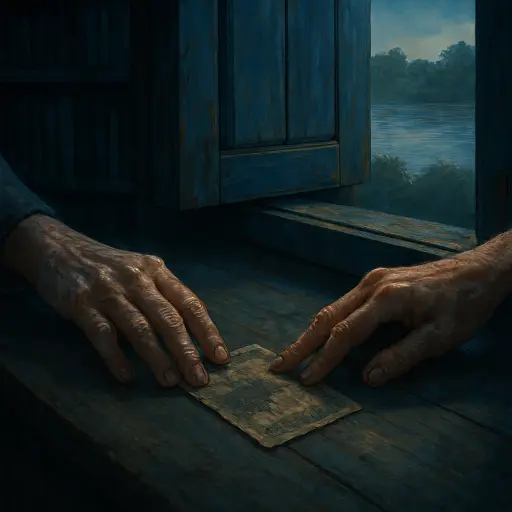
My father weighed the stranger’s brass key against a sack of seed rice, then pushed the key back as though it had bitten him.
“I lend grain,” he said. “I don’t buy old metal.”
Srey kept her hand on our counter. Mud had dried in pale scales around her ankles. She had come from Cambodia three months earlier to marry Phúc, who farmed the narrow field beyond ours.
“Not payment,” she said in careful Vietnamese. “Something you keep until I repay you.”
“What does it open?”
“A house that burned.”
I was twelve. I remember looking up from the rice sieve, waiting for my father to apologize. He scooped another measure into the sack instead.
Phúc had spent their savings treating a fever. Planting time was nearly over. Without seed, their rented field would remain bare, and the landlord would give it to someone else.
“One sack now,” Father said. “One sack of planting seed after harvest. Not eating rice. Good seed.”
“I promise.”
He took the key.
At our small church that Sunday, Srey stood beside Phúc beneath a ceiling fan that clicked with every turn. When the congregation prayed, she prayed in Khmer, her fingers moving against the empty cord around her neck.
Afterward, I asked why she had surrendered something she could never replace.
“Your father doesn’t know me yet.” She adjusted the sack on Phúc’s bicycle. “He needed something I would come back for.”
The Flattened Field
That September, water overtopped the canal bank before dawn.
By noon, the paddies looked like sheets of hammered tin. Rice heads floated among torn leaves. Srey stood waist-deep in brown water, trying to lift the flattened stalks with both hands.
“Leave them!” Phúc shouted from the bank.
“Some may stand.”
But none did.
When the water withdrew, sour-smelling mud coated everything. The grain had sprouted on the stalk. You could boil some of it into porridge, but it would never sow another field.
My father’s higher plot survived. He dried his harvest in our courtyard, turning it with a wooden rake. Whenever Srey passed, the rake slowed.
She came on the repayment day carrying her wedding earrings.
Father did not touch them.
“I need seed,” he said. “My sister’s field needs planting too.”
“Give me until Sunday.”
“Where will you find it?”
She looked down at the earrings in her palm. “I’m still asking.”
That evening I found her behind the church, scraping flood mud from a bench.
“You could go away,” I said. “My father only has a useless key.”
She stopped scraping.
“When I became Christian, I thought perhaps being good would become easier.” She gave the bench another hard stroke. “That has not happened.”
“Then what changed?”
“Now I have someone to ask when I cannot bear to do it.”
She knelt beside the bucket. I slipped away before she could hear me crying.
The Sack at the Door
On Saturday night, I stole from my father.
I filled a sack from the seed he had reserved for my aunt and dragged it along the irrigation path. Husk dust scratched my throat. At Srey’s door, I whispered that my father had changed his mind.
She held the lamp near my face.
“He sent you?”
“Yes.”
The lie came out much more easily than the sack had come through our gate.
At breakfast, Srey arrived carrying it.
My father rose so sharply his stool fell backward.
“Your son brought this,” she said.
I stared at her. You could have kept it.
Father caught my arm. “You took your aunt’s seed?”
“You have plenty!”
“That was not yours to give.”
“And hers was drowned!”
Srey set the sack between us.
“He saw me in trouble,” she said. “But please don’t let him learn that kindness needs a lie.”
Father released me. Red marks from his fingers remained on my arm.
“I still owe you,” she told him. “I can sort seed. Weed. Carry sacks. You decide the wages, and keep them until the debt is paid.”
“That could take months.”
“Yes.”
He picked up his stool but did not sit.
“Why bring it back? I might never have counted it.”
“Your boy would have known.”
Outside, someone rode past selling steamed rice cakes. The lid of his tin rattled against his bicycle. Nobody at our table moved.
The Open Palm
My father put Srey to work on Monday.
He was not suddenly generous. He measured her hours as carefully as grain, and she accepted every mark he made. After school, I worked beside her without wages. Father called that my repayment.
We sorted seed on woven trays, pinching out broken grains until my fingertips ached. Srey taught me Khmer words. I helped her practice the Vietnamese she needed at the market.
By Christmas, the account was settled.
Father called her into the courtyard and laid the brass key in her open palm.
“You kept your promise,” he said.
She closed her fingers around it. Then he brought out another sack.
“For your next planting.”
Srey’s shoulders stiffened. “Another loan?”
“No. Half the seed, half the work. We share whatever grows. Including nothing, if that is what comes.”
She studied him for so long that he began picking husks from his sleeve.
“You should ask Phúc too,” she said at last.
“Then fetch him.”
Years later, after my father’s burial, Srey came to our house with that key on its cord. Her hair was white by then. Mine was beginning to turn.
“He told me something,” she said. “About the morning I brought your sack back.”
I waited.
“He had already counted the seed. He was coming to our house to accuse Phúc.”
I looked toward the courtyard where we had sorted grain together.
“You saved him from that,” I said.
“So did you. Though you chose a very troublesome way.”
She put the key around her neck again. It still opened no lock. When she asked me to walk her home, I took her hand.