A Banknote for Her Own Name
An older woman’s request to learn her name draws a shy librarian beyond familiar walls.
- Christian
 By Storyleo Editorial
- 4 min read


The Woman at the Window
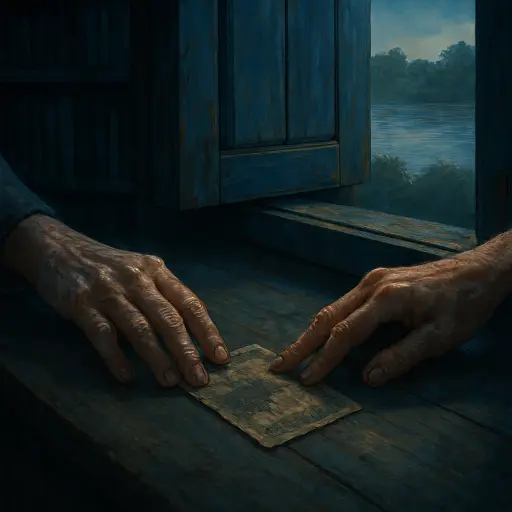
The woman pushed a muddy banknote through the library window and asked how much it cost to learn her own name.
I had been scraping a dead moth from the dictionary. Beyond the shutters, our Amazon river town rattled with outboard motors, market carts, and someone hammering a loose sheet of roofing.
“Nothing,” I said.
She glanced at the empty tables. “Not even at my age?”
Her gray hair was pinned with two blue clips. Cassava flour powdered the creases of her fingers.
“Especially not at your age.”
She kept the banknote between us. I pushed it gently back.
My name is Cecília. I could recommend a book without looking up, repair its spine, and remember who had borrowed it three years earlier. But inviting strangers inside made my tongue feel too large for my mouth.
“I’m going to church on Sunday,” she said. “They’ll ask me to sign the baptism register. I don’t want another thumbprint.”
“We could practice now.”
A truck backfired outside. She stepped away from the window.
“Too many eyes here.”
She searched her basket, found a folded napkin, and flattened it against the sill. With my pencil, she drew the river, three landing stages, and a square beside a towering breadfruit tree.
“My house. After the market closes. I’m Conceição.”
I looked at the twisting line. Most afternoons, I took the same six-minute walk home.
“Please,” she said.
I tucked the napkin inside my Bible before I could invent a reason not to go.
A Name Made Slowly
Conceição’s house stood on stilts above brown water that slapped bottle caps against the posts. The napkin brought me there more reliably than any street address could have.
She opened the door with flour on her cheek.
“You came.”
“You drew good directions.”
Inside, warm coconut milk steamed in a saucepan. A white blouse hung from a nail, its collar carefully pressed beneath a heavy book.
“For Sunday,” she said, following my glance.
I laid out paper and two pencils. Her first letter leaned so far sideways that she covered it with her hand.
“My teacher hit our fingers with a ruler. Said mine were made for washing clothes.”
I waited until she uncovered the page.
“These fingers drew three landing stages exactly where they belong.”
She rubbed the pencil between her palms.
We worked through her name. Outside, children splashed beneath the walkway. By the sixth attempt, the letters stood apart clearly enough to read.
Conceição touched them one by one.
“That’s me?”
“That’s you.”
She turned toward the stove and lifted the saucepan, though nothing needed stirring.
Before I left, she asked me to read the passage her pastor had chosen. I opened my Bible to the baptism of Jesus.
“Again,” she said when I finished.
On the second reading, she stopped me at the voice calling Jesus beloved.
“Before he’d done the preaching?”
“Yes.”
She looked at her page.
“I think I’d like to learn more than my name.”
The People Behind the Curtain
On Thursday, Conceição set eight cups on the table.
“Are you expecting family?” I asked.
“Not exactly.”
A fisherman emerged from behind the curtain dividing her room. Then a young mother carrying a sleeping baby. Two market porters waited on the steps, holding school notebooks against their chests.
My stomach tightened.
“You said the library was empty,” Conceição whispered.
“I didn’t say I could teach a class.”
“Neither did I. I said you wouldn’t laugh.”
The fisherman studied the floorboards. One porter began edging toward the door.
Say something.
I put my bag on the table.
“I’ve only brought two pencils.”
Conceição opened a tin. Inside lay a dozen sharpened stubs.
We started with names. The fisherman wanted to read fuel receipts. The mother wanted to understand the messages her son’s school sent home. One porter admitted he memorized the colors of medicine packets.
Every sentence made me wish I had come sooner.
By Saturday, twelve people were sharing Conceição’s table and doorstep. I asked whether they might come to the library, where there were chairs.
“Everyone can see through those windows,” the fisherman said.
I almost promised curtains. Instead, I asked what would help.
They considered it together.
“An hour before opening,” the mother suggested. “And nobody calling it the children’s class.”
That evening I prayed with my forehead against the library door.
“Lord, help me ask for the key an hour earlier.”
It was a small prayer. I had to say it twice.
Room for the Whole Name
At Sunday’s baptism, Conceição wore her white blouse and both blue clips.
Afterward, she sat at the church table with a towel around her shoulders. When the register reached her, she took the pen.
No one hurried her.
She wrote slowly, her lips moving over each letter. Then she added her family name, which we had practiced on the backs of old library notices.
“You didn’t tell me you’d learned that part,” I whispered.
“Wanted to surprise you.”
She inspected the line, then handed the pen to the next person.
The council secretary gave me permission to open early. I had rehearsed a speech about public service; she interrupted to ask whether her brother could attend.
By the end of the month, we needed another table.
There were mornings when the lessons went badly. Adults had work, sick children, aching hands. I learned to stop praising every mark as though I were speaking to toddlers. They learned they could tell me when I did.
Then Conceição arrived carrying my napkin map, now soft at the folds.
“Turn it over.”
On the back, in her careful handwriting, was a question.
Will you teach us how to borrow books?
“Of course. Which book do you want?”
She pulled out a chair.
“I don’t know yet.” She smiled at the shelves. “You’ll have to tell me about them.”
I sat beside her, with a whole hour before opening, and began.