The Miraculous Feast on the Shores of Galilee


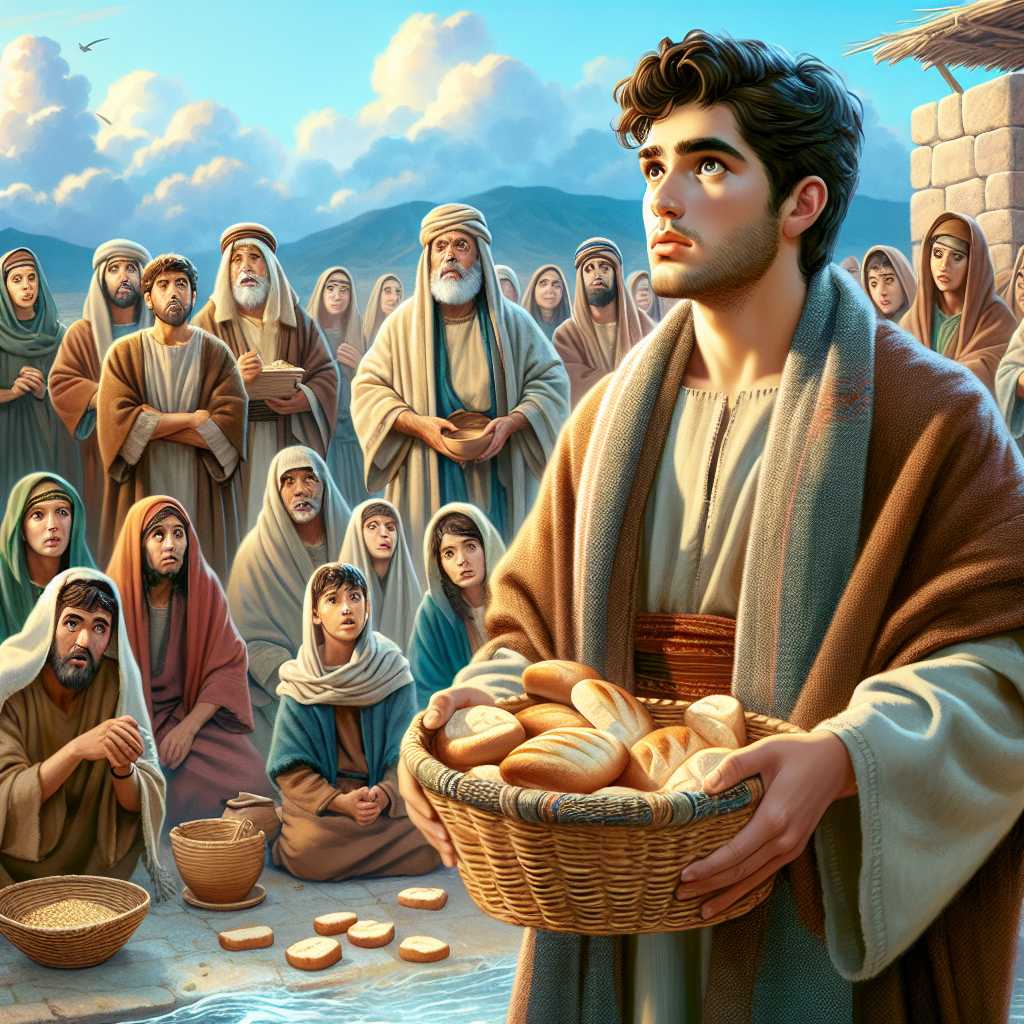
In the small, sun-baked village of Bethsaida, nestled along the Sea of Galilee, lived a humble fisherman named Benjamin. With hands calloused from hauling nets and feet accustomed to the unyielding sand, Benjamin's life was a steady rhythm of labor and toil. Yet, despite the predictability of his days, his heart yearned for something greater. He often found himself pondering the words he had heard of the great teacher Jesus of Nazareth—a man said to walk with the kind of wisdom and peace unfamiliar to the world.
Bethsaida was abuzz one hot summer's morning with news that this very Jesus was passing through. Positioned at the crossroad of commerce and culture, the village frequently witnessed travelers and traders, but few figures stirred such excitement. As the sun climbed higher, Benjamin mended his nets, casting occasional glances to the dusty road leading into the village, pondering whether this man was as miraculous as they said.
It was nearly noon when a gentle murmur in the air announced Jesus's approach, growing into a jubilant outcry. The streets lined with villagers bore witness to the spectacle and in their midst, clothed in simplicity, was Jesus. He moved amidst them with a presence that did not demand awe yet invariably inspired it. Benjamin, captivated by an inexplicable pull, found himself stepping away from his nets, wandering toward the gathering crowd.
As he stood among the throng, Jesus began to speak of a kingdom not fashioned by human hands. His words were like water to a parched soul, each sentence a balm to the weary. Benjamin listened intently, his heart echoing the sentiment of the crowd: here was truth, tangible and raw, unlike anything he had ever known.
A hush descended as Jesus finished speaking, but as the crowd began to disperse, a murmur of concern arose. It was soon apparent that a great concern had surfaced—the people had followed Jesus so ardently that they had forgotten the hour and their hunger began gnawing at them. Whispers of “How shall we eat?” floated like dry leaves through the crowd.
Moved by compassion, Jesus called His disciples, and among them was Philip, whom Benjamin recognized, being from Bethsaida himself. “Where shall we buy bread for these people to eat?” Jesus asked Philip, almost as if testing. Philip thought of the cost—counting the meager coins in their purse—but fell silent, for even a layman knew that no purse was deep enough for this multitude.
As uncertainty lingered, a voice from nearby reached Jesus’s ears. It was Andrew, Simon Peter’s brother. “Here is a boy with five barley loaves and two small fish,” he said, his tone almost apologetic. “But how far will they go among so many?” A ripple of skepticism coursed through the skeptics in the crowd, their faces etched with doubt.
Jesus smiled gently at such concerns, his eyes reflecting the assurance of higher provisions. With an instruction to have the people sit, He took the loaves and the fish. **Lifting His gaze heavenward**, He gave thanks and began distributing the food to the seated masses. To the crowd’s astonishment, each person ate their fill, and there remained twelve baskets full of leftovers—a fact as undeniable as the sun shining upon them.
The miracle sparked great awe, and whispers of Jesus as the new prophet filled the air. However, amidst the miraculous feast, a deeper transformation had taken place. Men and women, like Benjamin, realized the bread and fish consumed were but a reflection of the true sustenance available—surpassing mere physical need.
As the day waned and the crowd reluctantly dispersed, their burdens felt lighter, and the prospect of tomorrow held more promise. Benjamin, now stirred and hopeful, returned to his small fishing boat, carrying with him more than fish—he bore witness to hope itself. It was this profound inner change that stayed with him long after the dust settled, marking the day as the turning point of his life.
Long after that remarkable day, as Benjamin grew old, he would gather his grandchildren around the hearth, recounting this story of provision and faith. His voice would tremble, not from age, but from the memory of an encounter with the kingdom itself—a kingdom unfurling in hearts ready to receive it.
His grandchildren, wide-eyed and enthralled, would listen intently, envisioning a land where love and miracles were commonplace. And as they drifted off to dreams filled with wonder, Benjamin would quietly pray, ever thankful for a simple lesson learned from five loaves and two fish.
Thus the story, passed from generation to generation, whispered its truth across time and space, echoing the presence of a teacher whose words fed the soul and whose actions illuminated the path to an eternal kingdom.