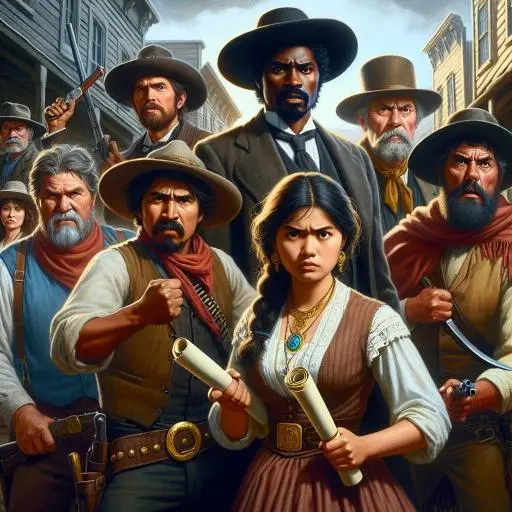
The Gunslinger of Red Rock Gulch: A Tale of Legends
A boy seeking gunfighter glory hears a story his family knows all too well.
- Western
 By Storyleo Editorial
- 7 min read


The Bullet in the Porch
Sam McGraw drove his walking stick into the bullet hole in the saloon porch and told Billy Trent to put his pistol away.
“It ain’t loaded,” Billy said.
“Neither was the one that took the schoolmaster’s thumb.”
Billy pushed the old cap-and-ball revolver beneath his coat. At fourteen, he had grown too tall for his trousers but not tall enough to stop resenting remarks about them. He had come to hear how a man made himself feared.
“You promised me Cole Maverick.”
“I promised you his story.”
Sam lowered himself into his usual chair outside the saloon. The morning smelled of hot pine boards, horse sweat, and the cook’s scorched biscuits. Across the street, sunlight struck the red sandstone wall above Red Rock Gulch.
“Fetch whoever wants to listen,” Sam said. “Including your mother. She’ll hear something different from you.”
By the time Billy returned, the blacksmith had brought a stool, the storekeeper was leaning in her doorway, and three teamsters had abandoned a disputed harness buckle. Billy’s mother stood beside the hitching rail, flour whitening one sleeve.
“Did he tell you about the pistol?” she asked.
“We’re coming to that.”
Sam rested both hands on his stick. His right forefinger would not bend; Billy had often watched him work a spoon awkwardly around it.
“Cole rode in on a Tuesday,” Sam began. “His horse was lame, his coat had been mended with blue thread, and he had eleven dollars. That’s what the fastest gun in three territories amounted to when he reached us.”
“Was he looking for somebody?” Billy asked.
“Work.”
A teamster snorted.
Sam turned toward him. “Ever tried finding honest work with your face nailed outside every sheriff’s office?”
The teamster stopped working his toothpick.
“He wanted one ordinary week,” Sam said. “Then he saw the schoolhouse roof.”
The Blue-Thread Coat
The roof had peeled back in a windstorm, leaving the children to study beneath a sky bright enough to hurt. Cole stood in the schoolyard while the teacher spread slates over a desk to shade a sleeping child.
“I can mend that,” he said.
“Can you do it for board?”
He glanced toward the street. Two boys were pretending to shoot one another beside the well.
“Board,” he said, “and no questions.”
For nine days he hammered shingles above the alphabet lessons. He ate beans in the teacher’s kitchen and slept in the stable, where the horses shifted whenever he cried out.
“What did he cry?” Billy asked.
Sam scraped a splinter with his thumbnail. “Names.”
The first hunter came while Cole was carrying a bundle of shingles. He drew from behind the water trough. Cole dropped the bundle, fired, and stood staring at the man until the teacher took the pistol from his hand.
The second came three mornings later.
“Did Cole beat him, too?”
“Yes.”
“How fast?”
“Fast enough that afterward he couldn’t remember drawing.” Sam leaned forward. “He remembered digging, though. Ground was hard that summer.”
After the second burial, Cole packed his saddlebag. The teacher found him beside his horse.
“Roof’s unfinished,” she said.
“So dock my wages.”
“You haven’t earned any.”
That made him sit on the mounting block. He put his face in his hands, and she waited until he could speak.
“I killed men for a cattle company,” he said. “Some drew on me. Some were only standing where the company wanted nobody standing.”
“And now?”
He looked up at the exposed classroom.
“Now I’d like to finish something that stays finished.”
He stayed three more days.
On the fourth morning, Jeb Turner arrived with a clean collar, two revolvers, and a warrant folded inside his hat.
The Warrant Under the Hat
“Turner was the worst of them?” asked the blacksmith.
Sam nodded. “Though he kept his boots polished.”
Jeb found Cole on the schoolhouse ladder. Instead of drawing, he waited below and read the warrant aloud. It offered eight hundred dollars, dead or alive.
“Alive,” Cole said. “There’s a word men seem to skip.”
“Unbuckle your gun, then.”
Cole climbed down. “And spend the journey trying to sleep while you decide whether a corpse travels easier?”
Jeb smiled. He had brought no irons.
On the porch, Billy shifted his feet. His mother reached for him, but let her hand fall before touching his shoulder.
“Why didn’t the sheriff stop it?” Billy asked.
“Sheriff was buried that spring. Folks hadn’t agreed who should replace him.”
“Somebody could’ve helped.”
Sam looked across the street at the windows above the store.
“Plenty watched.”
Cole walked toward the middle of the street. Jeb followed, keeping six paces between them. The schoolteacher herded the children inside, but one small boy slipped around her skirt and crouched behind the watering barrel.
“Get him out,” Cole said.
Jeb thought it was a trick.
“Hands where I can see them.”
“There’s a child behind you.”
“Then don’t miss.”
The town clock began striking noon.
Sam’s walking stick tapped the porch. Tok.
“They drew together?” Billy whispered.
“Near enough.”
Both shots struck before the second bell. Jeb’s bullet entered Cole below the ribs. Cole’s went through Jeb’s shooting hand and into the porch.
“There?” Billy pointed.
Sam nodded.
Jeb fell against the steps. Cole dropped to his knees. For a moment, neither moved.
Then Jeb reached with his left hand for his other revolver.
“And Cole shot him dead,” Billy said.
“No.” Sam’s stick stopped tapping. “That’s where the story gets troublesome.”
The Watering Barrel
Cole saw the second gun coming free. He tried to raise his own, but his arm gave beneath him.
Behind Jeb, the boy stood up.
“Don’t!” the child shouted.
Jeb turned. The boy had both hands extended, as though he could push the gun down from ten feet away.
“His father sold harness,” Sam said. “Quiet man. Jeb had killed him outside Abilene for a reward that turned out to belong to somebody else.”
Nobody on the porch spoke.
“Jeb had paid the widow forty dollars. Considered it settled. Then there was the boy, looking right at him.”
Cole crawled forward and pulled the second revolver from Jeb’s hand. He flung both guns beneath the porch.
“You want to earn something?” he asked Jeb. “Stay here. See what you’ve bought.”
Then he got to his feet.
Blood soaked his waistband. He reached his horse by holding the hitching rail, stopping twice. Nobody cheered. Nobody asked him to finish the roof.
The teacher brought his saddlebag and held the stirrup while he mounted.
“Which way?” she asked.
“Don’t watch.”
She turned her back. So did the others.
“And he left?” Billy asked.
“He left.”
“Did he live?”
“There are stories. A man running a ferry up north. Another raising mules in California. Somebody’s uncle who never touched a pistol.”
“Which one’s true?”
Sam rubbed the stiff finger against his knee.
“I hope all of them.”
The teamsters went back to their harness. The blacksmith lifted his stool. Billy’s mother waited until her son nodded, then crossed toward the bakery.
Billy stayed beside the bullet hole.
“You said the boy’s father sold harness.”
“He did.”
“My grandfather sold harness.”
Sam watched him work it through.
“Your mother remembers him,” he said. “You ought to ask her.”
The Empty Holster
Billy drew the old revolver slowly, holding it by the barrel.
“This was his?”
“Your grandfather’s. Your mother kept it wrapped in a towel for years.”
“I took it from her trunk.”
“I suspected.”
Billy sat on the porch step. Through a gap beneath the boards, he could see a bottle neck, a scrap of sackcloth, and the pale dirt where things fell and remained.
“You’re Jeb Turner.”
Sam’s hand tightened around his stick.
“Yes.”
A wagon rattled past, iron tires grinding grit against stone. Billy waited until it had gone.
“Does Mother know?”
“Since before you were born. She was the little boy’s sister.”
“Why does she let you sit here?”
“You’ll have to ask her that, too.”
Billy examined the revolver’s worn grip. He had practiced drawing it in the hayloft until his wrist ached.
“Did you finish the roof?”
“With my left hand. Took a month. Leaked afterward.”
“That ain’t much.”
“No.”
Sam did not offer anything else. From the bakery came the slap of dough against a board, followed by his mother calling an order to the delivery boy.
“Why tell me now?”
“Because yesterday you asked whether Cole could kill a man before the man heard the shot.”
Billy laid the revolver on the step between them.
“I’ll take it back,” he said. “Tell her I took it.”
Sam nodded.
At the bakery door, Billy stopped.
“Tomorrow,” he called, “tell me about the teacher.”
Old Sam lifted his hat.
That afternoon, Billy returned with a wooden plug and a little pot of glue. He knelt over the bullet hole, tried the plug, then shaved it narrower with his pocketknife.
Sam watched the shavings gather around his boots.
“Don’t hammer it yet,” he said. “You’ll split the board.”
Billy held out the glue.
“Then show me.”