
Can He Trust the Tower He Approved?
A taxi driver trapped in a skyscraper confronts the deadly cost of his signature.
- Thriller
 By Storyleo Editorial
- 6 min read

The Scarf in the Door
The woman in my back seat wrapped my daughter’s scarf around her bleeding hand and told me not to stop for the men with guns.
We were already inside the vehicle lift of Qamar Tower, rising through a skyscraper whose windows still carried the day’s heat. Beyond the glass shaft, Dubai lay in copper-coloured strips: motorway, sand, sea.
“That’s not a bandage,” I said.
“Then charge me for it.”
On the lift platform below us, two men in grey security uniforms stepped out of a service door. One raised a compact weapon.
I stamped the accelerator. My taxi struck the lift’s front barrier with a crunch that drove the seat belt into my chest.
“We’re in a box,” the woman said.
“I noticed.”
The lift continued upward. The men dwindled beneath the transparent floor.
She had hired me outside a clinic, offering cash for a human driver and no route sharing. In 2036, both requests cost extra. I had expected an affair, perhaps a stolen prototype. Not blood soaking through yellow wool.
“Who are you?”
“Dr Huda Mansour. Building systems engineer.” She glanced at the driver identification on my dashboard. “And you’re Sameer Qureshi.”
My hands stopped moving.
“You knew?”
“I spent three weeks finding your taxi.”
The lift chimed at the hundred-and-twelfth floor. Ahead, charging bays stood empty under white lights. Beyond them was the private arrivals lobby for the tower’s upper residences.
“Drive out,” she said. “Before they recall the platform.”
I drove. Behind us, the barrier dropped and the lift sank away.
Steel shutters slammed across the parking deck’s exits.
My daughter had knitted the scarf during a school trip to Fujairah, complaining that nowhere in the Emirates justified so much wool. I kept it in the taxi because she checked.
Now a stranger unwound it from her hand. Through the windscreen, the security lights changed from white to red.
“You signed the occupancy clearance,” Huda said. “I need you to explain what you signed.”
The Red Cabinet
“Get out,” I said.
“They’ll kill us both.”
“You should have mentioned that at the clinic.”
She held out a small recorder with a cracked screen. A man’s voice came from it, flat and impatient.
“Purge the archive before the inspectors connect. Use the suppression cycle. Nobody enters that plant room tonight.”
I knew the voice: Rashed Darwish, operations director for the company that owned Qamar Tower.
“My assistant is in that room,” Huda said. “He’s copying the original commissioning records. Darwish thinks he’s alone.”
“Call the police.”
She showed me her phone. No service. Mine had lost its network too.
“The tower runs its own indoor network. He’s isolated it. The emergency radio still has an external antenna, but the nearest handset is across this floor.”
Above us, a ventilation fan wound down. The sudden quiet made the cooling metal of my bonnet sound loud.
“What suppression cycle?” I asked, although I remembered.
“Nitrogen. In nine minutes, if he keeps the scheduled test.”
“There’s a delay. Alarms. Door releases.”
“That’s what your certificate says.”
I looked away.
Four years earlier, I had inspected the tower’s service levels. Eight hours into a fourteen-hour shift, my supervisor had offered me three months’ wages to accept the test results without witnessing them.
My daughter needed surgery. I had signed. I had also resigned the following week, which was the part I usually allowed myself to remember.
Huda opened her door.
“Where?” I asked.
She pointed to a red emergency cabinet beside the pedestrian corridor.
We ran. Her shoes slapped the concrete unevenly; one heel had broken off.
At the corridor, a fire door began closing. I shoved my shoulder into it. Its powered closer pushed me backward.
“Scarf,” I gasped.
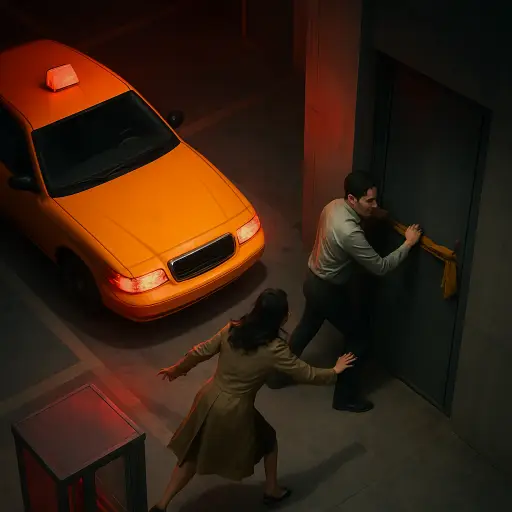
She thrust the wool into my hand. I bundled it around the latch, holding the door short of locking.
From the far end of the parking deck came the metallic rattle of a shutter being raised.
The Yellow Thread
The handset in the red cabinet was dead.
Huda lifted it twice, then struck its cradle with the heel of her hand.
“Local power,” I said. “He’s cut it.”
A green lamp glowed above the cabinet. Beside it, an old inspection socket sat beneath a rubber cover.
“The radio has a battery at the refuge station,” I said. “One floor up.”
“Can we reach it?”
“If they built what I approved.”
She stared at me, then pulled open the stair door.
We climbed into hot, still air. Behind us, someone shouted my name through a loudspeaker.
“Sameer. Stay where you are. The passenger is carrying stolen company property.”
My taxi had identified me at the lift. They would have my licence, my address, my daughter’s school route.
I missed a step.
Huda caught my elbow. “Keep moving.”
The refuge station had concrete benches, bottled water and a wall radio beneath a clear cover. Its battery indicator glowed amber.
I pressed transmit.
“Emergency at Qamar Tower. Occupied plant room threatened with nitrogen discharge. Security preventing access.”
Static scraped through the speaker. Then a dispatcher answered.
Huda gave the floor, room designation and cylinder capacity without pausing. The dispatcher asked whether the room had functioning occupant safeguards.
Huda looked at me.
I could say yes. My signature was on every document they would find. We could get help, get downstairs, let investigators untangle it later.
“Sir?” the dispatcher said.
I gripped the handset until its moulded ridges hurt.
“No. Treat the safeguards as absent. The occupancy clearance is false. I signed it without testing. My name is Sameer Qureshi.”
The dispatcher repeated the warning to someone beside her.
Huda took a sharp breath, then leaned toward the microphone. “The system has a manual abort station outside the plant room.”
“Two floors down,” I said.
Below us, the stair door banged open.
I handed her the radio.
“Keep talking.”
“Where are you going?”
“To find out whether they fitted the handle.”
The Abort Handle
I met the first guard on the landing.
He grabbed my jacket. I drove forward, carrying us both against the railing. His weapon struck concrete and skidded down the steps.
He punched me under the ribs. Air left me in a dry grunt.
“Stop,” he said. “Just stop.”
From somewhere below came three electronic notes.
I remembered them from training.
Discharge warning.
“There’s a man inside,” I wheezed.
“The room’s empty.”
“Then come and look.”
He hesitated. It was enough. I slipped out of my jacket, leaving it in his fists, and stumbled down the next flight.
The plant corridor smelled of hot insulation. Through a wired-glass panel I saw a young man hammering on a locked door. His face shone with sweat.
The abort handle was beside him, under a hinged shield.
I lifted it and pulled.
The alarm stopped.
I nearly let go.
Hold to abort. That detail returned with such force that my knees weakened. I kept pulling as the spring dragged against my fingers.
The guard appeared behind me.
“Unlock it,” I said.
He looked through the glass. The young man raised both hands against it.
The guard’s access card opened the door.
By the time Huda reached us, still relaying instructions over the portable radio, my hand had cramped around the handle. She put her good hand over mine.
“They’re isolating the cylinders now,” she said. “Don’t release yet.”
The police took my statement downstairs at dawn. Beyond the ambulance doors, the tower’s upper floors caught the sun.
Huda sat beside me with the scarf across her knees. A firefighter had retrieved it from the damaged door.
“The records?” I asked. “Did your assistant get them?”
“Yes.”
“Then you didn’t need my confession.”
“I needed someone who knew the building.” She picked a strand of yellow wool from the dried blood. “I didn’t know what you’d say.”
My phone rang. My daughter.
I answered before I could prepare anything.
“Baba? Are you coming home?”
I watched an officer approach with a notebook.
“Not yet,” I said. “There’s something I have to tell you.”