
Rowan's Legacy: A Tale of Resilience
Rejected by the alchemists’ guild, a farmer’s daughter seeks a cure for her salt-stricken fields.
- Motivational
 By Storyleo Editorial
- 4 min read


What the Water Left
Rowan caught the roof beam before it struck her father, and for three breaths she held their house above his head.
“Move!” she shouted.
He scrambled through the broken doorway. Rowan let go and followed him into the storm as the rafters collapsed behind her. Her mother seized them both, pressing their faces against her wet wool shawl.
By morning, brown water covered the barley fields. Their winter grain lay in the mud, split and swollen. Rowan’s father knelt beside a sack and scooped until her mother gently closed his hands.
“Leave it,” she said. “There’s nothing to save there.”
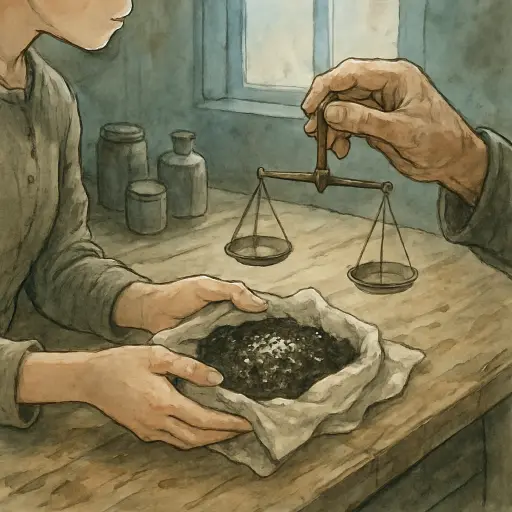
Rowan walked the field boundary. Where the flood had receded, a pale crust glittered on the soil. She touched it, tasted her fingertip, and spat.
The storm surge had reached farther inland than anyone remembered.
At sixteen, she had wanted to leave this village and become an alchemist in Althea. She had imagined returning in a fine coat, with silver clasps and stories worth interrupting supper for.
Now she crouched beside a drowned furrow.
“I’m still going,” she told her parents that evening.
Her father studied her blistered palms. “We could use those hands.”
“I know.” She struggled to meet his eyes. “But I don’t know how to mend this. Someone in Althea must.”
Her mother wrapped the last oatcakes in a cloth.
“Then learn properly,” she said. “And write, even when there’s nothing good to write.”
The Door Behind the Guild
Althea smelled of hot copper, horse dung, and bread Rowan could not afford.
At the Alchemists’ Guild, a clerk examined her application without touching the little parcel of ruined soil she had brought.
“Your sponsor?”
“I haven’t one.”
“Your schooling?”
“I can read. I keep our farm accounts.”
He returned the paper. “Come back when you have a sponsor.”
She returned six times. On the seventh, a student behind her muttered, “Perhaps she means to turn turnips into gold.”
Rowan stuffed her application into her coat before anyone could see her hands shaking.
She found work scouring vessels at a dyer’s yard. Each evening she visited the bookseller’s stall and read until he covered his shelves.
One afternoon, an old man watched her copying a formula onto a scrap of wrapping paper.
“That edition is wrong,” he said. “Follow it and you’ll lose your eyebrows.”
“Which part?”
“The part you’ve underlined.”
His name was Theron. He lived above a shuttered apothecary and admitted, with irritation, that he had once taught at the Guild.
“Will you teach me?”
“No.”
“Will you explain the mistake?”
He did. She asked another question.
By sunset, Theron had missed his supper.
“Come tomorrow,” he grumbled. “Bring your soil. And don’t call me master.”
His laboratory had a cracked window and smelled sharply of vinegar. Rowan set her parcel on the bench as carefully as if something inside it were still alive.
The Failed Batch
Her first remedy killed the seedlings.
The second grew a magnificent blue mould.
The third appeared to work until the leaves curled inward, brittle as burned paper.
Rowan swept the pots into a sack.
“Keep one,” Theron said.
“To remind me?”
“To examine.” He took the broom from her. “You’re very quick to clean away an answer you dislike.”
She left the pot on the bench.
Over three winters, Rowan learned to weigh powders while exhausted, to record a failure before correcting it, and to stop heating a mixture just because she desperately wanted it finished.
She made burn salves for foundry workers. She developed fever drops that children could swallow without retching. Customers began asking for her rather than Theron.
Still, the salt-damaged soil resisted her.
One night she found him examining her latest seedlings.
“They’re smaller,” she said.
“Yes.”
“But they’re alive.”
He nodded toward her notes. “What changed?”
She had used less of the costly mineral compound. Almost none, in fact. Then she had mixed in crushed limestone and compost, and let fresh water drain slowly through the pot.
“I was trying to make the remedy cheaper.”
“Try making it cheaper again.”
By spring, barley bent over her windowsill.
The Guild offered her a laboratory and a handsome stipend for exclusive rights to the mixture.
Rowan read the contract twice.
“They’ll charge by the acre,” she said.
Theron waited.
She pushed it away. “My father hasn’t paid last winter’s miller.”
“Then you’d better pack.”
A Place at the Bench
Her mother dropped a basket when she saw Rowan coming up the path.
For a moment neither spoke. Then her mother brushed road dust from Rowan’s cheek with both thumbs.
“You’re thin.”
“You wrote that last month.”
“And you ignored it last month.”
Rowan laughed into her shoulder.
Beyond the repaired cottage, much of the land remained bare. Her father had planted the higher ground, but the harvests barely covered their debts.
When Rowan explained her treatment at the meeting hall, one farmer folded his arms.
“We’ve bought cures before.”
“Then don’t buy this one,” she said. “Give me the strip beside the ditch. Keep the rest until you’ve seen it.”
They dug drainage channels together. They hauled compost and broke limestone. Rowan measured, adjusted, and started again when the first heavy watering washed part of the mixture away.
Her father arrived each morning before she did.
By midsummer, the trial strip stood green against the pale fields.
At harvest, he rubbed a barley head between his palms. He poured the plump grains into hers without a word.
That autumn, the villagers gathered outside the old grain store. They had repaired its roof as a gift for Rowan.
“Your laboratory,” her mother said, opening the door.
Inside stood a polished workbench—and twelve smaller benches, crowded together.
Rowan turned. “Who are those for?”
“We hoped you’d tell us what to put on them,” her father said.
A girl waiting by the doorway raised her hand.
“Do we need a sponsor?”
Rowan set down her travelling case.
“No,” she said. “But we’ll need more stools.”
For parents & teachers
The moral of the story
Keep learning from your mistakes, and use what you learn to help others.
Talk about it
- Why did Rowan leave her village for Althea?
- How did Rowan feel when the student made fun of her?
- Why did Rowan refuse the Guild's offer?
- What would you do if your first attempts failed like Rowan's?
Words to know
- receded: moved back or went down
- alchemist: a person who studies and experiments with substances
- sponsor: a person who supports someone seeking a chance
- remedy: something used to fix a problem
- stipend: money paid regularly for work
- exclusive: belonging only to one person or group
Printed from storyleo.com/motivational/rowans-legacy-a-tale-of-resilience