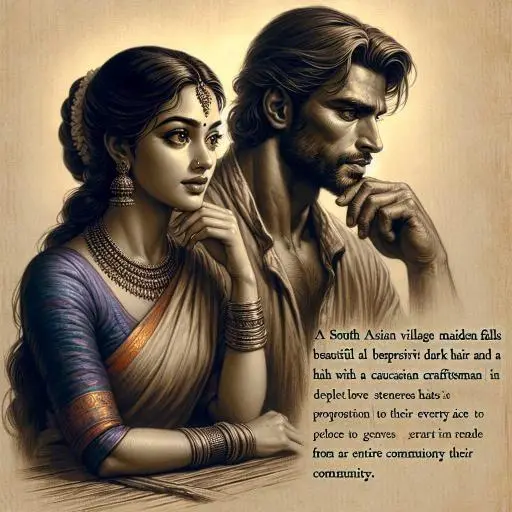
Hana and Caelan: A Timeless Tale of Love and Resilience
A healer who cannot save her grandmother struggles to accept a blacksmith’s gentler kind of care.
- Love
 By Storyleo Editorial
- 5 min read



The Note That Broke
Hana’s harp string snapped just as the blacksmith opened his mouth to speak.
“If you were about to complain,” she said, catching the loose wire before it struck her cheek, “the instrument has saved you the trouble.”
Caelan stood beneath the old oak with a honey cake crushed between his fingers. Around them, the Midsummer dancers stamped the grass flat. Lanterns swung overhead, lighting the soot he had missed beneath his jaw.
“I was going to say it was beautiful.”
“The tune?”
He looked directly at her, then down at the ruined cake. “That would have been wiser.”
She moved her skirts along the bench.
Hana knew his work: plowshares, horseshoes, the latch on her grandmother’s medicine cupboard. Caelan knew hers: the neat stitches across his apprentice’s thumb, the fever visits, this music he had heard through his open forge door.
“You always stop hammering when I practice,” she said.
“I thought I was spoiling it.”
“You make me lose my place when you stop.”
He sat. She divided the cake, giving him the larger, less battered half.
Before the lanterns burned out, he had promised to mend her harp’s fastening. Before summer ended, he was walking her home through hills smelling of cut hay, carrying her medicine basket while she described the room she wanted someday: shelves within reach, a broad worktable, sunlight enough for stitching wounds.
“And a window toward the forge,” she added.
He nearly dropped the basket.
Flowers That Would Not Wilt
Caelan’s first iron flower was a daisy, small enough to disappear in Hana’s palm.
“No watering,” he said.
“A considerable advantage in a suitor.”
He brought others: a bluebell from a bent nail, a sprig of heather so delicate she accused him of employing beetles. She kept them in a chipped salve pot beside her harp.
Then autumn came, and her grandmother began leaving half her supper.
By harvest’s end, the woman who had taught Hana to set a wrist could no longer lift a cup without both hands.
Hana boiled linen until the cottage windows streamed. She checked the pulse beneath that thin skin, changed herbs, fetched another healer from beyond the western hills.
He left without offering a remedy she had not tried.
Caelan found her afterward scrubbing an already clean mortar.
“Walk with me,” he said. “Only to the stream.”
“And if she needs me?”
“Your neighbor could sit with her.”
“She needs someone who knows what to do.”
The pestle struck stone hard enough to chip it.
Caelan reached for her hand. She pulled away.
“Please. I haven’t time to make you feel welcome.”
He stood very still, then set down the bundle he had brought: a lighter kettle, with a handle shaped to spare her grandmother’s swollen fingers.
“You needn’t.”
After he left, Hana touched the smooth wooden grip. From the bed came her grandmother’s dry voice.
“That one listens. Try not to punish him for it.”
The Work He Could Do
The first snow melted on Caelan’s shoulders while he waited outside her door.
Hana opened it with a candle in one hand. In his lay an iron rose, its petals beaten thin, its stem wrapped in soft leather.
“I nearly didn’t bring it,” he said. “It’s no use for anything.”
She took it carefully.
Behind her, her grandmother coughed—a long, tearing sound that made Hana turn before it ended.
“I can’t make her better.” Her candle shook. “Everyone comes here expecting me to know how. And I can’t.”
Caelan caught the dripping wax on his sleeve as he took the candle.
“What needs doing tonight?”
She stared at him.
“Not everything,” he said. “Tonight.”
“The sheets.” Her breath caught. “There’s broth, but she won’t eat it. And I haven’t brought in the wood.”
He shut the door behind him.
Later, with clean linen warming by the hearth, Hana fell asleep against his shoulder. He stayed upright until dawn, one foot numb beneath him.
In the weeks that followed, he learned which cup her grandmother preferred and how little broth to put on the spoon. Sometimes he returned to the forge. Sometimes Hana slept.
One evening her grandmother asked for music.
“I should change your poultice,” Hana said.
“After the song.”
Halfway through, Hana’s fingers faltered.
“Keep going,” came the whisper from the bed. “I’m listening.”
Hana finished. Her grandmother slept, her hand resting open on the coverlet.
By morning, it had grown cold.
Room for the Music
Spring arrived without asking whether Hana wanted it. Lambs cried on the hills. Patients knocked. Once, reaching for a jar, she turned to ask her grandmother where it belonged.
Caelan heard her stop speaking. He waited in the doorway until she held out her hand.
They chose the next Midsummer for their wedding, one year after the broken string.
Under the oak, Hana wore meadow flowers threaded with his little iron blossoms. He had made each stem light enough not to pull her hair.
When it was her turn to speak, she brought a small object from her pocket.
“I made you something.”
It was an iron ring, thick on one side and marked with shallow hammer dents.
Caelan examined it with the solemn attention he gave a difficult repair.
“Your apprentice helped,” Hana admitted. “He swore you wouldn’t dismiss him.”
“Sensible of him.”
“It isn’t round.”
“Neither is my finger, after that cart axle.” He slipped it on. It caught at the knuckle, then settled. “There.”
She had practiced a speech. Instead she kissed the small burn beside his thumb.
Years later, their cottage had the broad worktable Hana wanted, shelves she could reach, and a window facing the forge.
Visitors sometimes paused outside to hear her harp beneath the ringing hammer. The children of the village knew both sounds, and complained whenever either stopped too long.
On summer evenings, Caelan still came to the window with soot beneath his jaw.
“Am I spoiling it?” he would ask.
Hana would pluck the broken string’s replacement, bright and clear.
“You’re late,” she would say. “I’ve been waiting for your part.”