
Dana and Aiden: A Village Love Story
A baker mistakes a blacksmith’s kindness for passing affection, until a distant job threatens their mornings.
- Love
 By Storyleo Editorial
- 5 min read

The Bun He Didn’t Eat
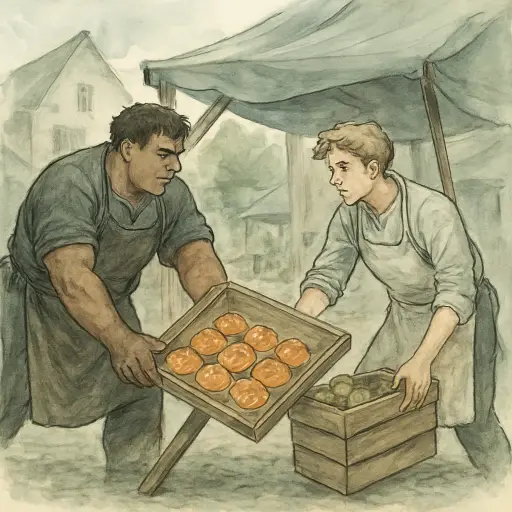
Dana caught the blacksmith stealing a bun—or so she thought, until he dropped three copper coins and grabbed her collapsing stall with both hands.
“The left leg,” he said through his teeth.
She shoved an apple crate beneath it. Her tray settled with a clatter, honey glaze trembling on twenty-seven buns. Around them, the village market went on bargaining over cabbages.
“Well,” Dana said, retrieving his coins from beneath a cabbage leaf, “that’s an extravagant way to ask for breakfast.”
Aiden released the stall carefully. Soot darkened his cuffs, and a fresh blister shone beside his thumb.
“Just one, please.”
She chose the largest. He stood holding it while she straightened her cloth.
“It improves considerably if you eat it.”
He took a bite. Honey caught at the corner of his mouth.
“Good?” she asked.
He nodded so solemnly that she smiled.
“You might tell your face.”
That brought a small, startled grin. Dana felt herself reaching for another bun, then stopped. Every unsold pastry went home to her mother; every coin bought flour, fuel, or medicine.
At noon, Aiden returned with an iron brace for the stall.
“I didn’t order that,” she said.
“No.” He knelt in the dust. “But I’d like to buy breakfast here again.”
She watched him fit the brace, his broad fingers unexpectedly precise.
“Tomorrow?”
His hammer paused.
“Tomorrow,” he said.
Things Left Unsaid
Through autumn, Aiden became Dana’s most dependable customer and least efficient eater. A single bun could occupy him for half an hour.
“You’re going to wear a groove in that spot,” she told him.
“I can repair it.”
“Naturally.”
He learned that she wanted a proper bakehouse, with shelves deep enough for cooling trays. She learned that he made beautiful hinges but hated shoeing the miller’s mule, which seemed to regard him as a personal disappointment.
He never asked why she packed up before the other sellers. One afternoon, he simply carried her baskets home.
Dana’s mother sat beside the kitchen window, rubbing swollen knuckles. Aiden put down the baskets and accepted the chair she pointed to.
“Does she feed you?” her mother asked.
“For money.”
“Sensible girl.”
Afterward, Dana walked him to the gate. Beyond the roofs, sheep dotted the green hills; smoke rose from his forge at the village edge.
“You needn’t keep helping,” she said.
“I know.”
She wished he would say something less easy to misunderstand.
In November, a carter mentioned that the ironworks in the county town had offered Aiden steady wages.
That evening, Dana went to the forge. The air tasted of coal; orange sparks burst beneath his hammer.
“When were you going to tell me?”
He laid the hammer down.
“I haven’t answered them.”
“It’s good work.” She picked at dried dough on her sleeve. “You ought to take it.”
“Is that what you want?”
“I can’t leave Mother.”
Neither spoke. Dana went home with her basket pressing a red line into her palm.
A Place Beside the Fire
By December, snow blocked the hill road, and Dana had stopped saving the largest bun.
She still looked toward the forge each morning. Its chimney smoked. That proved nothing; Aiden could leave when the thaw came.
On the coldest evening of the month, someone knocked while she was coaxing damp kindling to burn.
Aiden stood outside with snow melting in his hair.
“Your mother said you’d be awake.”
“My mother has become remarkably well informed.”
“May I come in?”
He stayed beside the door until she took his coat. Then he placed a small silver locket on the table. Delicate leaves curled around its rim, each vein cut by hand.
“I’m better with iron,” he said. “This took several attempts.”
Dana opened it. Inside lay a folded scrap of parchment.
I have no wish for distant ground.
The work I want is here:
To earn a place beside your fire,
And keep you always near.
She read it twice, smoothing one edge with her thumbnail.
“You should have said.” Her voice came out thin.
“You told me to go.”
“I thought staying would cost you something.”
“It will.” He pulled out a chair but did not sit. “So will leaving. I’d rather choose with you than have you choose for me.”
Dana drew a breath. “Some days Mother needs everything I have.”
“Then we won’t promise easy days.”
She crossed the kitchen and took his cold hands.
“Stay,” she said. “Please.”
His forehead touched hers. Behind the bedroom door, a floorboard creaked, followed by an unconvincing cough.
The Other Half
They married in spring, when the hedges beside the village church were white with blossom.
Dana’s mother attended wrapped in two shawls, stationed where she could inspect every guest. The miller brought flour. His mule remained, by mutual agreement, elsewhere.
After the meal, Dana drew Aiden away from the fiddles and stamping feet.
“I have something for you.”
“You’ve married me. I’m trying not to appear greedy.”
She opened her locket. Opposite his poem, in the space he had left empty, lay another folded scrap.
Beside your fire is very fine,
But here’s my counterclaim:
A door between your work and mine,
And both names on the frame.
Aiden looked up. “A door?”
“The old washhouse behind your forge. I’ve spoken to the owner about renting it.” She rubbed her thumb along the locket’s seam. “Mother could sit in the courtyard. I could bake more than one ovenful. You’d have to tolerate customers.”
“And you’d have to tolerate hammering.”
“I’ve grown rather attached to it.”
He read her verse again, his lips moving.
“I thought this was a love poem.”
“It is. With premises.”
By summer, the door stood open.
Some mornings they argued about flour on the tools or soot on the cooling cloths. Her mother settled these disputes from the courtyard, usually in favor of whoever brought tea.
And every morning, Aiden crossed the threshold to buy one honey bun.
“You know,” Dana said, handing it over, “you’re allowed to eat breakfast at home.”
He leaned across the counter and kissed her.
“I am.”