
The Silent Sentinel: Guardian of Ancient Ur


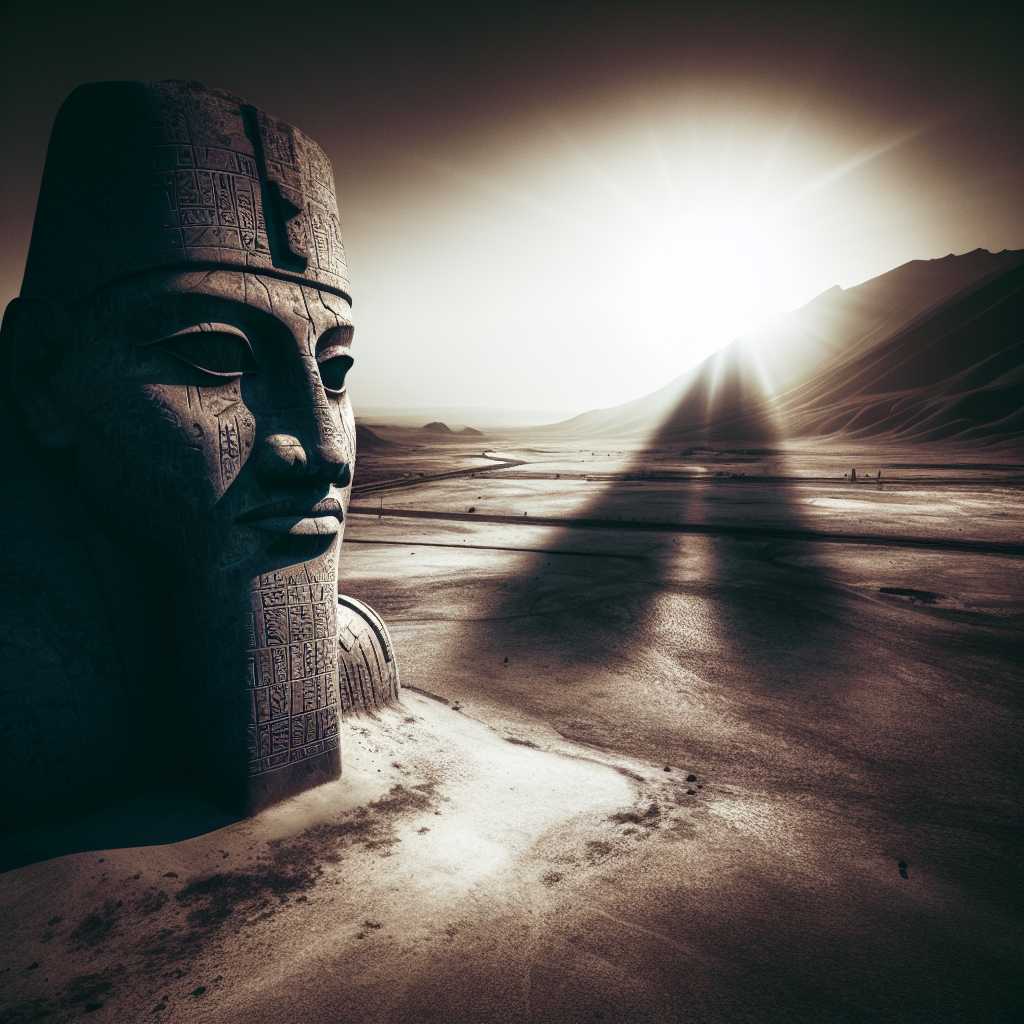
In the bustling city of Ur, nestled deep within the cradle of Mesopotamia, there existed a guardian who was neither of flesh nor blood. She was called the Silent Sentinel, a magnificent statue carved from the finest stone they could find along the banks of the Euphrates. Her tale is woven into the very fabric of Sumerian history, a story passed down through generations as a tapestry of mystery and wonder.
Long ago, when the world was filled with gods and men still dared to whisper their names, the city of Ur was at the height of its glory. It was a land where ziggurats pierced the sky and where the people's faith in their deities shaped their destinies. It was in this luminous era that the Silent Sentinel first stood, a gift from the gods, so said the priests who consulted the stars.
It was a time when divination and destiny danced hand in hand, and the priests looked to the heavens for guidance. The people of Ur, fervent in their rituals and sacrifices, sought to appease the gods with offerings and build monuments in their honor. The Sentinel, crafted by the revered sculptor Ishkigal, was intended to stand watch over the city, her gaze unflinching and eternal, ensuring prosperity and protection.
The Sentinel was more than stone; she was the embodiment of Ninhursag, the Mother Goddess, bringer of life and fertility. The artisans who carved her did so with reverence and fear, believing that one misstep would bring them Ninhursag's wrath. But Ishkigal was not just any artisan. He was a man with a vision, whose soul pulsed with artistic fervor, hands moved by the muses themselves. His chisel sang against the stone, each tap resonating with divine purpose.
"This, my Sentinel, will stand for ages," Ishkigal would whisper to her as day turned to night, each soft utterance a secret shared between creator and creation.
But as is often the way in stories of old, the gods' gifts come with strings attached. It was said that the Sentinel possessed inner sight, a sight that saw beyond the present and into the veiled tapestry of the future. For years, her uncanny presence was both a comfort and a mystery to the people of Ur, who spoke of her like they would a wise yet silent oracle.
Amongst the citizens, there was one, a young scribe named Enkimdu, whose curiosity about the Sentinel burned like a thousand fires. Enkimdu spent his days inscribing tablets with records of commerce and law, but it was his nights that fueled his true pursuit. He studied the Sentinel, captivated by the idea that she knew more than anyone alive, more than all the wise men in Ur combined.
Enkimdu's zeal did not go unnoticed. The High Priest of the temple, Lugal-Gula, a man revered and feared in equal measure, summoned him one evening under the light of the waxing moon. The priest's chambers were dimly lit, the air thick with the scent of incense that cloaked secrets in every corner.
"You meddle with things beyond your understanding, Enkimdu," the priest intoned, his eyes two pools reflecting the embers of hidden fires.
At this, Enkimdu, unbowed by the looming presence of Lugal-Gula, replied with genuine wonder, "Wise Priest, can a man not seek the truth in the shadows when the light only blinds?"
Lugal-Gula considered the scribe's question, a wry smile playing at the corner of his thin lips. "The Sentinel's gaze is fixed," he finally said, "but her vision wanders far and near, among the stars and deep within the earth. Only those who listen with an open heart might hear her speak."
Enkimdu left the temple with a newfound vigor, the priest's words an echo he couldn't shake. He decided that he would keep vigil at the foot of the Sentinel, seeking the truths her stone lips refused to utter. And so, beneath the moonlit sky of Sumer, Enkimdu watched and waited, night after night, his silhouette a lone shadow against the Sentinel's ethereal glow.
Weeks turned to months, and the city of Ur buzzed with its daily life while Enkimdu continued his vigil. The people began to speak of the scribe with both awe and pity, seeing in him either a devoted seeker or a fool chasing shadows.
Then, on a night when the stars hung like scattered gems upon the velvet sky, Enkimdu received his answer. In a voice softer than a whisper, the Sentinel conveyed a vision of impending drought, a decade of dry skies and barren fields. The weight of her message pressed upon Enkimdu, who realized the heavy burden of truth. He had communed with the divine, but now, he needed to act.
With his heart fastened upon the will of the gods, Enkimdu approached the city's leaders. At first, they laughed, dismissing him as a dreamer touched by madness. Yet, his conviction was unyielding, his faith in the Sentinel's vision a palpable force. Relenting, the leaders forged plans to build granaries, store water, conserve the very lifeblood of their civilization.
The years unfolded as foretold, with the land parched and the sun more fierce than ever before. But Ur endured, a bastion against the brink of despair. The city's survival story became legendary, a testament to foresight and faith.
As for Enkimdu, he lived his days as a humble scribe, his heart forever aligned with the Sentinel's silent wisdom. And even as the world changed, the story of the Silent Sentinel grew, flourishing in the songs of poets and the annals of history.
Thus, in the age of myths and men, amidst the echoes of the past, the Silent Sentinel stands eternal, her stone gaze forever upon those who dare to seek her truth.