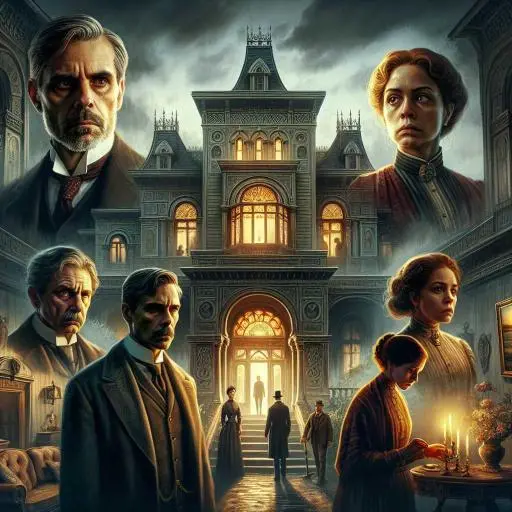
The Thompson Family Secret
A daughter returns to a sealed accusation and the midnight coat-washing she never forgot.
- Drama
 By Storyleo Editorial
- 4 min read



The Unbroken Seal
Thomas Thompson held the letter over the fire until its wax seal began to soften, and Margaret caught his wrist.
“Not another thing burned,” she said.
Across the hearth, Samuel stopped cracking a walnut. The shell remained cupped in his palm.
“What does that mean?”
Before either parent answered, the front door struck the umbrella stand. Alma stood in the hallway, carrying a small suitcase. Six years away, and she still knew which floorboard would complain beneath her foot.
“You came,” Margaret said.
“Your telegram said Father needed me.” Alma looked at Thomas. “Are you ill?”
He held out the letter instead.
She recognized the emblem pressed into its seal: the wheatsheaf from the old Thompson mill. Peter had stamped invoices with it before they found him dead beside the gears fifteen autumns ago.
Alma broke the wax.
The mill is being cleared on Monday. Before Peter Thompson’s death is buried a second time, his family must answer for what happened there.
“Who sent this?” she asked.
Thomas watched a black curl of paper settle among the coals.
“Father?” Her voice sharpened. “Who?”
“I don’t know.”
It was almost exactly what he had said when she was seventeen and asked why he had washed his coat at midnight.
She set her suitcase down.
“I’m not leaving with that answer again.”
Margaret released Thomas’s wrist. Four pale marks remained where her fingers had gripped him.
What the Mill Kept
By morning, Willowmere knew Alma had returned. At the grocer’s, two women stopped speaking when Samuel asked for lamp oil. One offered to put it on his account without meeting his eyes.
He found Alma in the garden, snapping dead stems from Margaret’s chrysanthemums.
“We could leave it alone,” he said.
She twisted another stem. It refused to break.
“You stayed here. Did leaving it alone work?”
He took the stem from her and cut it with his pocketknife.
The mill smelled of mouse nests and old flour. Its machinery had been sold, leaving pale rectangles on the floor and the iron wheel beside which Peter had died.
Samuel stood by the doorway. “I used to think Father hit him with something.”
“So did I.”
“You never said.”
“Neither did you.”
They searched the office until their fingers were gray. Beneath a warped drawer, Alma found an envelope containing a woman’s letters to Peter. They spoke of rented rooms, a husband who must not know, and money for a departure Peter kept postponing.
Not an accident, then? She folded the papers carefully.
At the parish archive, they read the inquest report. Thomas had found his brother shortly after nine. Death was attributed to a fall.
A witness statement had been crossed through: a carter had seen a woman leaving the yard at half past eight.
“Why strike it out?” Samuel asked.
Alma read the cramped explanation beneath it.
“Father said Mother was home with us.”
The Chair Beside the Fire
Margaret was mending Thomas’s cuff when they returned. Alma placed the report beside her sewing basket.
“We were at the harvest supper that night,” she said. “Samuel and I. You weren’t home with us.”
The needle paused.
Thomas reached for the report, but Samuel moved it away.
“Let her answer.”
Margaret laid the shirt across her knees. “I wrote the letter.”
No one spoke. A coal broke apart in the grate.
“And the telegram,” Alma said.
Margaret nodded. “They’re demolishing the mill office. I thought if it disappeared, I might let myself keep quiet forever.”
“You could have simply told us.”
“I tried. Every Sunday you were expected. Every Christmas you didn’t come.” She rubbed the needle’s tiny eye between her fingers. “That isn’t an excuse.”
Thomas sat down heavily.
“Peter was taking money,” Margaret continued. “From the mill wages. To leave with a married woman. Your father meant to replace it rather than expose him.”
“I would have managed,” Thomas muttered.
“You were selling the house.”
She looked at Alma now.
“I went there to stop him. He laughed. Said Thomas had always paid for his mistakes, and I had married the wrong brother if I wanted courage.”
Her hands closed around the shirt.
“I pushed him. Hard. I wanted him to hurt.”
Samuel turned toward the window.
“He caught his heel on the platform edge. His head struck the wheel.”
“And Father?” Alma asked.
“Came when I fetched him. Then told me what we would say.”
Thomas lifted his face. “I thought I could spare you children.”
Alma pressed both palms against the mantel until the wood hurt.
“You let us choose which parent to be afraid of.”
A Different Account
“I’ll go in the morning,” Margaret said.
“Tonight,” Samuel answered.
His mother flinched, but he was already taking her coat from the peg.
Thomas rose. “I should come. The false statement was mine.”
Alma picked up the letter and the inquest report. For years she had imagined proof would make her certain of everything. Now she could barely fasten her coat.
Outside, dry leaves scraped along the garden wall. Margaret missed the step, and Samuel caught her elbow without looking at her.
The investigation lasted through winter. There were interviews, solicitors, and mornings when Thomas could not make himself open the curtains. Margaret gave her account twice, refusing the gentler wording offered the second time.
Alma stayed through the first hearing. Then she returned to her job, leaving her new address on the kitchen table.
In March, she came back for Sunday dinner.
Margaret stood over a pan of scorched carrots. She had been home since the court imposed a suspended sentence, but still looked toward the door whenever footsteps passed.
“I can do eggs,” she said.
“Carrots are fine.”
“They’re burned.”
“Then we won’t pretend otherwise.”
Margaret let out a small, startled laugh. Alma took the pan from her.
In the dining room, Thomas was moving his chair from the head of the table.
“What are you doing?” Alma asked.
He set it beside Margaret’s.
“Making room.”
Alma put her suitcase beneath the stairs, rather than beside the front door.