Baatar’s Blue Kite and the Silver Fish Lie


The Fish That Flew Away
The trout was gone, and old Baatar had only a blue kite to show for it.
He stood beside the shallow bend of the Tuul River, his boots sunk in cool mud, his fishing line limp in one hand. All afternoon he had promised little Naraa a fish for supper. Not just any fish, either.
“A silver one,” she had said that morning, bouncing on her heels outside her family’s ger. “With spots like black sesame seeds.”
“Then I will bring you the silverest fish in the river,” Baatar had said, because Naraa’s missing front tooth made her smile look like a small open gate, and he could never shut a gate like that.
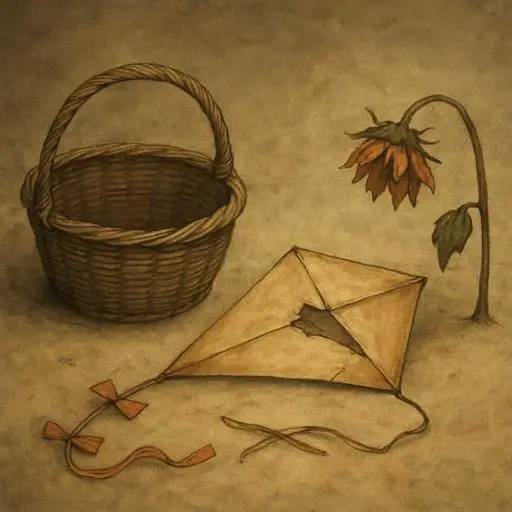
Now the sun had lowered until the steppe grass shone gold. Sheep bells clinked far off. Smoke from dung fires lifted straight into the evening air. Baatar’s creaky knees complained as he bent to gather his empty basket.
Beside him, snagged on a willow twig, fluttered a kite.
It was made from blue silk patched with yellow cloth. Its tail was braided from red yarn and bits of ribbon. Someone had painted a great fish on it, scales curling like waves, mouth open as if laughing.
Baatar knew the kite belonged to Naraa. He had seen her run with it for days, shouting, “Higher! Higher!” until even the goats seemed tired of hearing it.
He lifted it carefully. The frame was cracked, but not broken. The silk smelled faintly of smoke, milk tea, and river reeds.
“Well,” he muttered, his white mustache twitching, “you are not supper.”
When he reached the camp, children swarmed around him like sparrows. Naraa came first, her cheeks dusty, her braid crooked.
“Grandfather Baatar! Did you catch it?”
He opened his basket. Empty.
Naraa’s smile wobbled.
Baatar felt something pinch behind his ribs. He held up the kite instead.
“The fish was so silver,” he said, “that when I pulled it from the water, it leaped into the sky and became this.”
The children gasped.
Naraa blinked at the kite. “My kite?”
Baatar swallowed. “Your kite was brave enough to help me bring it home.”
It was a small lie, soft as felt. He thought it would end there.
It did not.
A Tale With a Tail
By supper, the lie had grown legs, fins, and nearly a singing voice.
Baatar sat on a low stool outside Naraa’s ger, accepting a bowl of salty milk tea from her mother, Saran. The air smelled of mutton stew, warm wool, and crushed thyme under children’s bare feet.
“Tell it again,” Naraa begged, hugging the blue kite against her chest.
“Again?” Baatar said. “My tongue is an old horse. It needs rest.”
“Please.”
Three smaller children leaned closer. Even Saran paused with her ladle over the pot.
Baatar scratched his chin. He could have said, I was foolish. I caught nothing. I found your kite by the river.
Instead, he saw Naraa’s hopeful eyes and stepped deeper into the puddle.
“Well,” he began, “the fish did not simply leap. First it bowed to me.”
“Fish do not bow,” said Bat-Erdene, who was six and suspicious of everything except dumplings.
“This one did. A very polite fish.” Baatar nodded solemnly. “It said, ‘Old Baatar, do not put me in soup. I have an errand in the sky.’”
Naraa pressed both hands over her mouth.
“What errand?” Saran asked, her eyes smiling though her lips stayed flat.
Baatar looked up. The first stars were pricking through the pale blue. Beyond the horse lines and rounded white gers, the steppe rolled away like a sleeping animal.
“It had to count the stars before moonrise,” he said.
“Why?” Bat-Erdene demanded.
“Because if no one counts them, some might forget to shine.”
The children fell quiet.
Naraa looked at the painted fish on the kite. “Did it count all of them?”
“Almost,” said Baatar. “But then its tail snagged on a cloud.”
“There were no clouds today,” Bat-Erdene said.
Baatar sipped his tea. “A very small cloud. Shy.”
The children laughed, and Baatar laughed too, though softly. The lie warmed them like the fire.
Then Saran tilted her head. “If the sky fish still has work to do, perhaps the kite should fly again tomorrow.”
Naraa hugged it tighter. “Can you mend it, Grandfather?”
Baatar looked at the cracked frame.
“Of course,” he said.
Another lie, larger than the first.
The Wind Listens
In the morning, Baatar tried to mend the kite before anyone woke.
He sat beside his own small ger, where nets hung from poles and dried in the sun. His fingers, bent from years of tying knots in cold weather, worked slowly. He trimmed a reed. He wrapped it with horsehair thread. He licked the thread, squinted, and tied again.
The kite sagged.
“Stand up, you river pancake,” he whispered.
A lamb bleated as if laughing.
Baatar sighed and reached for more thread.
“Grandfather!” Naraa’s voice rang across camp.
He hid the kite behind his back too late.
Naraa ran up with Bat-Erdene and two cousins behind her. Saran followed more slowly, carrying a bundle of laundry. A dog trotted beside them, hoping for dropped breakfast.
“Is it ready?” Naraa asked.
The kite drooped over Baatar’s elbow.
“It is resting,” he said. “Sky fish must rest before counting stars.”
Bat-Erdene folded his arms. “My uncle says fish cannot count.”
“Your uncle once tried to milk a gelding,” Baatar said.
The children howled. Even Saran turned away to hide her laugh in the laundry.
Baatar felt pleased for one breath. Then Naraa touched the broken frame with one small finger.
“Can it fly?” she asked.
Her voice was not begging now. It was quiet. That was worse.
Baatar looked at the kite. He wanted to make her smile. He wanted to be the old man who could still pull silver things from the river and send blue things into the sky.
“Yes,” he said. “At sunset, when the wind comes from the west.”
The lie stood up tall and put on boots.
All day, the camp prepared for the flight.
Children gathered ribbons, feathers, and bits of shiny sweet wrappers from traders who had passed through weeks before. Saran boiled glue from flour. Naraa brought Baatar a smooth stick for the handle.
“For the sky fish,” she said.
Baatar’s chest tightened.
An old neighbor, Tuya, shuffled over with a needle. “I hear you caught a fish that became a kite.”
Baatar winced. “People hear too much.”
Tuya threaded the needle without looking. “People lie too much, also. Hold the silk.”
He held it.
She stitched.
Neither of them spoke for a while.
Too Heavy for the Sky
By sunset, the kite looked magnificent and impossible.
The children had tied on so many ribbons that its tail dragged like a festival sash. Feathers trembled along the frame. Sweet wrappers winked in the light. Someone had added two round buttons for fish eyes, so it stared at Baatar with bright accusation.
“It is beautiful,” Naraa breathed.
It was. It was also far too heavy.
The whole camp gathered on a low rise where the grass grew short and springy. Horses lifted their heads from grazing. A baby laughed from inside a cradle tied near a ger door. The west wind moved gently over the steppe, smelling of dust, sage, and distant water.
Baatar held the kite. His hands felt clumsy.
“Perhaps,” he said, “the sky fish prefers tomorrow.”
“But the stars,” Bat-Erdene said. “They will forget.”
Several children looked worriedly upward.
Baatar closed his eyes. The lie had grown so large it was no longer soft. It pressed against everyone.
Naraa took the string handle from him. “I can run,” she said. “Fast.”
She turned and bolted across the rise, braid flying, boots thudding. Baatar lifted the kite and let go.
For one glorious heartbeat, the blue fish rose.
Then it dipped, spun, and flopped into the grass.
The ribbons settled slowly.
No one laughed.
Naraa stood with the string in her fist. Her chin trembled, but she bit her lip so hard Baatar could see the mark.
He walked to the kite and knelt beside it. His old knees popped.
“Naraa,” he said.
She did not come.
“Children,” he said, louder. “Saran. Tuya. Everyone.”
The camp quieted. Even the dog sat down.
Baatar picked up the kite and brushed grass from its painted fish.
“I did not catch a silver fish yesterday,” he said.
Bat-Erdene’s mouth opened.
Baatar went on before courage leaked out. “I caught nothing. Not even a boot. I found Naraa’s kite by the river, broken. I wanted to bring supper. I wanted to bring wonder. So I told one small lie.”
He tugged a ribbon loose. “Then another.”
Another ribbon. “And another.”
Naraa watched him.
“Now the kite is too heavy to fly.”
Tuya nodded once. “That is what lies do.”
The Kite That Carried Truth
Baatar held the heavy kite out to Naraa.
“I am sorry,” he said. “Your kite did not fail. I made it carry too much.”
Naraa came slowly. She touched one button eye, then looked at him. “So there is no sky fish?”
Baatar opened his mouth, then shut it. He glanced at the children, at Saran, at the wide steppe turning purple at the edges.
“There is a painted fish,” he said carefully. “There is a kite. There is wind. And there is an old fool who loves stories too much.”
Naraa sniffed. “And me?”
“And you,” he said, “who love flying things enough to make them fly again.”
She leaned against his shoulder for just a moment. That was all. It was enough.
“Then let us make it lighter,” she said.
Everyone moved at once.
Bat-Erdene untied ribbons. Saran cut away the heavy wrappers. Tuya removed the button eyes and slipped them into Naraa’s pocket “for another creature.” Baatar straightened the reed frame and retied it with simple knots, the kind his fingers remembered from fishing nets and winter repairs.
They left only three ribbons on the tail: red, yellow, and white.
“For fire, sun, and milk,” Saran said.
“For soup, cheese, and sheep teeth,” Bat-Erdene said.
The children shrieked.
This time, Naraa gave the string to Baatar.
“You run,” she said.
“Me?” He patted his knees. “These are old cart wheels.”
“Then roll.”
So Baatar rolled.
He ran across the rise, slow at first, then faster than anyone expected. His hat flew off. His coat flapped. His boots kicked up the dry smell of grass. Behind him, Naraa laughed so hard she hiccupped.
The kite tugged.
Baatar let out more string.
The blue fish rose, wobbled, caught the west wind, and climbed. Higher it went, past the horse line, past the smoke, into the first silver wash of evening.
The camp cheered softly, as if not to startle the sky.
Baatar stopped, breathing like an old bellows. Naraa slipped her hand into his.
“Look,” she whispered.
Above the kite, one star appeared. Then another. Then many.
Bat-Erdene squinted. “Maybe it is counting them.”
Baatar smiled but did not answer.
Naraa squeezed his fingers. “Maybe we can just watch.”
So they did.
The blue kite floated over the Mongolian steppe, carrying no lie at all, only three light ribbons, a painted fish, and the quiet truth of a camp settling into night.
When Baatar walked back later, Naraa sleepy against his side, Saran handed him a warm bowl.
“No fish,” she said. “Mutton stew.”
Baatar breathed in the steam. “Best catch of the day.”
Naraa yawned. “Tomorrow, Grandfather, tell a true story.”
He tucked his coat around her shoulders and looked up at the kite, still nodding among the stars.
“I know one,” he said. “It begins with an empty basket.”
This story was created with the help of AI writing tools and published by Storyleo Editorial.