George Pickles and the Pineapple Festivity Escapade


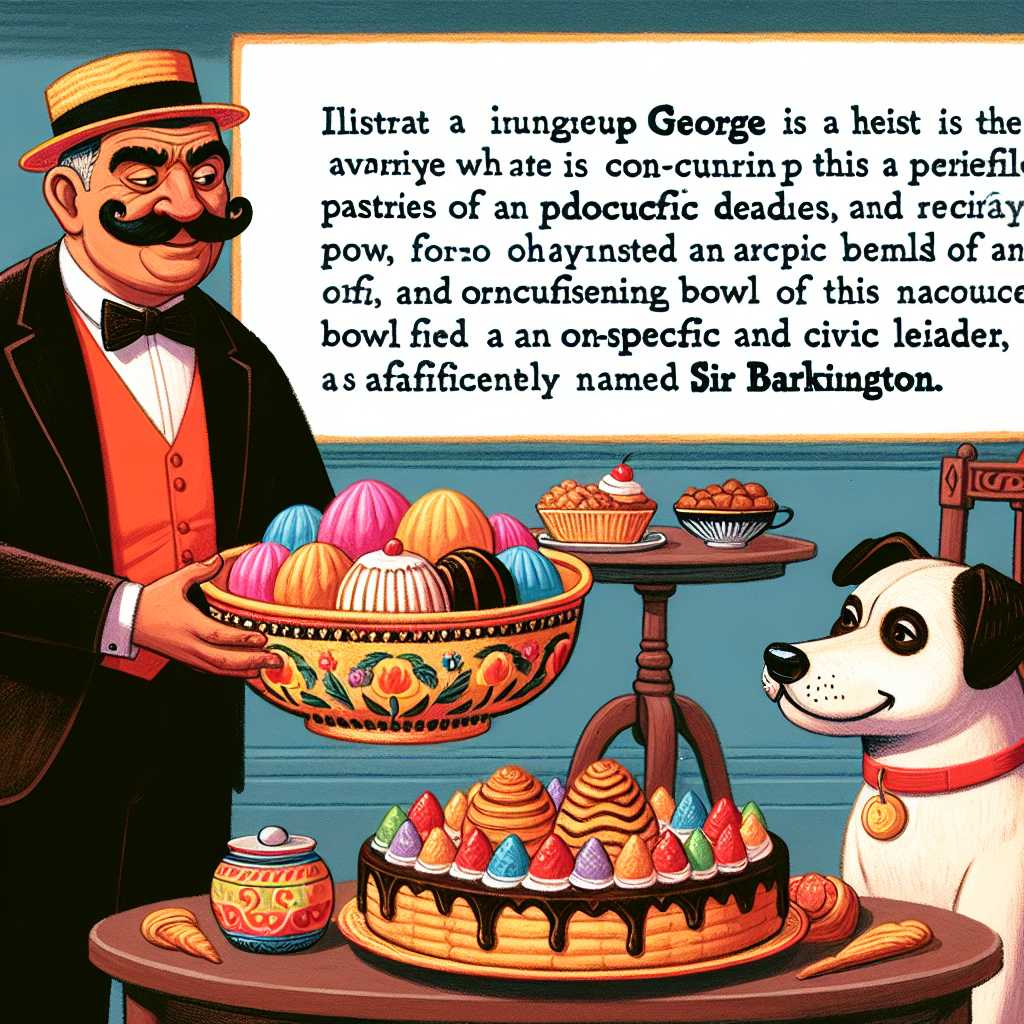
Once upon a time, in the bustling hamlet of Little Valley, there lived a rather eccentric fellow named George Pickles. Now, George had the peculiar knack of imagining himself as the hero of every legend, fable, and fairy tale he ever read. So, when he came across the story of Robin Hood, he decided to emulate his bravery—though, with the finest twist of pineapple-flavored absurdity ever concocted.
You see, Little Valley was renowned for two things: its annual pineapple festival and its notoriously un-stealable mayor's fruit bowl, which sat pompously on a pedestal in the town hall. This fruit bowl was a symbol of the town's prosperity, filled to the brim with the juiciest pineapples grown in the valley—pineapples purportedly so delicious that even fairies flew down from mystical lands to take a subtle nibble.
George Pickles, armed with a mischievous smile and a penchant for pineapple-laced adventures, declared to his faithful friend Martha, "By the ripe pineapples of Little Valley, I shall whisk away the mayor's prized fruit bowl to teach the foolish naysayers a lesson in legendary cunning!"
Martha, a pragmatist by nature, exclaimed,
"George, I declare, it can't be done! The godlike guardian bulldog, Sir Barkington, guards the hall day and night! Last I heard, even shadows tiptoed around him with great caution!"
Yet George, eyes twinkling with mischief, plotted and schemed under the glowing moonlight. Little Valley had never faced such hilarity as that which George was about to unleash.
By dawn's early light, with a sack disguised as a late-night snack delivery—because who could suspect pastries from "Pineapple Pies & Lies," the valley's newest bakery?—George approached the town hall with sufficient swagger to sway a parade of penguins.
Outside lounged Sir Barkington, formidable and furry, with ears perked jurisdictionally at every leaf that rustled in the crisp morning air. What George needed was a lure even more tempting than his bag of pie-treasures—which was, admittedly, an ambitious ask given the rolling tug of the sack one could almost hear.
"Fear not," whispered George to the wind, "for I am but a humble deliverer of much-appetizing pastries, invigorated for adventure, cupid of convenience who summons favor with sweet confections."
With unshakable confidence, George launched a pastry into the air, a pineapple and pecan tart, spinning through the sky like a sugary discus headed for Olympic gold. Sir Barkington, eyeing the pastry with the intensity of a sleuth reunited with a long-lost scent, leapt after it with less regal rigour, imagining himself guardian of confectionary realms.
In the blink of an eye mixed with a dash of bewilderment, George slipped past the guard, entering the hallowed halls of fruit grandeur. Little Valley's pride, shining under the soft light filtering from whimsical stained glass windows, gleamed like a golden chalice granted by tangy fruit deities.
But this was not just any fruit bowl. The pedestal had sensors, sirens wired to sing operatic arias of alarm. George realized, mid–monologue, he had trodden upon unchartered territory.
What now, oh virtualized hero of his own story? Improvise!
"My dear accoutrements," George muttered to no one in particular but all at once, "let there be frivolity amidst flagrant flouting!" And thus, he pulled from his cloak a small tape recorder, flicked the switch, and filled the chamber with the resonant tones of classical piano music—his own voice doing an exceptionally irreverent rendition of "Pineapple Sunrise Serenade."
Now imagine it, dear audience, a man standing triumphantly, fruit bowl hoisted, as Beethoven’s "Symphony No. Pineapple" orchestrated the untimeliest escape! George Pickles, clad in imagination's finest regalia, dancing lightly as if conducting an escapade grand enough to be reminiscent of an epic romance abruptly mixed with a slapstick comedy.
Sir Barkington, turning back with grumbling elegance (for no gentle-nosed creature dismisses a pastry easily), barked with syncopated gusto. But his timing was tragically awry—for George, in another brilliant stroke of inconspicuous cunning, dashed through the clearly unlocked side door as fortuitous fate and the timid cleanup crew barely glanced his way.
With nary a scratch or mark of trial, George was dancing down the lane, the mayor’s fruit bowl in hand, clumsy-kicking open the defenses of folklore and pineapple pomposity.
His celebratory jaunt was not of secret design but conducted with tapered finesse until the townspeople, who had gathered quickly thanks to those strange siren arias, joined in. Laughing, George narrated the event with grandiose embellishments, retelling a hero's victory, though the villain was an insatiable pie-loving dog and the fruit bowl never actually left sight of the awed crowd.
And thus, dear friends, ended the great pineapple heist that never quite was, much loved and chronicled savagely by those who whispered in the quaintest cafe-corners of cascading chronologies.
As George forever after affirmed with stout pride, "In the sunniest pot of pineapple mayhem, lies the zest of carefree tales—tales where pastries are potent and pies hold the power to both deceive and delight!"